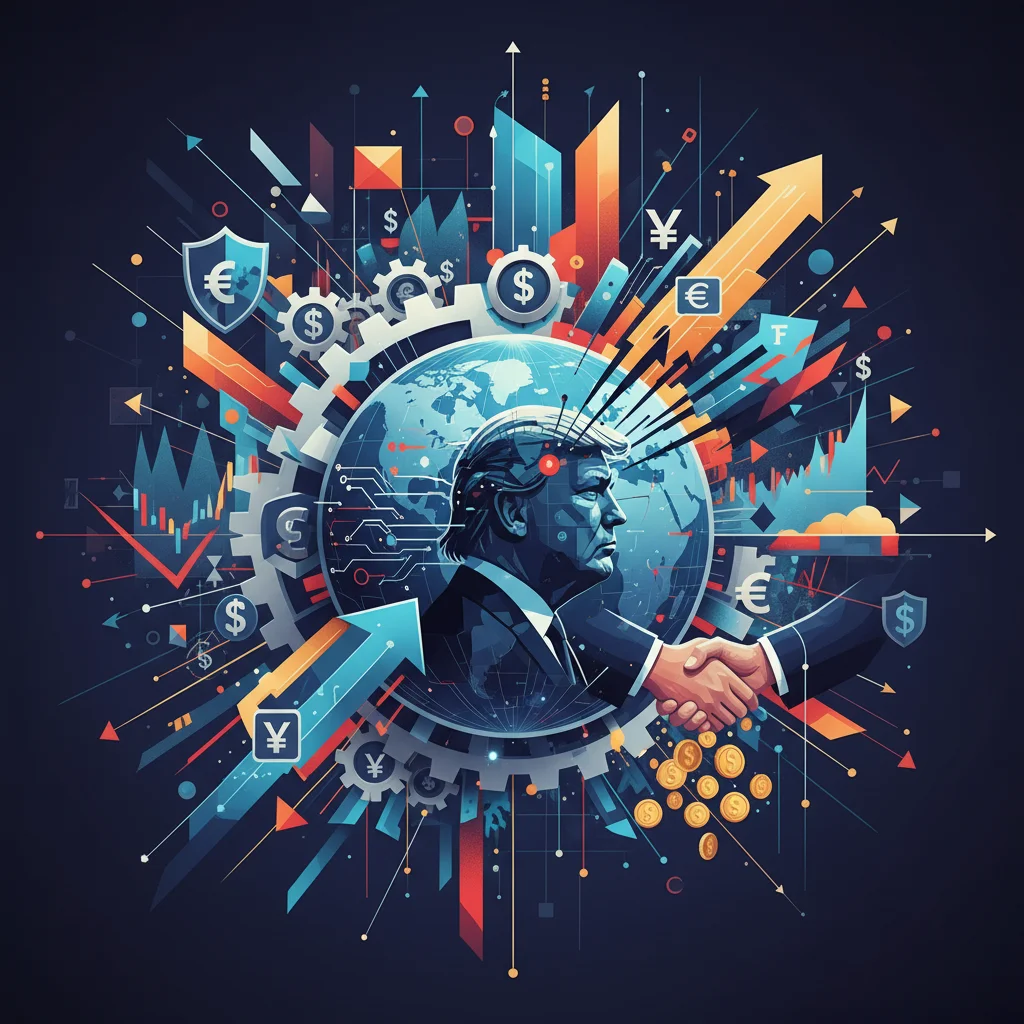
The New Economic Battlefield: Decoding the Financial Strategy Behind Trump’s Contentious Foreign Policy
In a world where tweets can move markets and diplomatic handshakes can dictate the flow of billions in capital, the line between foreign policy and economic strategy has all but vanished. This reality was cast into sharp relief this week during a lengthy two-hour press conference where Secretary of State Marco Rubio mounted a vigorous defense of the Trump administration’s most debated international policies. While calling for “patience” from allies and markets alike, the Secretary’s remarks painted a clear picture: the administration views tariffs, sanctions, and strategic realignments not just as diplomatic tools, but as potent weapons in a global economic contest.
For investors, finance professionals, and business leaders, ignoring the undercurrents of this geopolitical shift is no longer an option. Every decision, from imposing new tariffs on manufacturing imports to sanctioning a rival nation’s central bank, sends shockwaves through the global economy, impacting everything from supply chain logistics to stock market valuations. Understanding the long-term financial doctrine behind these moves is paramount to navigating the volatile landscape ahead. This analysis will deconstruct the key pillars of this foreign policy, examine their intended and unintended consequences for the financial world, and offer a framework for strategic decision-making in an era of unprecedented uncertainty.
Pillar 1: The Tariff Tightrope – Protectionism as Economic Shock Therapy
At the heart of the administration’s strategy is the aggressive use of trade tariffs. Presented as a tool to protect domestic industries and correct long-standing trade imbalances, these policies represent a fundamental break from decades of free-trade consensus. Secretary Rubio argued that short-term market pain is a necessary price for long-term economic sovereignty and industrial revitalization. He pointed to a supposed 8% growth in domestic steel production as an early victory of this approach (source).
However, the effects on the broader economy are far more complex. For businesses, tariffs create a cascade of challenges. Increased costs for raw materials and components squeeze profit margins, forcing companies to choose between absorbing the cost, passing it on to consumers (fueling inflation), or re-engineering their entire supply chains—a costly and time-consuming endeavor. The stock market has reacted with pronounced volatility, with sectors like technology and retail, which are heavily reliant on global supply chains, experiencing significant downturns following each new tariff announcement.
The table below provides a simplified breakdown of the sector-specific impacts, illustrating the dual-edged nature of this protectionist approach.
| Sector | Potential Benefits (Administration’s View) | Observed Challenges & Risks |
|---|---|---|
| Heavy Industry (e.g., Steel, Aluminum) | Protection from foreign competition, potential for domestic job growth, increased domestic production. | Retaliatory tariffs from other nations hurting exports, increased input costs for domestic manufacturers using these materials. |
| Consumer Electronics & Tech | Incentive to re-shore manufacturing and R&D over the long term. | Massive supply chain disruption, higher component costs, reduced competitiveness in global markets, lower profit margins. |
| Agriculture | Leverage to open new markets for specific U.S. products. | Immediate and severe retaliatory tariffs from major buyers (e.g., China, EU), leading to lost revenue and increased reliance on government subsidies. |
| Financial Services & Banking | Minimal direct impact from tariffs on goods. | Indirect impact from market volatility, reduced M&A activity due to uncertainty, and potential for a slowdown in the global economy. |
The core issue for investors is uncertainty. The unpredictable nature of trade negotiations makes long-term capital allocation difficult. This environment favors short-term trading strategies that can capitalize on volatility, but it punishes long-term investing that relies on stable, predictable growth. The call for “patience” may be a political necessity, but it is a luxury that the fast-paced world of global finance can scarcely afford.
The Anarchist in the Boardroom: Why Radical Thinkers Are Finance's Unsung Heroes
Pillar 2: The Sanctions Doctrine – Weaponizing the Financial System
Beyond tariffs, the administration has increasingly wielded financial sanctions as its primary tool of coercion. By restricting access to the U.S. dollar—the world’s reserve currency—and the global banking system, the U.S. can exert immense pressure on adversarial nations. Secretary Rubio defended these actions as a more precise and humane alternative to military conflict, capable of targeting rogue regimes without broader devastation.
This strategy, however, has profound implications for the future of global finance. Each new sanction pushes targeted countries—and even non-sanctioned allies wary of U.S. overreach—to seek alternatives to the dollar-dominated system. This has accelerated research and development into central bank digital currencies (CBDCs) and created new use cases for decentralized financial technology. Adversaries are actively exploring blockchain-based payment rails and other fintech innovations to create sanction-proof financial networks.
While these alternative systems are still nascent, they represent a long-term existential threat to the very source of U.S. financial power. The more sanctions are used, the greater the incentive for the rest of the world to de-dollarize. According to recent estimates, central banks in several emerging markets have increased their gold reserves by over 20% in the last two years, a clear hedge against dollar-denominated assets (source). This trend, if it continues, could fundamentally reshape the landscape of international economics, leading to a more multipolar currency world and reducing the effectiveness of future U.S. sanctions.
Investing in Harmony: What Paul Klee's Art Teaches Us About Modern Finance
Pillar 3: The Alliance Shake-up – Redefining Economic Partnerships
The final pillar of this strategy involves a transactional approach to international alliances. Long-standing partnerships are being re-evaluated through a starkly economic lens, focusing on trade balances and defense spending contributions rather than shared values or historical ties. This has created friction with traditional allies in Europe and Asia while opening the door to pragmatic, if sometimes uneasy, relationships with other nations.
For business leaders and investors, this shift creates both risk and opportunity. The risk lies in the breakdown of established international legal and trade frameworks that have provided a stable environment for global business for decades. Supply chains that cross through once-stable allied nations may now face new political and regulatory hurdles.
The opportunity, however, lies in emerging markets. As the U.S. pivots its strategic focus, new economic corridors are forming. Countries in Southeast Asia, Latin America, and Eastern Europe are becoming attractive destinations for foreign direct investment as corporations seek to diversify their manufacturing bases away from geopolitical hotspots. This “great diversification” is a defining trend for multinational corporations, driving M&A activity and infrastructure investing in previously overlooked regions.
The Investor’s Playbook in an Age of Geopolitical Economics
Navigating this complex environment requires a new playbook. The old assumptions of ever-increasing globalization and stable international norms are no longer reliable. So, how can one adapt?
- Geopolitical Risk Analysis is Non-Negotiable: Asset managers and corporate strategists must integrate sophisticated geopolitical analysis into their core decision-making processes. Understanding the political motivations behind economic policies is as crucial as reading a balance sheet.
- Supply Chain Resilience Over Efficiency: The “just-in-time” supply chain model, optimized for maximum efficiency, is fragile. Businesses must now prioritize resilience, diversifying suppliers and manufacturing locations to mitigate the risk of being caught in the crossfire of a trade dispute.
- Currency and Commodity Hedging: In a world where sanctions can disrupt energy markets and tariffs can alter currency flows, hedging strategies are vital. Exposure to volatile currencies and commodities must be actively managed as part of any robust investing or corporate treasury strategy.
- Monitor the Fintech Frontier: The geopolitical push for financial alternatives is supercharging innovation in financial technology. Keeping an eye on the development of CBDCs, decentralized finance (DeFi), and cross-border payment systems is essential for understanding the future of global banking and trading.
Conclusion: Patience is a Strategy, But Markets Demand a Plan
Secretary Rubio’s defense of the Trump administration’s foreign policy asks the world of finance for patience. The underlying message is that there is a coherent, long-term economic vision behind the seemingly chaotic and disruptive actions. The goal, in their view, is to secure a more advantageous position for the U.S. in the global economy of the 21st century.
Whether this high-stakes strategy will succeed remains the subject of intense debate. The risks of miscalculation are enormous, with the potential for a global recession, the fragmentation of the international financial system, and a permanent erosion of trust between economic partners. For investors and business leaders, the immediate challenge is not to predict the ultimate outcome but to adapt to the new reality. The era of separating politics from portfolios is over. Welcome to the age of geopolitical economics, where the pronouncements of a Secretary of State can have a more lasting impact on your bottom line than the quarterly reports of a blue-chip company.

Related Posts
A Canary in the Coal Mine? Why Australia’s $200 Billion Pension Fund is Selling AI Stocks

The New Geopolitical Playbook: Decoding Trump’s Foreign Policy and Its Impact on Your Portfolio