The Great AI Debate: Is Big Tech Unbeatable or Is History Repeating Itself?
The world of tech is buzzing with a single, electrifying question: who is going to win the AI revolution? Every developer, entrepreneur, and investor is placing their bets. On one side, you have the titans—Microsoft, Google, Amazon—wielding colossal compute power and data moats. On the other, the scrappy, innovative startups, armed with fresh ideas and the agility to move at lightning speed. It feels like we’re on the cusp of a massive paradigm shift, but the script for this new era is still being written.
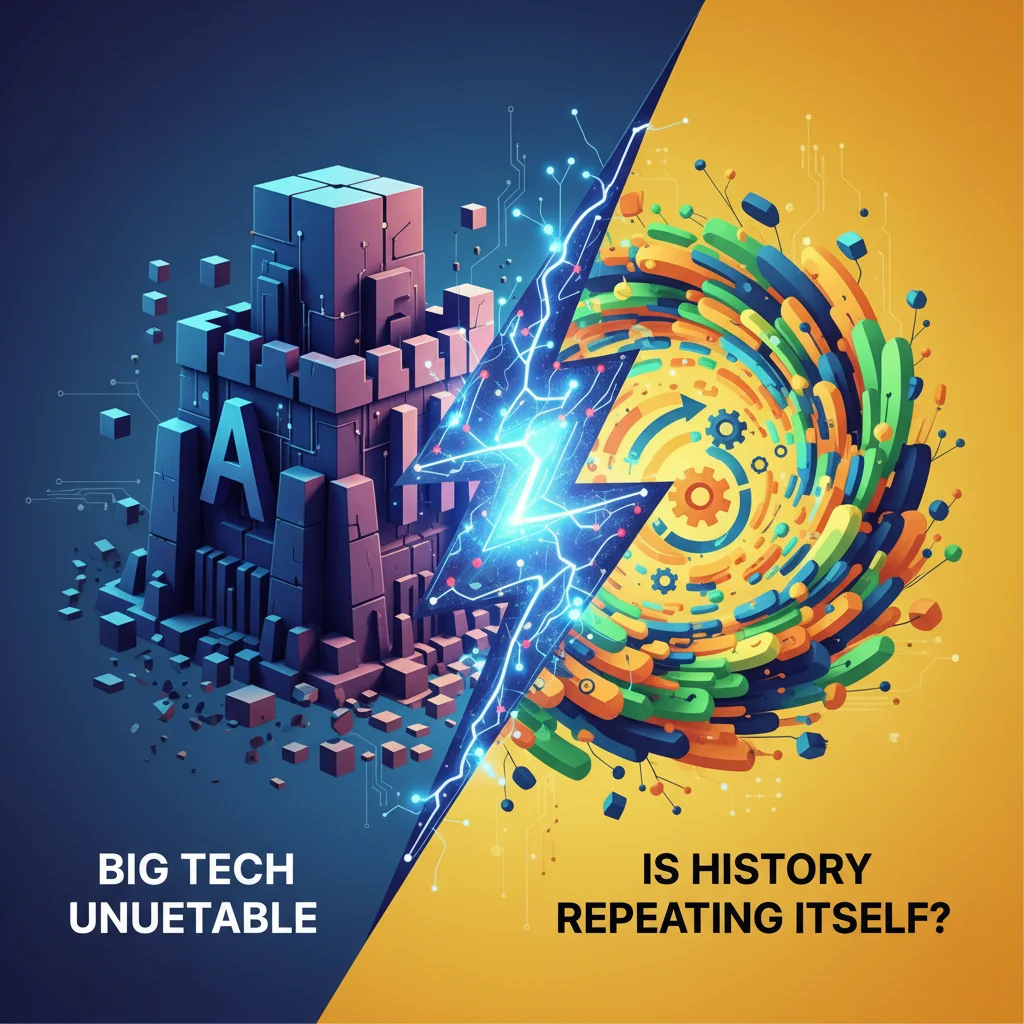
The debate boils down to two compelling, yet contradictory, narratives. Is this just another chapter in the history of software, where nimble startups always find a way to topple the giants? Or is this time truly different, an industrial-scale revolution where the sheer capital required to compete creates an unbreachable fortress for Big Tech?
Let’s unpack these two clashing views and explore what they mean for the future of innovation, startups, and the entire tech landscape.
View 1: The “Déjà Vu” Argument — It’s Still Just Software
For many seasoned venture capitalists and entrepreneurs, the current AI frenzy feels familiar. They argue that, at its core, artificial intelligence is simply the next evolution of software. This perspective is built on the classic principles that have governed Silicon Valley for decades.
Think back to the great tech waves of the past:
- The PC Revolution: IBM dominated the mainframe era, but Microsoft and Apple, two garage startups, redefined computing for the individual.
– The Internet Revolution: Established giants were slow to adapt, while newcomers like Google and Amazon built empires on the new digital frontier.
– The Mobile Revolution: The rise of the smartphone created a new ecosystem where companies like Instagram and Uber thrived, building billion-dollar businesses on top of the new platform.
The “déjà vu” camp believes this pattern is repeating. They argue that the fundamental economics of software haven’t changed. Once a piece of software is written, the marginal cost of distributing it to another million users is close to zero. This dynamic allows small, brilliant teams to create products with massive scale and impact. According to this view, AI and machine learning are powerful new tools in the programming toolkit, but they don’t change the underlying game.
Startups can now leverage powerful AI APIs from companies like OpenAI or Google to build incredibly sophisticated applications with a fraction of the resources it would have taken just a few years ago. The focus shifts from building the foundational technology to creatively applying it. The winner won’t be the one with the biggest model, but the one who builds the best product that solves a real-world problem. This is the classic SaaS playbook, supercharged by AI.
Oracle's AI Paradox: Why a Revenue Miss Sparked a Debate About the Future of Cloud
View 2: The “This Time It’s Different” Argument — An Industrial Revolution
The counterargument is that comparing this AI wave to previous software shifts is like comparing a craft brewery to a global oil conglomerate. This perspective posits that foundational AI models are not just another software tool; they represent a new kind of industrial infrastructure, much like electricity grids or railroads.
The barriers to entry are staggering. Building a state-of-the-art large language model is an undertaking of immense scale and cost. For instance, it’s estimated that training OpenAI’s GPT-4 cost well over $100 million in compute resources alone. This isn’t just about clever coding; it’s about securing thousands of specialized AI chips, building massive data centers, and hiring a small army of the world’s most sought-after AI researchers.
This creates a dynamic where only a handful of players—namely Big Tech companies with their vast cloud infrastructure and deep pockets—can afford to compete at the foundational level. Startups, in this view, are relegated to building applications on top of these platforms. While this can still be lucrative, it makes them fundamentally dependent on the giants. They are customers, not competitors.
This dependency creates significant platform risk. What happens if the API provider decides to increase prices, change its terms of service, or build a competing feature directly into its own product? This power dynamic is fundamentally different from previous eras, where startups could build their own independent technology stacks. This concentration of power also raises new questions around cybersecurity and systemic risk.
A Tale of Two Revolutions
To make this distinction clearer, let’s compare the two viewpoints across several key factors:
| Aspect | The ‘Déjà Vu’ View (Software Revolution) | The ‘This Time It’s Different’ View (Industrial Revolution) |
|---|---|---|
| Primary Resource | Talent & Code | Capital, Compute Power & Data |
| Barriers to Entry | Low. A small team can build a disruptive product. | Extremely High. Requires massive investment in infrastructure. |
| Role of Startups | Disruptors. They create new markets and topple incumbents. | Application Builders. They build on top of platforms provided by incumbents. |
| Key Differentiator | Product Innovation & User Experience | Scale of Foundational Model & Infrastructure |
| Historical Analogy | The rise of PC software, the internet, and mobile apps. | The rise of railroads, electricity, and oil production. |
Silicon Spies: Inside Taiwan's Secret War to Protect the World's Most Vital Technology
However, the “Software Revolution” is happening on top of that grid. The real opportunity for startups and innovation isn’t in trying to build a better GPT-5. It’s in building the “AI-powered appliances.” Think about it: once the electrical grid was established, thousands of companies emerged to build everything from lightbulbs to refrigerators to televisions. They didn’t generate their own power; they used the grid to create novel solutions for specific problems.
The most successful AI startups will be those that focus on vertical applications. They will combine public APIs with proprietary data, unique workflows, and a deep understanding of a specific industry (like law, medicine, or manufacturing) to create something the giants can’t. Their defensible moat won’t be the AI model itself, but the data and domain expertise they wrap around it. The game hasn’t ended; the playing field has just shifted.
Strategies for Thriving in the New AI Ecosystem
So, how should different players in the tech world navigate this complex new landscape? The right strategy depends on who you are.
For Startups & Entrepreneurs:
The message is clear: don’t try to out-Google Google. Instead of competing on the size of your model, focus on the depth of your solution.
- Go Vertical: Target a specific industry or niche. Become the undisputed expert in AI for legal contract analysis, or diagnostic imaging, or supply chain automation.
- Build Data Moats: Your unique, proprietary dataset is your most valuable asset. Use AI to create a feedback loop where your product gets smarter with every new user and data point.
- Focus on the “Last Mile”: Foundational models are generalists. The real value is in the user experience, workflow integration, and the specific problem you solve. This is where you can outmaneuver the slower-moving giants. As one VC put it, the opportunity lies in the “boring” work of applying AI to real business processes (source).
For Developers & Tech Professionals:
The demand for skilled individuals who can bridge the gap between AI potential and business reality has never been higher.
- Become an AI Applicator: Master the art of using APIs from major platforms. Learn about prompt engineering, fine-tuning, and integrating AI into larger software systems.
- Understand the Stack: While you may not be building foundational models, understanding the principles of machine learning, data pipelines, and cloud architecture is crucial for building robust and scalable AI applications.
- Think About a Niche: Just like startups, individual developers can build a valuable career by specializing. Become the go-to expert for AI in fintech, healthcare tech, or cybersecurity.
Oracle's Billion AI Gamble: Why Wall Street Flinched and What It Means for the Future of Tech
Conclusion: A New Era of Innovation Awaits
The debate between the “déjà vu” and “this time it’s different” views of AI highlights the central tension of our time. Big Tech has an undeniable, industrial-scale advantage in building the foundational models that will power the next decade of technology. The sheer capital and data required create a moat that seems, for now, impenetrable (source).
But to declare the game over would be to underestimate the relentless force of innovation. The history of technology is a story of disruption, and while the rules may have changed, the spirit of the game remains the same. The most exciting opportunities may not be in building the power plants, but in inventing the countless new ways we will use this incredible new power. The AI revolution is here, and for the creative, agile, and determined, the opportunities are just beginning.