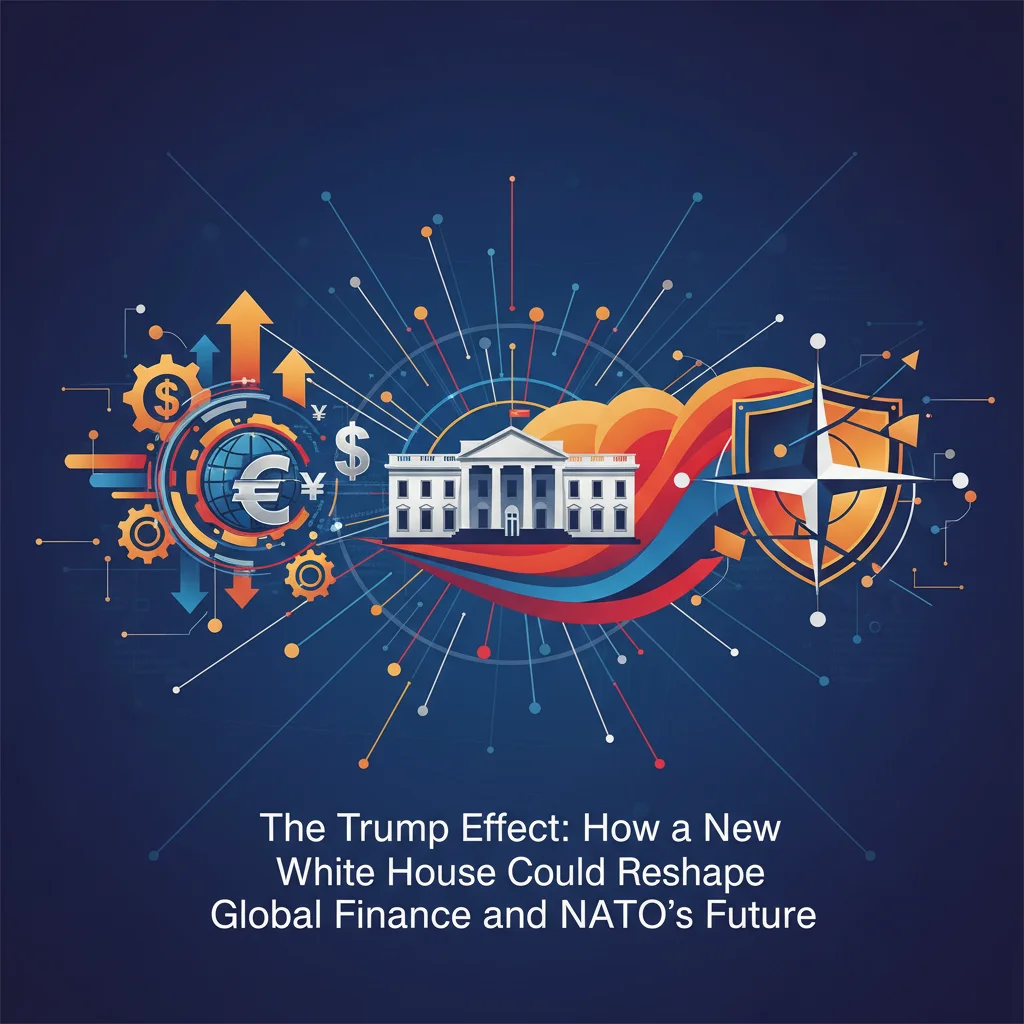
The Trump Effect: How a New White House Could Reshape Global Finance and NATO’s Future
The global political landscape is holding its breath. As the prospect of a second Donald Trump presidency looms, investors, business leaders, and policymakers are scrambling to decipher the potential economic and geopolitical shockwaves. The first Trump term was characterized by a transactional, often disruptive, approach to international relations that rattled long-standing alliances and sent tremors through the global economy. What would a second term look like, and how should we prepare?
To gain unparalleled insight, we turn to the analysis of a man who spent a decade at the heart of the transatlantic alliance: Jens Stoltenberg, the former NATO secretary-general. In a recent candid conversation with the Financial Times’ Gideon Rachman, Stoltenberg provided a masterclass in understanding the complexities of dealing with Donald Trump and the future of European security. His perspective is not just a lesson in diplomacy; it’s a critical roadmap for anyone navigating the volatile intersection of geopolitics and global finance.
The Transactional President: Deconstructing the “Trump Doctrine”
One of the most crucial insights from Stoltenberg is his characterization of Trump’s worldview. He describes the former president as someone who is not fundamentally an isolationist but is deeply skeptical of multilateral agreements and alliances that he perceives as a bad deal for the United States. “The main challenge with him is not that he is against NATO,” Stoltenberg explains, “but that he has a problem with what he regards as an unfair burden-sharing, where the US is paying too much.” (source)
This “America First” transactionalism has profound implications for the global economic order. For decades, the global stock market and international trading systems have been built on a foundation of predictability, upheld by US-led alliances. Trump’s approach replaces this predictability with a constant negotiation, where everything from trade tariffs to security guarantees is on the table. For investors, this translates directly into heightened market volatility and geopolitical risk. A single tweet could threaten to unravel a trade deal, sending ripples through supply chains and affecting corporate earnings across continents.
The core of Trump’s criticism of NATO has always been financial: the failure of many European nations to meet the agreed-upon defense spending target of 2% of their GDP. Stoltenberg admits the criticism has merit, noting that for years he struggled to get European leaders to increase their budgets. It was, ironically, the pressure from Trump that finally spurred significant change.
The Poverty Paradox: Why Free Markets and Social Safety Nets Are Two Sides of the Same Coin
The 2% Conundrum: Defense Spending as an Economic Catalyst
The debate over the 2% target is not just about military hardware; it’s a fundamental issue of national finance and economics. For many European nations, increasing defense spending means making difficult budgetary choices, potentially diverting funds from social programs or infrastructure. However, the narrative is shifting.
The war in Ukraine has served as a brutal wake-up call, transforming the 2% target from an aspirational goal into a bare minimum for national security. Stoltenberg highlights that when he left office, more than half of NATO allies were on track to meet or exceed this target. This surge in spending represents a significant fiscal stimulus for the defense industry, impacting everything from aerospace engineering to cybersecurity. This has direct consequences for investing, creating new opportunities in defense-related sectors while also raising questions about long-term economic sustainability.
To put this in perspective, here is a simplified look at the evolution of NATO defense spending commitments:
| Time Period | NATO Spending Reality | Primary Driver | Economic Implication |
|---|---|---|---|
| Pre-2014 | Most allies decreasing spending; few met the 2% target. | Post-Cold War “peace dividend.” | National budgets focused on domestic priorities over defense. |
| 2014-2020 | Slow, gradual increase after Russia’s annexation of Crimea. Trump’s pressure accelerates trend. | Russian aggression; US political pressure. | Shift in fiscal priorities; early growth in defense sector stocks. |
| 2022-Present | Rapid, widespread increases across Europe. The 2% target is now seen as a floor. | Full-scale invasion of Ukraine. | Massive stimulus for defense industry; potential strain on public finance. |
Institutional Strength vs. Political Rhetoric
Despite the alarming headlines and Trump’s threats to potentially withdraw from NATO, Stoltenberg offers a more optimistic counter-narrative. He argues that the institution is far more resilient than the political rhetoric suggests. “NATO is stronger now than it has been for many, many years,” he asserts, pointing to the addition of Finland and Sweden and the massive increase in defense spending. He believes that even under a Trump presidency, the fundamental US security interests aligned with a strong Europe would prevail.
This highlights a crucial tension: the power of a single leader versus the inertia and strength of established institutions. While a president can set the tone and direction, the US government is a vast apparatus with deep-rooted interests in transatlantic security. The defense, intelligence, and diplomatic communities have a long history of cooperation with their European counterparts. This institutional ballast can often moderate the most radical political impulses. However, relying on this alone is a risky strategy. A determined president can still inflict significant damage on alliances and international norms, creating instability that financial markets abhor.
A Red Line Crossed: Why the 1.5°C Climate Breach is a Tipping Point for the Global Economy
The Ukraine War: The Ultimate Litmus Test
The war in Ukraine is the single most important factor shaping the current geopolitical landscape. It has starkly reminded Europe of its security vulnerabilities and its reliance on the United States. Stoltenberg recounts a telling anecdote about a conversation with Trump regarding the Nord Stream 2 pipeline, where Trump warned Germany about its energy dependence on Russia. At the time, European leaders dismissed it. In hindsight, Trump’s warning was prescient. (source)
A potential shift in US policy on Ukraine under a second Trump administration is perhaps the biggest risk to global stability. A reduction or cessation of US aid could dramatically alter the course of the war, with cascading consequences for the European economy, global energy prices, and the international security order. This uncertainty is a significant headwind for economic recovery and a major concern for anyone involved in international finance or trading.
The Canary in the Coal Mine: What One Pub's 'Warm Space' Initiative Reveals About the Global Economy
Actionable Takeaways for a Volatile Future
Stoltenberg’s analysis is not just a historical account; it’s a guide to the future. For business leaders, investors, and finance professionals, the message is clear: the era of stable, predictable geopolitics is over. Here’s what this means in practice:
- Integrate Geopolitical Risk Analysis: Standard economic models are no longer sufficient. Companies and investment funds must actively monitor and model geopolitical risk, from trade disputes to military conflicts. Modern financial technology and AI-driven analytics platforms are becoming essential tools for this purpose.
- Focus on Resilience: For businesses, this means diversifying supply chains and reducing dependence on single countries or trade routes. For investors, it means building portfolios that can withstand market shocks, possibly by increasing allocations to assets that are less correlated with the broader stock market.
- Monitor Defense and Energy Sectors: The push for increased European defense spending and energy independence will create significant long-term shifts in the economy. These sectors will likely see sustained investment and innovation, presenting both opportunities and risks.
- Understand the Power of Narrative: In a world influenced by figures like Trump, political rhetoric can move markets as much as economic data. Staying informed beyond the headlines and understanding the underlying motivations of key political actors is crucial for effective decision-making.
Ultimately, Jens Stoltenberg paints a picture of a challenging but not hopeless future. He shows that by understanding the transactional nature of the key players and focusing on the fundamental strengths of our institutions, we can navigate the turbulence. The relationship between Europe and the US may be rocky, but the shared interests remain deep. For those in the world of finance and business, the key is not to predict the future with certainty, but to prepare for a range of possible outcomes with strategy, resilience, and a clear-eyed view of the risks and opportunities ahead.