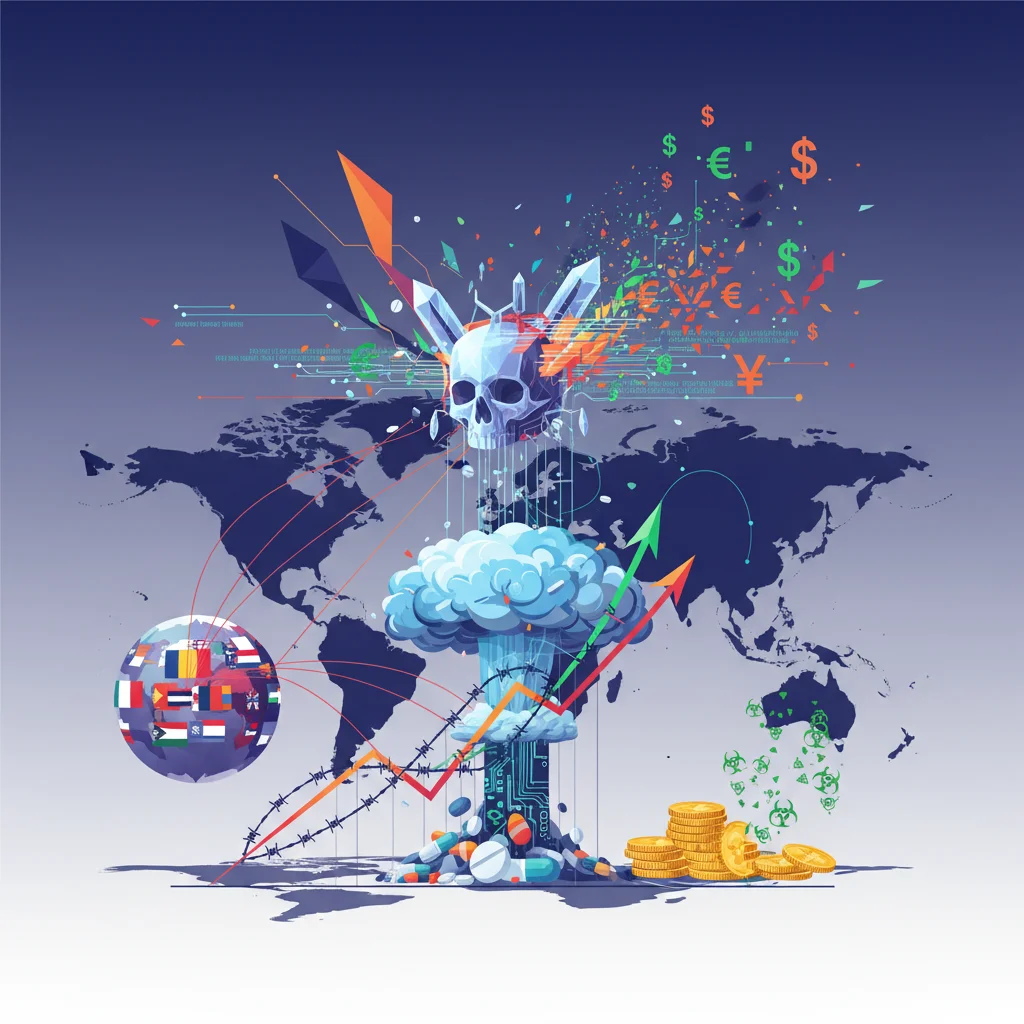
Fentanyl as a WMD: The Economic Fallout of a Geopolitical Gambit
A Geopolitical Escalation with Economic Consequences
In a move that blurs the lines between public health, law enforcement, and national defense, a recent executive order has officially classified fentanyl as a Weapon of Mass Destruction (WMD). This decision, detailed in a report by the Financial Times, is far more than a symbolic gesture. It represents a fundamental shift in U.S. policy, equipping the government with a powerful, and potentially disruptive, justification for military and economic actions against the global networks that produce and traffic the synthetic opioid. For investors, business leaders, and financial professionals, understanding the ripple effects of this policy is critical, as it stands to impact everything from international trade and supply chains to specific sectors of the stock market.
The opioid crisis has exacted a devastating human toll on the United States. In 2022 alone, over 109,000 people died from drug overdoses, with synthetic opioids like fentanyl being the primary driver (source: CDC). By reclassifying fentanyl from a narcotic to a WMD, the administration is signaling a move away from a purely domestic issue towards an international security threat. This legal re-framing is profound; it potentially authorizes the Department of Defense and intelligence agencies to take actions typically reserved for countering nuclear, chemical, or biological threats. This could include everything from heightened surveillance of chemical manufacturers abroad to direct interdiction operations against smuggling networks.
The Geopolitical Chessboard: Targeting Global Supply Chains
The executive order is implicitly aimed at the two countries central to the fentanyl supply chain: China, the primary source of the chemical precursors, and Mexico, where cartels synthesize and traffic the final product into the U.S. The WMD designation provides a new, potent lever in an already complex geopolitical landscape.
Historically, combating drug trafficking has been the purview of agencies like the DEA, working in cooperation (or at times, friction) with foreign governments. Classifying fentanyl as a WMD could subordinate these efforts to a national security mandate, potentially leading to more aggressive and unilateral actions. These might include:
- Aggressive Sanctions: The U.S. Treasury could impose sweeping sanctions on Chinese chemical companies, financial institutions, and individuals even tangentially linked to the precursor trade. This goes beyond targeting specific criminals and could ensnare legitimate businesses, disrupting the broader chemical and pharmaceutical industries.
- Military Interdiction: The order could be used to justify military operations to intercept shipments of precursors or finished fentanyl on the high seas or even within the sovereign territory of other nations, a move that would dramatically escalate international tensions.
- Intelligence Operations: It greenlights expanded cyber warfare and intelligence gathering against cartel communication networks and the financial systems that support them.
This strategic pivot places the fentanyl crisis squarely within the ongoing economic and ideological competition between the U.S. and China. It adds another contentious issue to a relationship already strained by disputes over trade, technology, and Taiwan. Any aggressive action taken under this new WMD pretext could trigger retaliatory measures from Beijing, further destabilizing the global economy.
Silence or Ruin: The Crushing Cost of Whistleblowing in UK Finance
Economic Tremors: Market Volatility and Sector-Specific Impacts
For those focused on finance and investing, the declaration’s true significance lies in its potential to create economic volatility and reshape market dynamics. Geopolitical risk is a powerful driver of market sentiment, and this policy introduces a new and unpredictable variable. The immediate economic costs of the opioid crisis are already staggering, providing the backdrop for this drastic policy shift.
The following table, based on data from a U.S. Congressional Joint Economic Committee report, outlines the immense financial burden of the opioid epidemic, illustrating why policymakers are seeking more forceful solutions.
| Cost Category | Estimated Annual Financial Impact |
|---|---|
| Lost Productivity & Labor Force Participation | $700 billion+ |
| Healthcare Expenses (Treatment, Emergency Services) | $250 billion+ |
| Criminal Justice System Costs | $100 billion+ |
| Reduced Quality of Life (Valued Economically) | $450 billion+ |
| Total Estimated Cost | ~ $1.5 Trillion in 2020 (source) |
Faced with these figures, the move to a national security footing is understandable, but its economic consequences could be equally vast. Investors should monitor several key areas:
- Supply Chain Fragility: A broad crackdown on Chinese chemical exports could disrupt more than just the illicit drug trade. Many precursor chemicals have dual uses in legitimate industries, including pharmaceuticals, plastics, and agriculture. Companies reliant on these chemicals could face shortages and price spikes, impacting their profitability and stock performance.
- Defense and Cybersecurity Stocks: A militarized approach to counter-narcotics could be a boon for the defense sector. Companies specializing in surveillance technology, drones, intelligence analysis software, and cybersecurity are likely to see increased government contracts. This creates a potential growth area for investors, albeit one tied to escalating conflict.
- Financial Sector Scrutiny: The focus on disrupting illicit finance will place greater pressure on the banking sector. We can expect regulators to demand more sophisticated transaction monitoring, creating opportunities for fintech companies that specialize in anti-money laundering (AML) and know-your-customer (KYC) technology.
The Monochrome Portfolio: What Interior Design Teaches Us About High-Conviction Investing
Fintech and Blockchain: The New Frontier in the War on Drugs
As the conflict shifts towards disrupting the financial arteries of drug cartels, financial technology will play an increasingly vital role. The WMD declaration provides a mandate for intelligence agencies and the Treasury to aggressively pursue the money trail, creating a unique intersection of national security and fintech innovation.
Traditional banking systems are already on the front lines, but their legacy systems often struggle to keep pace with the sophisticated laundering techniques of modern criminal enterprises. This is where cutting-edge technology comes in. AI and machine learning algorithms can now analyze billions of transactions in real-time, detecting subtle patterns of illicit activity that would be invisible to human analysts. This creates a significant market for reg-tech (regulatory technology) firms that can help financial institutions meet heightened compliance demands.
Beyond tracking money, technology offers potential solutions for the physical supply chain. The concept of using blockchain to create an immutable, transparent ledger for chemical precursors is gaining traction. Imagine a system where every transaction, from the chemical plant in China to a legitimate pharmaceutical lab in the U.S., is recorded on a secure, distributed ledger. Such a system could make it exponentially more difficult for precursors to be diverted to illicit channels without detection. While implementation is complex, the WMD designation may provide the impetus and funding for such ambitious pilot programs, representing a future-forward application of blockchain technology to a pressing global problem.
Sun, Sand, and Scrutiny: A Radical New Deal for Britain's Offshore Financial Havens?
Conclusion: A New Paradigm for Risk and Investment
The classification of fentanyl as a Weapon of Mass Destruction is a landmark policy decision that transcends the headlines. It reframes a public health crisis as a national security emergency, fundamentally altering the tools the U.S. government can deploy. For the financial world, this is not a distant political issue; it is a direct catalyst for a new set of economic and market risks.
Investors and business leaders must now factor this new geopolitical reality into their risk assessments. The potential for sudden sanctions, supply chain shocks, and heightened US-China tensions adds a layer of uncertainty to the global economy. Simultaneously, it creates targeted opportunities in sectors like defense, cybersecurity, and fintech. The key takeaway is that the war on drugs has entered a new, more aggressive phase, and its battlefields will be found not only on the border but also in global supply chains, international banking systems, and the very structure of the digital economy. Navigating this new landscape will require vigilance, strategic foresight, and a deep understanding of the intersection between policy, conflict, and capital markets.

Related Posts
The UK’s Economic Puzzle: Rising Unemployment, Resilient Wages, and What It Means for Your Finances
UK’s Economic Crossroads: Unemployment Rises, But Real Wages Offer a Surprising Silver Lining