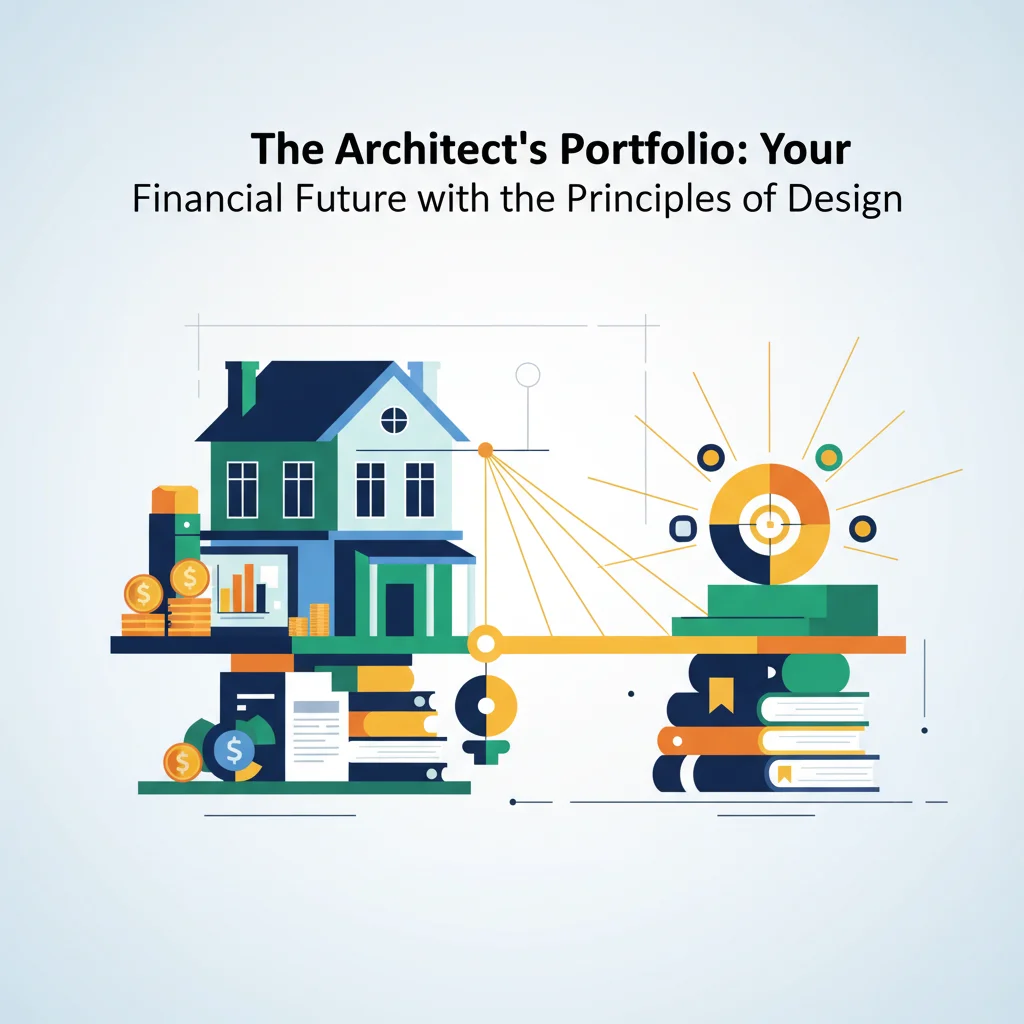
The Architect’s Portfolio: Rebuilding Your Financial Future with the Principles of Design
In a recent feature, the Financial Times explored the meticulous transformation of a textile artist’s three-storey home into a light-filled, family-friendly studio and living space. On the surface, it’s a story of architecture and interior design. Yet, beneath the layers of plaster and paint lies a powerful metaphor for the world of finance, economics, and strategic investment. The complex renovation of a physical structure offers a profound blueprint for how we should approach the construction of a resilient financial portfolio, the restructuring of a modern business, and even the recalibration of a national economy.
Just as an architect must balance form with function, and a homeowner must balance budget with vision, today’s investors and business leaders must navigate a complex landscape of risk, opportunity, and technological disruption. The principles that turn a dilapidated building into a valuable, life-enhancing asset are the very same principles that build enduring wealth and sustainable economic growth. This is not merely about renovation; it is about strategic reconstruction. It’s about tearing down outdated frameworks to build something stronger, more transparent, and designed for the future.
Phase 1: The Strategic Blueprint – Deconstructing for Growth
The journey from an old structure to a modern sanctuary begins not with a hammer, but with a plan. The artist’s “complex renovation” mirrors the essential first step in any significant financial undertaking: a deep, analytical due diligence process. Before a single wall is removed, an architect assesses the building’s foundation, its structural integrity, and its potential. Similarly, before reallocating capital or diversifying a portfolio, an investor must conduct a thorough analysis of their existing assets, liabilities, and the prevailing market conditions.
This initial phase is critical in the world of finance. It involves asking difficult questions: Are our current strategies built on a solid foundation, or are they relics of a bygone economic era? Are we holding onto legacy assets or business units that are draining resources, much like old, inefficient plumbing? In corporate restructuring, this is the process of identifying non-core assets for divestiture. In personal investing, it’s the honest appraisal of underperforming stocks or funds that no longer align with long-term goals.
The cost and complexity of this “renovation” require meticulous capital allocation. A construction budget is a masterclass in financial planning, balancing fixed costs with contingencies for unforeseen problems—a concept every seasoned trader understands. The global economy itself is in a perpetual state of renovation, with central banks and governments constantly adjusting fiscal and monetary policy to repair structural weaknesses and foster new avenues for growth.
The Fed's High-Wire Act: Is a Dovish Pivot on the Horizon for the Global Economy?
Phase 2: The Three-Storey Portfolio – A Framework for Diversification
The artist’s home spans three storeys, each with its unique function, yet all contributing to a cohesive whole. This architectural design provides a perfect analogy for a well-diversified investment portfolio. Relying on a single asset class is like living in a one-room shack—it may serve a purpose, but it offers no protection when one wall fails. A multi-storey approach, however, builds resilience and creates multiple avenues for value.
Let’s envision a modern investment portfolio as a three-storey structure:
- The Ground Floor: The Foundation. This level represents core, stable assets. Think of blue-chip stocks, government bonds, and high-quality real estate. These are the foundational pillars that provide stability and predictable, albeit modest, returns. They are the load-bearing walls of your financial house, designed to withstand shocks in the stock market.
- The Second Floor: Growth and Innovation. This is where you house your growth assets. This includes investments in technology stocks, emerging markets, and venture capital. This floor is designed for capital appreciation and requires a higher tolerance for risk. It’s the open-plan living space where new ideas and opportunities can flourish, driven by advancements in financial technology and other disruptive sectors.
- The Third Floor: The Studio of Alternatives. This top floor is the creative space, representing alternative investments. Here, you find assets that are often uncorrelated with the broader market, such as commodities, private equity, and even digital assets like those managed on the blockchain. Like an artist’s studio, this space is for calculated experimentation and can yield unique, asymmetrical returns.
The table below illustrates a simplified model of this diversified, “three-storey” approach to asset allocation, contrasting it with a less-resilient, single-focus strategy.
| Portfolio Strategy | Asset Allocation Example | Primary Goal | Risk Profile |
|---|---|---|---|
| The “Three-Storey” Model | 40% Bonds/Blue-Chips, 40% Growth Stocks/ETFs, 20% Alternatives | Balanced Growth & Resilience | Moderate to High |
| The “Single-Room” Model | 90% Tech Stocks, 10% Cash | Aggressive Growth | Very High |
Effective diversification isn’t just about owning different things; it’s about owning assets that behave differently under various economic conditions. According to a study by Vanguard, a diversified 60/40 portfolio has historically provided a smoother ride for investors, capturing upside while mitigating downside risk (source). This strategic allocation ensures that if one “floor” of your financial house is under pressure, the others can support the overall structure.
Phase 3: Let There Be Light – Transparency Through Financial Technology
A key outcome of the renovation was a “light-filled” space. In finance and economics, light is a synonym for transparency. For centuries, the traditional banking and investment industries operated in relative opacity, with information asymmetries creating advantages for insiders. The digital revolution, however, is throwing open the shutters.
The rise of fintech is the equivalent of installing floor-to-ceiling windows in a musty, old mansion. Financial technology platforms provide retail investors with access to data, tools, and markets that were once the exclusive domain of institutional players. Commission-free trading apps, robo-advisors, and real-time market data have democratized the world of investing, flooding it with light. This transparency fosters accountability and efficiency.
Nowhere is this quest for transparency more evident than in the development of blockchain technology. At its core, a blockchain is a distributed, immutable public ledger. It offers a way to record transactions and track assets with an unprecedented level of clarity and security. While often associated with cryptocurrencies, its application in supply chain management, real estate transactions, and even voting systems promises to eliminate fraud and create “light-filled” systems where trust is built into the architecture. The global fintech market is projected to reach over $324 billion by 2026, a testament to the immense demand for these transparent and efficient solutions (source).
Phase 4: The “Family-Friendly” Design – Building for a Sustainable Future
The final, and perhaps most important, aspect of the artist’s renovated home is that it is “family-friendly.” This speaks to longevity, sustainability, and a design that serves the needs of its inhabitants for years to come. In the financial world, this is the essence of sustainable investing and long-term value creation.
A “family-friendly” economic model prioritizes stability over speculative frenzy. It rejects the short-termism that often dominates the stock market, where quarterly earnings reports can overshadow a company’s long-term strategic vision. Instead, it embraces principles aligned with Environmental, Social, and Governance (ESG) criteria. Companies that focus on sustainability, ethical governance, and positive social impact are, in effect, building a more resilient and “family-friendly” corporate structure. This is not just altruism; it is sound financial strategy. ESG-focused funds have seen a massive influx of capital, with global sustainable fund assets hitting $2.74 trillion at the end of 2021 (source), as investors recognize that sustainable practices are intrinsically linked to long-term profitability and risk mitigation.
This long-term perspective is the ultimate lesson from the artist’s studio. She did not apply a quick coat of paint to hide the cracks; she undertook a complex renovation to build something of enduring value. The same should be true of our approach to investing and economic stewardship. We must be the architects of a financial future that is not only profitable but also resilient, transparent, and sustainable—a structure built to last for generations.
In conclusion, the transformation of a physical space from a state of disrepair to one of beauty and function is a journey of vision, planning, and execution. By applying the principles of this architectural metamorphosis to our financial lives, we can move beyond simply managing money to strategically constructing wealth. It requires us to be both the visionary architect and the pragmatic builder—designing a diversified, transparent, and sustainable portfolio capable of weathering any storm and serving our most important long-term goals.

Related Posts

The Canary in the Coal Mine: Why a Tripling in Food Bank Demand is a Critical Signal for the Global Economy

The Unseen Ledger: Gauging the Economic Shockwaves of Social Tragedy in Australia