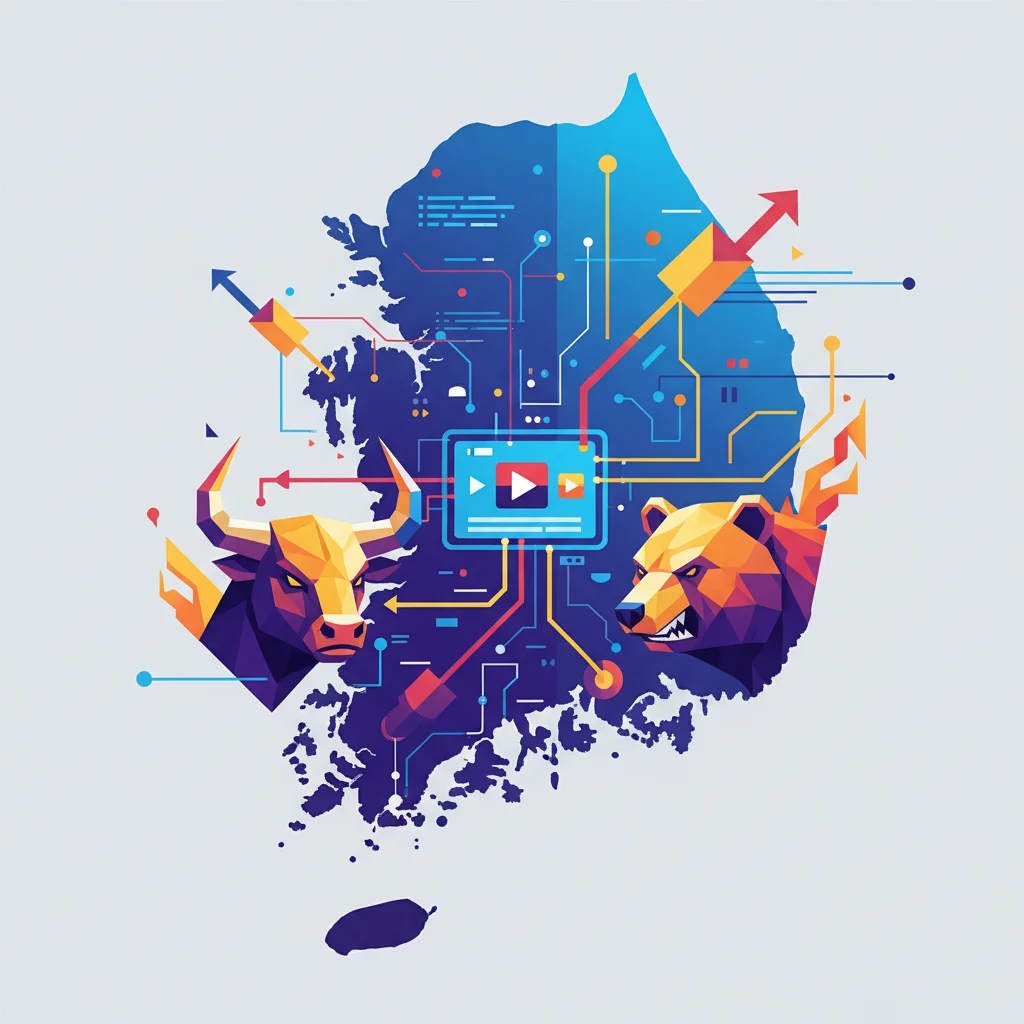
Mandatory Viewing: Why South Korea is Forcing Its Most Aggressive Investors to Watch Videos Before Trading
In the fast-paced world of global finance, where fortunes can be made or lost in a single click, regulators are constantly playing catch-up with technology and human behavior. Nowhere is this truer than in South Korea, a nation that has witnessed an unprecedented explosion in retail investing. Now, in a move that is part paternalistic, part pragmatic, the country’s financial watchdog is rolling out a novel requirement: before engaging in high-risk trades, investors must first sit down and watch a one-hour training video. This isn’t a suggestion; it’s a prerequisite.
The decision by South Korea’s Financial Services Commission (FSC) to implement this mandatory educational session for derivatives traders is a direct response to the meteoric rise of the “Donghak Ants.” This nickname, a nod to a 19th-century peasant rebellion, was affectionately given to the millions of new retail investors who swarmed the stock market during the COVID-19 pandemic. Armed with user-friendly fintech apps and a fervent belief in the national economy, these investors have become a dominant force, accounting for a significant portion of daily trading volume. But with this newfound power comes immense risk, and regulators are growing increasingly concerned that many are diving into complex financial instruments without fully understanding the potential for catastrophic losses.
This article delves into South Korea’s bold regulatory experiment. We’ll explore the cultural and economic context behind the retail trading boom, dissect the specifics of the new rules, and analyze what this means for the future of investing, not just in Asia, but across the global financial landscape.
The Rise of the “Donghak Ant”: A Retail Revolution
To understand the FSC’s new policy, one must first appreciate the scale of South Korea’s retail investment phenomenon. The pandemic acted as a powerful catalyst. With rock-bottom interest rates making traditional banking savings accounts unattractive and a volatile job market, millions of South Koreans turned to the stock market as a viable path to wealth creation. This movement was supercharged by the accessibility of sophisticated mobile trading platforms, a testament to the country’s advanced financial technology sector.
The numbers are staggering. In 2021, individual investors were responsible for nearly 65% of the total trading value on the main KOSPI board. This army of investors, often coordinating on social media and online forums, has shown a remarkable appetite for risk, piling into everything from local tech giants to highly leveraged derivatives and even speculative bets on US stocks. While their collective action has at times propped up the market, it has also introduced a new level of volatility and raised red flags for regulators tasked with maintaining financial stability.
The core concern is the knowledge gap. Many of these new market participants are drawn to the allure of quick profits offered by complex products like futures and options, instruments that can amplify both gains and losses. The FSC’s move is a direct attempt to bridge this gap, forcing a moment of reflection and education before capital is put at significant risk. The £1 Million Royal-Backed App That Vanished: A Fintech Cautionary Tale
Dissecting the New Rulebook: More Than Just a Video
The mandatory one-hour training video is the headline-grabbing component, but it’s part of a broader package of measures designed to strengthen investor protections. The FSC is tightening the entry requirements for the derivatives market, which has been a playground for some of the most speculative trading. The new rules, as outlined by the Financial Times, represent a significant shift from previous regulations.
Let’s compare the old requirements with the new ones for retail investors wishing to trade futures and options:
| Requirement | Previous Regulation | New Regulation |
|---|---|---|
| Educational Prerequisite | None | Mandatory 1-hour online training video |
| Initial Deposit (Futures & Options) | ₩10mn (approx. $7,200) | Increased to ₩20mn (approx. $14,400) |
| Mock Trading Experience | Required | Still Required |
| Applicability | New investors | All retail investors, including existing ones |
These changes are not merely administrative hurdles. Doubling the deposit requirement immediately raises the barrier to entry, ensuring that only investors with a more substantial capital base can participate. Crucially, applying these rules to all retail investors—not just new ones—indicates the regulator’s intent to reset the market’s risk profile. The goal is to curb the kind of hyper-speculative, lottery-like behavior that can lead to devastating personal financial crises and, on a macro level, threaten the stability of the financial system.
The mandatory video and higher deposit act as a friction point. It forces a pause, a moment of mandatory contemplation in a trading environment designed for frictionless, impulsive action. For some, it will be a box-ticking exercise. But for a meaningful segment of novice investors on the fence, that one hour might introduce concepts like leverage, volatility, and tail risk in a way they hadn’t considered. It’s a psychological speed bump on the road to financial ruin. The bigger question this raises for the global fintech industry is one of responsibility. As platforms gamify investing and make it as easy as ordering food, where does their duty of care begin and end? South Korea’s experiment, however imperfect, places that question front and center.
A Global Regulatory Tightrope
South Korea’s approach is a fascinating case study, but it’s part of a global conversation among regulators grappling with the same fundamental problem: how to protect retail investors in the digital age without stifling market access and innovation. Different jurisdictions have adopted different strategies.
- United States: In the U.S., FINRA (Financial Industry Regulatory Authority) imposes specific requirements for trading complex products. To trade options, for instance, an investor’s brokerage account must be approved for it, a process that involves assessing their financial situation and investment knowledge. For frequent traders, the “Pattern Day Trader” (PDT) rule requires a minimum equity of $25,000, acting as a significant capital barrier to high-frequency speculative trading.
- European Union: The EU’s Markets in Financial Instruments Directive (MiFID II) framework includes “appropriateness” and “suitability” tests. When a retail client wants to invest in a complex product, firms must assess whether the client has the necessary knowledge and experience to understand the risks involved.
Compared to these approaches, South Korea’s mandatory video is unique in its universal, one-size-fits-all nature. While the US and EU systems rely more on disclosure, self-assessment, and capital-based tiers, the Korean model leans into direct, compulsory education. It’s a novel attempt to scale financial literacy, but its effectiveness remains to be seen. Could this model be a blueprint for other nations seeing similar retail booms, or will it prove to be an easily circumvented administrative task? The Monroe Doctrine 2.0: What a US 'Peace Through Strength' Policy Means for the Global Economy
Future Implications: Nudge, Nuisance, or New Normal?
The long-term consequences of this policy will be multifaceted. For the South Korean stock market, it could lead to a slight cooling of speculative fervor in the derivatives space, potentially reducing volatility. However, there’s also the risk of unintended consequences. Highly motivated traders could seek out less-regulated avenues, such as offshore brokers or the burgeoning world of decentralized finance (DeFi) on the blockchain, where such protections do not exist. As one analyst quoted by the FT noted, determined investors will likely “just click through it.”
This initiative also highlights a critical point in the evolution of economics and personal finance: the democratization of market access must be accompanied by a parallel democratization of financial education. A single video is not a panacea. It must be part of a broader, sustained effort—from schools, regulators, and the private sector—to build genuine financial literacy. The fintech platforms that have profited immensely from this retail boom have a significant role to play, moving beyond sleek user interfaces to integrate robust, engaging, and continuous educational tools.
For investors and finance professionals worldwide, South Korea’s experiment is a must-watch. It is a real-time test of a behavioral intervention in one of the world’s most dynamic markets. Its success or failure will provide valuable lessons for policymakers everywhere as they navigate the delicate balance between empowering individual investors and protecting them from their own worst impulses. A Dangerous Silence: How US-Japan-China Tensions Over Taiwan Are Shaking Global Finance
Conclusion: A Necessary Pause in a High-Speed Race
South Korea’s decision to make its investors watch a training video is more than a quirky headline; it’s a significant policy signal. It reflects a deep-seated concern about the sustainability of a retail-driven market boom and the welfare of the individuals powering it. It acknowledges that in the digital age, the speed of financial technology has outpaced the speed of financial education.
Whether this mandatory pause will be an effective safeguard or a minor annoyance remains an open question. But it forces a crucial conversation about the responsibilities of regulators, fintech firms, and investors themselves. In the global quest for a more stable and inclusive financial system, this bold, if unorthodox, step in Seoul is an important data point. The world of finance will be watching—not just the video, but the results.

Related Posts

Black Swans on the Shore: Navigating Financial Markets in an Age of Geopolitical Shocks
The Jaffa Cake Principle: What a 1990s Snack Food Dispute Teaches Us About Modern Finance, Fintech, and the Economy