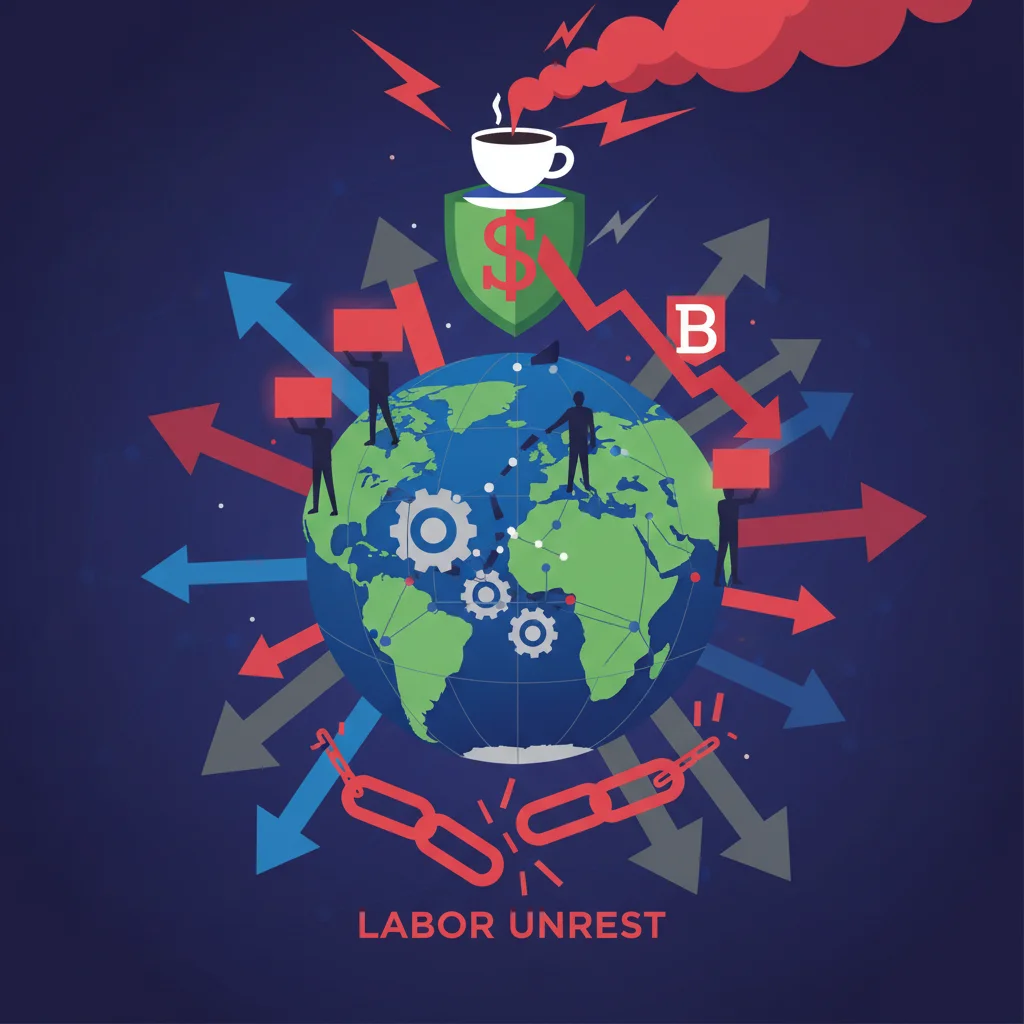
The Global Grind: Why Starbucks’ Labor Unrest is a Red Flag for Investors
The Steam is Building: A Global Protest Shakes a Coffee Giant
What starts as a local dispute rarely stays local in our hyper-connected world. This principle was vividly illustrated when Starbucks, the ubiquitous global coffee chain, found itself at the center of a coordinated international protest. On a single Wednesday, workers and union allies across 10 different countries staged demonstrations. This wasn’t about local grievances; it was a powerful act of solidarity with striking US baristas, sending a clear message to the C-suite in Seattle and, more importantly, to Wall Street. This event is far more than a human-interest story; it’s a critical case study for anyone involved in finance, investing, or corporate leadership. It signals a seismic shift in labor relations that carries profound implications for corporate valuations, risk assessment, and the future of the service economy.
The protests represent the latest escalation in a multi-year unionization drive that has swept through Starbucks’ US locations. The movement, primarily organized under the banner of Starbucks Workers United, has seen hundreds of stores vote to unionize since late 2021. The core of the conflict revolves around allegations of unfair labor practices, including claims of union-busting and a failure to bargain in good faith on the part of the company. While these battles have been fought store by store, the decision to globalize the protest demonstrates a new level of strategic organization by labor groups. For investors and financial analysts, this development should trigger a reassessment of the operational and reputational risks embedded in the company’s stock market profile.
Fast Fashion, Faster Fallout: Why the Shein & Temu IP Scandal is a Red Flag for Investors
The Economics of a Unionized Workforce: A Balance Sheet Perspective
The resurgence of unionization in sectors traditionally considered non-union, like retail and food service, presents a complex economic puzzle. For decades, the prevailing narrative in many business circles was that unions were an impediment to growth, introducing rigidity and inflating labor costs. However, a more nuanced understanding of modern economics reveals a two-sided coin.
From a corporate finance perspective, the arguments against unionization are straightforward. Increased wages, more robust benefits packages, and stricter working condition standards directly impact the bottom line. These higher operating costs can squeeze profit margins, potentially leading to lower returns for shareholders. Furthermore, the collective bargaining process can reduce a company’s agility, making it harder to adapt staffing models or operational procedures in response to market changes. The threat of strikes, as seen with Starbucks, introduces a significant element of operational risk, capable of disrupting supply chains and directly impacting revenue.
However, this view ignores the potential long-term financial benefits. Companies with unionized workforces often experience significantly lower employee turnover. The costs associated with recruiting, hiring, and training new staff are substantial, and reducing churn can lead to considerable savings. Moreover, a stable, experienced workforce is often a more productive and efficient one. A 2023 study by the Economic Policy Institute highlights that unionized workers not only earn more but also have better benefits and more secure jobs, contributing to a more engaged and motivated team. Investing in human capital through fair labor practices can, therefore, be a powerful driver of long-term value creation, even if it presents short-term costs.
A Timeline of Turmoil: Key Moments in the Starbucks Unionization Drive
To understand the current climate, it’s crucial to see how the movement has grown. The following timeline tracks key milestones in the Starbucks Workers United campaign, illustrating its rapid acceleration and the company’s response.
| Date | Key Event | Significance for Investors |
|---|---|---|
| December 2021 | A Starbucks store in Buffalo, NY, becomes the first company-owned US location to unionize in modern history. | Sets a critical precedent, proving that unionization is possible at the corporate giant. Initial market reaction is muted. |
| April 2022 | Howard Schultz returns as interim CEO, taking a more aggressive public stance against the unionization efforts. | Signals a corporate strategy of resistance, increasing the potential for protracted legal and PR battles, a red flag for ESG investors. |
| June 2023 | Starbucks Workers United reports that over 300 stores have successfully voted to unionize across the US (source). | Demonstrates the movement’s significant momentum and widespread appeal, indicating that this is not an isolated issue but a systemic trend. |
| November 2023 | Thousands of workers strike on “Red Cup Day,” one of the company’s busiest promotional days, costing significant revenue. | Highlights the union’s ability to execute targeted, financially damaging actions, escalating the material risk to the company’s quarterly earnings. |
| Present Day | International protests in 10 countries are held in solidarity with US workers, marking a new global phase of the campaign. | Elevates reputational risk on a global scale and complicates international operations, potentially impacting brand loyalty worldwide. |
From Coffee Cups to Stock Tickers: The Investor’s Dilemma
The persistent labor disputes at Starbucks (NASDAQ: SBUX) have created a complex scenario for those involved in trading and long-term investing. The direct financial impact of strikes, while notable, is often just the tip of the iceberg. The more significant, long-term risk lies in the erosion of brand equity. Starbucks built its empire on the concept of the “third place”—a welcoming environment between home and work. This brand identity is intrinsically linked to its employees, or “partners,” as the company calls them. Widespread, public conflict with these very partners directly undermines the brand’s core value proposition.
This is where the principles of ESG investing become paramount. The “S” for Social is increasingly scrutinized by large institutional investors, pension funds, and asset managers. A company’s approach to labor relations, employee treatment, and collective bargaining is a key performance indicator of its social governance. A poor record can lead to divestment by major funds, shareholder resolutions demanding changes in policy, and a lower overall ESG rating, which can restrict a company’s access to certain pools of capital. The financial world is slowly but surely waking up to the fact that a company’s greatest asset is its people, and mistreating that asset has tangible consequences on the stock market.
Australia's Social Media Standoff: A New Regulatory Ice Age for Tech Investors?
The Ripple Effect: Broader Implications for Banking, Fintech, and the Global Economy
The events at Starbucks are not happening in a vacuum. They are a bellwether for the entire service industry, from retail giants to fast-food chains. Business leaders and their banking partners must now factor in a higher probability of labor organization when modeling future costs and risks. Lenders assessing corporate creditworthiness will increasingly look at labor stability as a key variable. A company embroiled in constant conflict with its workforce is a riskier bet than one with a stable, collaborative labor agreement.
Furthermore, the evolution of labor organizing is being shaped by financial technology. As mentioned, crowdfunding platforms have democratized support for striking workers. There are even nascent discussions in tech circles about using blockchain technology to create more transparent and efficient systems for managing union dues and strike funds, removing reliance on traditional financial intermediaries. This technological empowerment of labor is a disruptive force that the corporate and financial worlds are only beginning to grapple with. It changes the risk calculus and demands a more proactive and empathetic approach to employee relations.
In conclusion, the image of baristas from London to Seoul protesting in solidarity with their American counterparts is more than a fleeting news item. It is a potent symbol of a new era in the global economy. It underscores the growing importance of social governance, the financial risks of ignoring labor rights, and the power of a globally connected workforce. For investors, executives, and financial professionals, the message is clear: the conversation happening at the coffee counter is now a key data point in the boardroom and on the trading floor. Ignoring it is no longer an option.
Beyond the Headlines: Why a Local 'Warm Homes' Scheme is a Bellwether for the Future of Finance

Related Posts

Intel’s $25 Billion Nosedive: A Warning Shot for America’s Tech Ambitions?

The Elephant in the Market: Is Reliance Jio’s IPO Set to Redefine India’s Economic Landscape?
