The AI Arms Race is a Myth: China is Hosting a Study Group, and You’re Invited
For the past few years, the narrative around artificial intelligence has been framed as a high-stakes arms race. On one side, you have the American titans—OpenAI, Google, Anthropic—building ever-larger, more powerful, and fiercely guarded proprietary models. They operate like secretive labs, each vying to create the ultimate “one model to rule them all.” On the other side is China, a nation pouring immense resources into catching up. The story we’re often told is one of two superpowers in a head-to-head sprint for technological dominance.
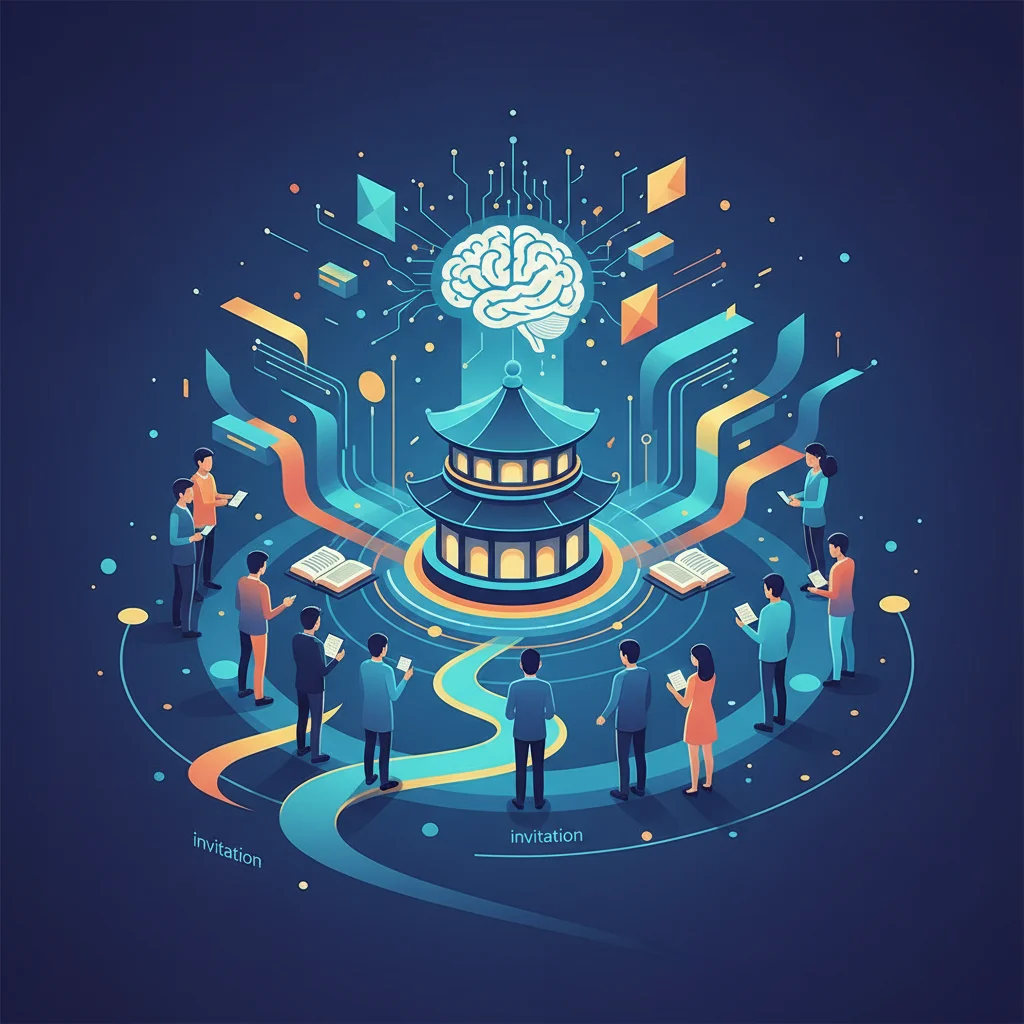
But what if that narrative is fundamentally wrong? What if China isn’t just trying to build a bigger fortress, but is instead cultivating an open, collaborative ecosystem? The Financial Times recently highlighted a fascinating strategic divergence: while the West focuses on closed, proprietary AI, China is aggressively embracing an open-source approach. Think of it this way: instead of a few geniuses studying alone for a final exam, China is hosting a massive, nationwide study group where everyone shares their notes. This collaborative strategy isn’t just a different path—it might be their single greatest national advantage in the global AI landscape.
This shift has profound implications for everyone in the tech world, from individual developers and programmers to venture-backed startups and established enterprises. It’s a fundamental rethinking of how innovation in artificial intelligence happens, and it’s time we paid attention.
The Two Philosophies: The Fortress vs. The Open Playground
At the heart of the global AI competition are two conflicting philosophies. Understanding them is key to grasping the significance of China’s strategy. The Western approach, led by companies like OpenAI, is what we can call the “Fortress Model.” It’s characterized by immense capital investment, secrecy, and controlled access via APIs. This model has produced breathtaking results like GPT-4, but it comes with significant trade-offs.
In contrast, the open-source “Open Playground” model, championed by companies like Meta with its Llama models and now a wave of Chinese tech firms, operates on a different set of principles: community, transparency, and accessibility. Instead of hiding the “source code” of the AI, they release it to the public. This allows anyone—from a student in their dorm room to a developer at a major corporation—to download, inspect, modify, and build upon these powerful tools.
To see the difference clearly, let’s compare the two approaches:
| Attribute | The Fortress (Proprietary AI) | The Open Playground (Open-Source AI) |
|---|---|---|
| Key Players | OpenAI, Google, Anthropic | Meta (Llama), Mistral, Alibaba (Qwen), Zhipu AI (GLM) |
| Access Model | Controlled API access, often with usage fees (SaaS model) | Direct model download, full control over deployment |
| Cost for Users | Can be high and unpredictable, based on usage | Free to download; costs are for computing power (cloud hosting) |
| Customization | Limited to what the API allows; “black box” internals | Deeply customizable; can be fine-tuned on private data |
| Innovation Driver | Centralized R&D by a single company | Decentralized, community-driven improvements and applications |
| Cybersecurity | Security is managed by the provider; less transparency | Code is auditable by the public, but misuse is harder to control |
This table illustrates a fundamental split in the road. The Fortress model centralizes power and profit, while the Open Playground model distributes it. China is placing a massive bet that the distributed, collaborative approach will ultimately out-innovate the centralized one.
David vs. Goliath, AI Edition: The German Startup Challenging Google and OpenAI
Why China is All-In on Open-Source AI
China’s pivot to open-source AI is not a random act; it’s a calculated strategic decision driven by a mix of economic, political, and practical factors. The Chinese government and its tech giants see this as a way to level the playing field and, in some areas, even pull ahead of their US rivals.
1. Supercharging the Startup Ecosystem
Building a foundational model from scratch, like GPT-4, costs hundreds of millions, if not billions, of dollars in computing power and talent. This is an insurmountable barrier for most startups. Open-source models change the game entirely. As one venture capitalist noted, this approach “democratises the use of AI” (source). Instead of spending a fortune on R&D, a startup can take a powerful, pre-trained open-source model like Alibaba’s Qwen or Zhipu AI’s GLM and fine-tune it for a specific industry, such as legal document analysis, medical diagnostics, or financial fraud detection. This dramatically lowers the cost of entry and unleashes a Cambrian explosion of specialized AI applications.
2. Accelerating the Pace of Innovation
The “study group” analogy is powerful because it captures the essence of open-source development. When a model is released to the public, thousands of brilliant minds in programming and machine learning immediately start tinkering with it. They find bugs, suggest improvements, and discover novel use cases the original creators never imagined. This collective intelligence creates a feedback loop that accelerates progress at a rate no single company can match. China’s top AI firms, including Baidu, Alibaba, and Tencent, alongside a new generation of startups like Baichuan and Moonshot AI, are all contributing to and benefiting from this shared pool of knowledge (source).
3. Bypassing Geopolitical and Technological Bottlenecks
With escalating tech tensions, there’s a real risk for Chinese companies that their access to cutting-edge US AI models could be restricted. By fostering a domestic open-source ecosystem, China builds a resilient, self-sufficient AI infrastructure. It ensures that its developers and businesses will always have access to powerful AI tools, regardless of the geopolitical climate. This is a critical move for technological sovereignty.
Furthermore, from a national perspective, the goal isn’t necessarily for every model-maker to become a profitable giant. The true economic value lies in the downstream innovation and productivity gains across thousands of other businesses that can now leverage AI. It’s a long-term bet on raising the entire economy’s technological tide, rather than just building a few profitable lighthouses. This is a fundamental difference in economic thinking that the West, with its focus on quarterly returns, often overlooks.
The Global Ripple Effect: A New Era for Developers and Entrepreneurs
China’s open-source strategy isn’t happening in a vacuum. It has massive implications for the global tech community.
For Developers and Tech Professionals:
The rise of high-quality open-source models is a liberation. Instead of being locked into a single vendor’s API and pricing structure, developers now have choice and control. They can inspect the model’s architecture, understand its biases, and run it on their own hardware or preferred cloud provider. This fosters a deeper understanding of machine learning and empowers developers to build more robust, efficient, and secure software. It’s a return to the roots of collaborative programming that built the internet itself.
For Entrepreneurs and Startups:
This is arguably the most exciting development. The ability to build a sophisticated AI-powered business is no longer the exclusive domain of those with massive funding. An entrepreneur can now build a highly specialized AI service with a small, agile team. This will fuel a new wave of automation and intelligent services in every conceivable industry. The competitive advantage will shift from who has the biggest base model to who can use these open models most creatively to solve a real-world problem.
The success of this approach is putting pressure on the Western “Fortress” model. Even within the US, there’s a growing debate. Meta’s decision to open-source its Llama models was a seismic event, and it has been met with both praise for democratizing AI and criticism over potential misuse. According to one industry expert, there is now a “stark split between the open-source and closed-source camps” in the global AI community, a divide that will define the next decade of development.
Apple's Big AI Shake-Up: Why Poaching a Microsoft Exec is a Massive Tell
The Road Ahead: Challenges and the Ultimate Prize
Despite its clear advantages, the open-source path is not without its challenges. For China, the primary hurdle remains monetization and creating a truly groundbreaking foundational model that can set the global standard, not just follow it. There’s also a risk of fragmentation, where too many variations of models could dilute community effort.
For the West, the challenge is adapting. The proprietary model, while highly profitable, risks being outmaneuvered in the long run. If the vast majority of application-layer innovation happens on open-source platforms, closed ecosystems could become isolated islands. The ongoing debate around cybersecurity and the risks of powerful AI falling into the wrong hands will also intensify, forcing a difficult conversation about balancing openness with control.
AI vs. Artist: The Jorja Smith Case and the Future of Musical Identity
Ultimately, the race for AI supremacy may not be won by the company with the single most powerful model. It may be won by the ecosystem that can attract the most developers, foster the most startups, and solve the most real-world problems. The narrative of a simple US-China arms race is outdated. The real story is a clash of philosophies: the closed, centralized fortress versus the open, collaborative study group.
China has made its bet. It’s a bold, strategic move that leverages the power of community to build a national advantage. And for the rest of the world, it’s a clear signal that the future of artificial intelligence is far from decided—and it might just be open to everyone.

Related Posts
TikTok’s Great Wall: Inside the High-Stakes Tech Divorce Reshaping AI, Cloud, and Cybersecurity

Huawei’s Phantom Chip: How One Phone Ignited a New Cold War in Tech