AI: The New Muse for Music and Fashion, or a Trojan Horse in the Toy Box?
Artificial intelligence is no longer the stuff of science fiction; it’s a silent partner in our daily lives, a ghost in the machine shaping everything from our playlists to our wardrobes. We’re living through a technological renaissance where AI is not just an analytical tool but a creative collaborator. This rapid innovation is birthing entirely new industries and empowering startups to challenge the old guard. But as this powerful force weaves itself deeper into the fabric of society, a crucial question emerges: Is it a benevolent muse, a tireless assistant, or something more complicated?
Today, we’re diving deep into the dual nature of artificial intelligence, exploring its groundbreaking applications in the highly creative fields of songwriting and fashion. We’ll see how machine learning algorithms are becoming the co-pilots for artists and designers. Then, we’ll pivot to a critical and necessary warning, examining the darker implications of AI when it enters our homes in the seemingly innocent form of children’s toys. It’s a journey from the studio to the runway, and finally, to the playroom—a story of immense promise and profound responsibility.
The AI Co-Producer: Crafting the Future of Music
For decades, the image of a songwriter was one of solitary genius—a lone artist with a guitar or a piano, waiting for inspiration to strike. That romantic notion is being radically updated. Today’s recording studio is increasingly a hybrid space where human intuition meets algorithmic ingenuity. AI-powered software is not here to replace the artist but to augment their creative process in ways we’re only beginning to understand.
Think of it less as an autonomous composer and more as the world’s most advanced musical assistant. Need a chord progression in the style of 70s funk? There’s an AI for that. Stuck on a lyric? A generative model can offer a dozen rhyming couplets to break your writer’s block. As discussed in the BBC’s Tech Life podcast, these tools are rapidly moving from experimental novelties to indispensable parts of the creative workflow. This isn’t about automation replacing art; it’s about providing artists with an infinite palette of sonic possibilities.
The programming behind these tools is fascinating. Many leverage deep learning models, trained on vast datasets of existing music, to identify patterns, structures, and styles. They can generate novel melodies, harmonize existing tracks, or even create realistic-sounding instrumental accompaniments from scratch. For entrepreneurs and developers, this has opened up a massive market for new SaaS (Software as a Service) platforms, offering subscription-based access to these powerful creative tools via the cloud.
The implications are huge:
- Democratization of Music Creation: Aspiring musicians no longer need a deep knowledge of music theory to start composing. AI can handle the technical complexities, allowing the creator to focus on the emotional core of the song.
- New Genres and Styles: By combining disparate musical influences in ways a human might never consider, AI could become a catalyst for entirely new genres of music.
– Accelerated Ideation: Professional artists can cycle through hundreds of ideas in the time it used to take to explore a few, dramatically speeding up the songwriting process.
Of course, this brave new world isn’t without its controversies. Debates around copyright, originality, and the very definition of “art” are heating up. If an AI helps write a hit song, who gets the credit—and the royalties? These are the complex ethical and legal questions that our society must now navigate.
The Cryptographers Who Lost Their Keys: A Modern Fable for Tech Startups
The Algorithmic Couturier: AI on the Digital Runway
The fashion industry, a world built on trends, taste, and human creativity, might seem like an unlikely frontier for artificial intelligence. Yet, behind the scenes, AI is quietly orchestrating a revolution. From initial design conception to supply chain management, machine learning is reshaping how clothes are imagined, created, and sold.
One of the most exciting developments is in generative design. Designers can now use AI models to create completely novel patterns and textiles. By feeding an algorithm a simple text prompt like “art deco floral pattern in autumn colors,” a designer can receive hundreds of unique, high-resolution options in seconds. This isn’t just a time-saver; it’s an imagination-expander. According to industry analysis, this type of automation can boost a design team’s creative output by over 50% (source).
Beyond the sketchpad, AI is also tackling one of fashion’s biggest problems: waste. By analyzing massive datasets—from social media trends and runway shows to real-time sales data—predictive analytics algorithms can forecast what styles, colors, and sizes will be in demand with stunning accuracy. This allows brands to produce only what’s needed, drastically reducing the environmental and financial costs of overstock. This is a prime example of how AI-driven innovation can lead to more sustainable business practices.
The backbone of this transformation is powerful cloud infrastructure. Training these complex models and processing petabytes of data requires computational power far beyond what most companies could host on-premises, making cloud-based AI services essential for both established brands and nimble startups.
Code of Conduct or Code of Law? Ofcom's Plan to Tackle Online Sexism and What It Means for Tech
AI Applications: A Tale of Two Worlds
To better understand the dual nature of AI, let’s compare its application in the creative fields versus its use in consumer products like toys. This table highlights the stark contrast between AI as a tool for empowerment and a potential source of risk.
| Industry | Creative Application (The “Muse”) | Potential Risk (The “Warning”) |
|---|---|---|
| Music | Generates melodies, lyrics, and chord progressions to assist artists and break creative blocks. | Copyright disputes, homogenization of sound, and questions of artistic authenticity. |
| Fashion | Creates novel patterns, predicts trends to reduce waste, and personalizes customer experiences. | Over-reliance on trends leading to less originality, job displacement for designers, data privacy in personalization. |
| Toys | Enables interactive and personalized play through conversational AI and adaptive learning. | Major cybersecurity vulnerabilities, invasive data collection on minors, and potential negative developmental impacts. |
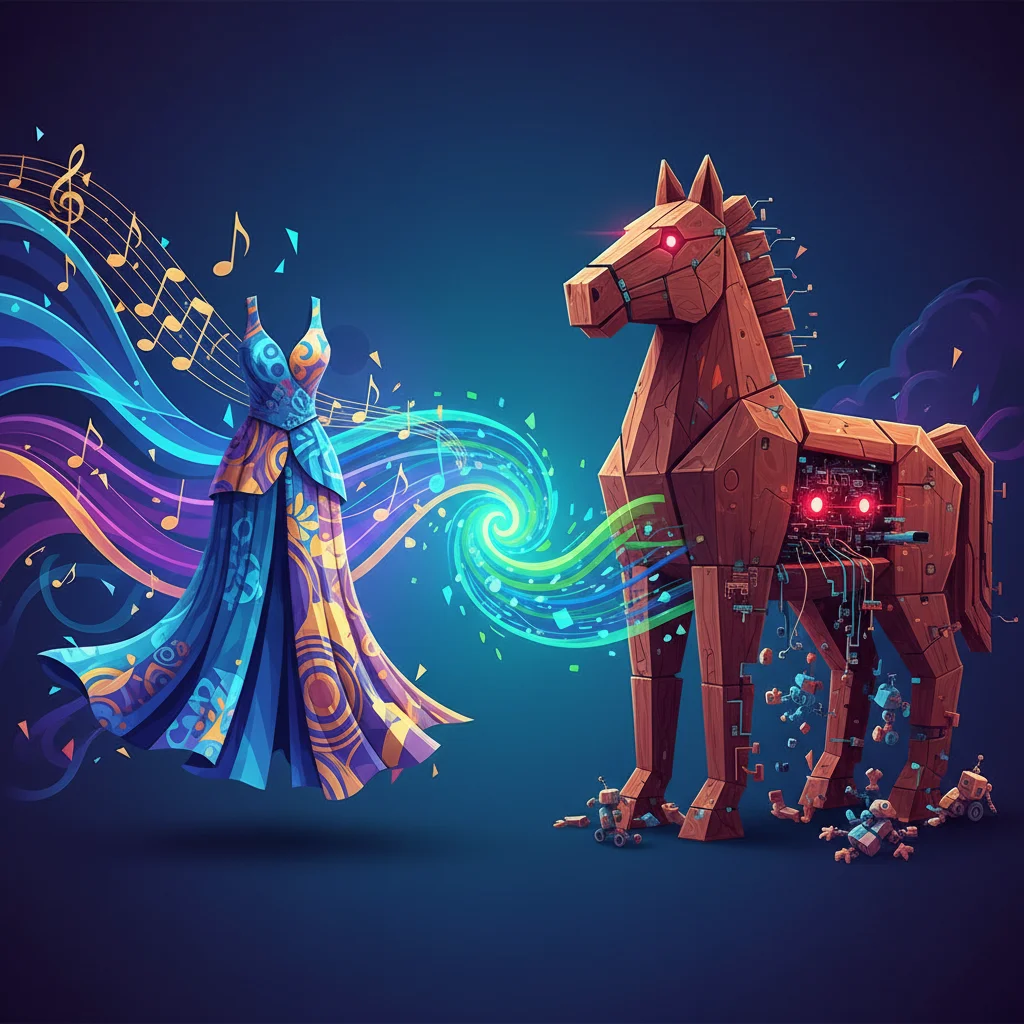
The Trojan Horse: A Critical Warning on AI-Powered Toys
While AI in creative fields presents complex but exciting opportunities, its integration into children’s toys requires a much higher degree of scrutiny. The “smart toy” market is booming, with dolls that listen and respond, and educational robots that adapt to a child’s learning pace. On the surface, this sounds like a wonderful innovation. However, beneath the friendly plastic exterior lie significant dangers that every parent, regulator, and developer must take seriously.
The primary concern is a potent cocktail of data privacy and cybersecurity. These toys are, in essence, internet-connected surveillance devices placed directly in a child’s most private environment. They are equipped with microphones, sometimes cameras, and sophisticated software designed to collect data. As highlighted in a recent security briefing, a staggering number of connected toys have been found to have critical security flaws (source), making them vulnerable to hackers.
The risks are chilling:
- Data Exploitation: Conversations between a child and their toy can be recorded, sent to remote cloud servers, and analyzed. This sensitive data could be used for targeted advertising or, in a breach, fall into the wrong hands.
- Hacking and Eavesdropping: A poorly secured toy could be hijacked, allowing a malicious actor to listen in on a child’s room or even communicate directly with the child through the toy’s speaker.
- Developmental Concerns: While proponents claim these toys are educational, critics worry they may hinder social and emotional development. A child learning to converse with a scripted algorithm is not the same as learning the nuances of human interaction.
The responsibility falls on everyone. Developers and startups in this space have an ethical obligation to prioritize security-by-design, employing robust encryption and transparent data policies. Parents need to be educated about the risks and demand higher standards. And regulators must step in to create and enforce strict cybersecurity and privacy laws for products marketed to children.
The AI Cold War: How China is Quietly Winning the Open-Source Revolution
Navigating the New AI-Powered World
The journey from the recording studio to the playroom reveals the profound duality of artificial intelligence. It is one of the most powerful tools humanity has ever created, with the potential to unlock new frontiers of creativity, efficiency, and personalization. In the hands of artists and designers, it is a muse, a collaborator that can elevate human talent to new heights.
However, when deployed without sufficient forethought and ethical guardrails—especially around our most vulnerable—it can become a vector for risk. The contrast between AI as a creative partner and AI as a potential threat in a child’s toy serves as a powerful reminder: the technology itself is neutral. Its impact, for good or for ill, is determined entirely by the choices we make in how we design, deploy, and regulate it. As we continue to build this AI-powered future, our focus must be not just on what we can do, but on what we should do.

Related Posts

Snap’s Strategic Surrender: Why Settling the Addiction Lawsuit is a Canary in the Coal Mine for Big Tech
The Takedown of a Shadow Banker: How Investigative Journalism Unmasked a Global Financial Scam Network