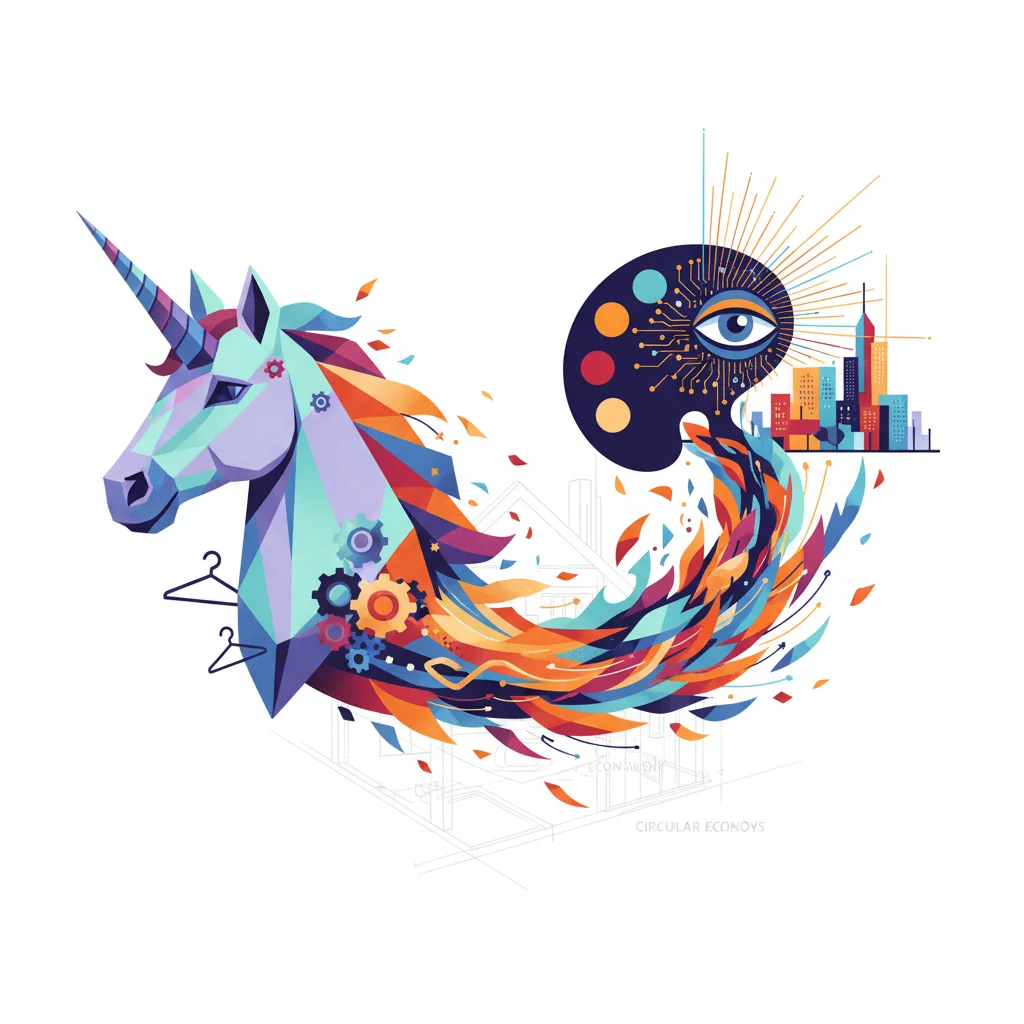
From Vinted Unicorn to Art World Visionary: The Founder’s Next Disruptive Play
The Architect of the Circular Economy Sets His Sights on a New Canvas
In the world of technology and finance, a “unicorn” is a privately held startup company valued at over $1 billion. Creating one is the dream of countless entrepreneurs. But what happens after you’ve not only built a unicorn but fundamentally reshaped an entire industry? For Justas Janauskas, the co-founder of the second-hand fashion behemoth Vinted, the answer isn’t to rest on his laurels. Instead, he’s applying the same disruptive, system-building mindset that powered Vinted to a new, far more opaque world: the art market.
Vinted, the Lithuanian-born marketplace, did more than just create a platform for selling used clothes. It engineered a micro-economy, a seamless peer-to-peer ecosystem that empowered millions. With a user base now exceeding 80 million members and a valuation that has soared past €3.5 billion, Vinted stands as a titan of the circular economy and a masterclass in platform strategy. Now, Janauskas is leveraging his success and expertise to launch a new art foundation aimed at connecting curators in the Baltic states and the UK. This isn’t just a passion project; it’s a calculated move that holds profound lessons for investors, business leaders, and anyone interested in how financial technology principles can be used to unlock value in unexpected places.
Deconstructing the Vinted Machine: A Fintech and E-commerce Revolution
To understand where Janauskas is going, we must first appreciate what he built. Vinted’s success wasn’t accidental; it was a masterstroke of user-centric design and clever economic incentives. It effectively became a fintech platform disguised as a clothing app. By integrating seamless payment processing, buyer protection, and a low-fee structure, it removed the friction that plagued online marketplaces like eBay. This focus on financial technology infrastructure was the engine of its growth.
The platform’s model capitalized on the burgeoning “circular economy,” a concept that is gaining significant traction in modern economics as a sustainable alternative to the traditional linear “take-make-dispose” model. Vinted demonstrated that a secondary market could be as dynamic and efficient as the primary one, creating a new form of value for consumers and contributing to a more sustainable economic cycle. For investors, Vinted became a prime example of how technology could unlock dormant economic potential in consumer-to-consumer (C2C) markets, a segment previously difficult to scale.
The AI Chip Wars: Is Google Poised to Topple Nvidia's Trillion-Dollar Throne?
The New Frontier: Applying Platform Principles to the Art Market
At first glance, the leap from second-hand fashion to the contemporary art world seems vast. One is a high-volume, low-margin C2C marketplace; the other is an exclusive, high-value, relationship-driven industry. But look closer, and you’ll see the same underlying logic at play. Janauskas isn’t buying multi-million dollar paintings. He’s building a network. His new venture, the Justas Janauskas Foundation, is focused on fostering connections and collaborations between curators—the influential but often-overlooked tastemakers and gatekeepers of the art world.
Why curators? Because in the art market, information, access, and reputation are the ultimate currency. By empowering curators, Janauskas is intervening at a critical leverage point. He is creating a network effect that can amplify talent, foster cross-pollination of ideas, and bring emerging artists from the Baltics to the attention of a major global art hub like London. It’s the Vinted playbook adapted for high culture: build the community and the infrastructure, and the transactions (in this case, cultural and commercial) will follow.
This approach stands in stark contrast to how many view art investing. The traditional art market is notorious for its inefficiencies and opacity, making it a challenging asset class for those outside the inner circle. The foundation’s model seeks to democratize access, not by selling fractional shares of a Warhol, but by strengthening the professional networks that discover and validate the Warhols of tomorrow.
The Art Market: Ripe for a Tech-Driven Overhaul?
The economics of the art world have long been a source of fascination and frustration for those in finance. It operates on principles that often seem alien to the transparent, data-driven world of the stock market. The table below illustrates the contrast between the traditional art market and a potential future ecosystem influenced by the platform-thinking Janauskas champions.
| Characteristic | Traditional Art Market Model | Platform-Driven Art Ecosystem |
|---|---|---|
| Price Discovery | Opaque; set by a few galleries, auction houses, and private deals. | More transparent; influenced by broader network consensus and data. |
| Access & Entry | High barriers; relies on personal relationships and wealth. | Lowered barriers; talent and quality surfaced through curated networks. |
| Key Players | Mega-galleries, auction houses, ultra-high-net-worth collectors. | Artists, curators, smaller galleries, institutions, and a wider collector base. |
| Technology Use | Primarily for cataloging and online auctions; slow adoption. | Integral for network-building, provenance (e.g., blockchain), and discovery. |
| Value Creation | Concentrated among a few gatekeepers who control supply and demand. | Distributed across the network, fostering a healthier and more diverse economy. |
While Janauskas’s foundation isn’t a fintech company, it addresses the market’s core inefficiencies in a strategic way. By strengthening the curatorial layer, it improves the quality of information and trust within the system. This is a necessary precursor to any future technological disruption, whether it involves AI-driven art discovery, blockchain-based provenance tracking, or new models for art investing and trading.
The End of an Era or a New Financial Strategy? Why a Top Art Gallery is Closing its New York Doors
Lessons in Value Creation for the Modern Investor
Janauskas’s journey offers several powerful takeaways for today’s business leaders and investors. The most critical is the enduring power of the platform model. Whether the product is a €10 t-shirt or a priceless piece of conceptual art, the principles of reducing friction, building community, and creating network effects are universally applicable.
Secondly, it highlights a broader trend in how wealth is being deployed. The most forward-thinking entrepreneurs are moving beyond simple checkbook philanthropy and are engaging in “impact investing” that aims to fix systemic problems. Janauskas identified a bottleneck in the art world—the isolation of regional talent from global conversations—and is investing directly in the solution. This is a far more leveraged use of capital than simply acquiring a large art collection. According to the FT article, the foundation has already “backed 15 curators to make research trips,” a tangible investment in the human capital of the industry (source).
Finally, it serves as a reminder that the skills honed in the fast-paced world of financial technology are transferable. The ability to analyze complex systems, identify inefficiencies, and design elegant, scalable solutions is invaluable. By applying this lens to the art world, Janauskas is not just becoming a patron; he is positioning himself as an architect of its future, potentially influencing the flow of capital, talent, and ideas for years to come.
Europe's Drone Wall: A Multi-Billion Euro Bet on Co-ordination Over Code
Conclusion: The Enduring Power of a Disruptive Mindset
Justas Janauskas’s story is a compelling narrative of entrepreneurial evolution. He mastered the new economy by building Vinted, a platform that transformed a niche activity into a global phenomenon. Now, he is turning his attention to one of the oldest and most traditional markets, not with an aim to dominate it, but to enrich and connect it. His focus on building networks rather than collections is a quiet but radical act.
For those in finance, banking, and the wider investment community, this is more than an interesting side project. It’s a case study in long-term value creation and a testament to the idea that the most profound disruptions often come from applying a proven model to an entirely new domain. Just as Vinted changed how a generation thinks about their closets, Janauskas’s new endeavor may subtly but surely change the map of the art world itself, proving that the most valuable asset a founder possesses is not their capital, but their vision for building a better system.

Related Posts
The Politicization of the Portfolio: How State Interference Puts US Companies and Investors at Risk
Beyond the IPO: Why a Fintech’s True Worth is Forged in Emerging Markets