The AI Revolution’s Human-Sized Hole: Why Your Best Bot is Still a Person
The Unspoken Truth About AI in Customer Service
Let’s be honest. The narrative we’ve been sold about artificial intelligence is one of relentless, inevitable replacement. We picture vast, server-cooled rooms humming with algorithms, efficiently handling every customer query, booking, and complaint, while the sprawling call centers of yesterday fade into memory. Tech headlines are filled with stories like Klarna’s, whose AI assistant now reportedly handles the workload of 700 full-time agents. The promise is intoxicating for any entrepreneur or CEO: slash operational costs, offer 24/7 support, and achieve unprecedented scale.
This is the age of automation, powered by sophisticated machine learning models running on the cloud. And for simple, repetitive tasks, this vision is becoming a reality. Resetting a password? Tracking a package? An AI can handle that flawlessly.
But a fascinating and crucial counter-narrative is emerging from the front lines of business, a reality check on the hype. As companies rush to implement AI, they’re hitting a wall—a profoundly human one. The truth is, when the stakes are high, when a problem is complex, or when a customer is genuinely distressed, a chatbot’s pre-programmed empathy falls flat. And business leaders are taking note. A recent PwC survey revealed that while 58% of UK chief executives expect AI to improve their products, a striking 45% do not anticipate it reducing their headcount in the next year. This isn’t a rejection of technology; it’s a recognition of its limits.
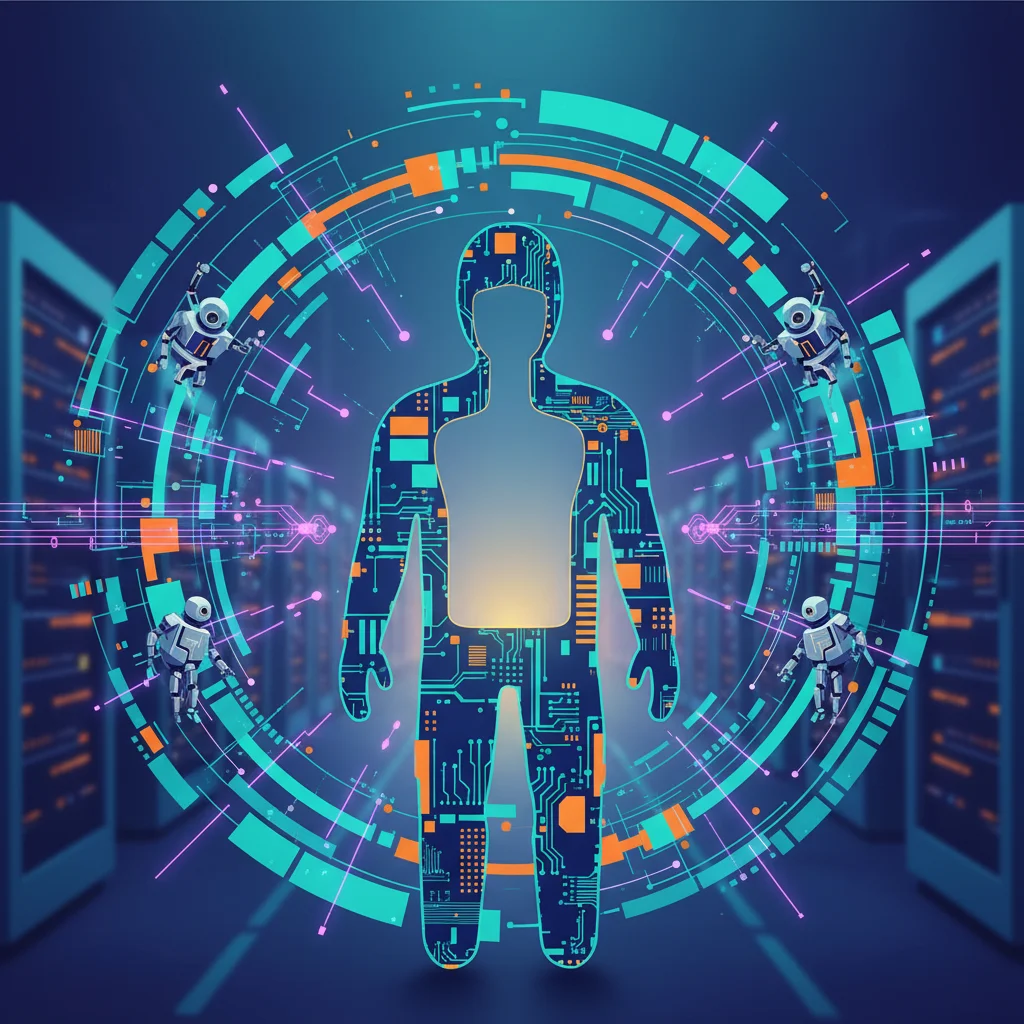
The real innovation isn’t about replacing humans. It’s about augmenting them. The future of customer service isn’t a binary choice between human and machine; it’s a powerful hybrid where each plays to its strengths.
When “I Don’t Understand” Becomes a Business Crisis
Every one of us has been there. Stuck in a chatbot loop, furiously typing “speak to a human” or “real agent,” only to be met with another canned response. This frustrating experience isn’t just a minor annoyance; it’s a direct threat to a company’s bottom line. Customer loyalty is fragile, and a single negative support experience can sever a relationship forever.
The core issue lies in the fundamental nature of current AI. While generative AI is a marvel of pattern recognition and language prediction, it lacks genuine understanding, consciousness, or the ability to reason from first principles. It can’t handle what it hasn’t seen before. Here’s where AI-powered customer service often breaks down:
- Complex, Multi-Layered Problems: An AI can handle “Where is my order?” but struggles with “My order arrived with a missing part, the box was damaged, and I need a replacement sent to a different address because I’m moving next week.” This requires context, nuance, and creative problem-solving.
- Emotional Nuance and Empathy: A customer dealing with a sensitive issue—like a fraudulent charge on their account or a problem with a medical device—needs more than just information. They need reassurance, empathy, and a sense of being heard. AI, for all its linguistic prowess, cannot genuinely connect on this level.
- Edge Cases and “Black Swan” Events: Business is messy. Unexpected issues crop up that fall outside the standard training data for a machine learning model. A human can improvise; an AI can only say, “I’m sorry, I can’t help with that.”
The risk for startups and established companies alike is immense. Over-automating can create an impersonal, frustrating brand experience that drives customers to competitors who still value the human touch. The cost savings from automation can be quickly erased by the cost of customer churn.
Beyond the Hype: How AI Is Quietly Reshaping the UK Job Market
The Augmented Agent: The Best of Both Worlds
The most forward-thinking companies are pioneering a new model: the “augmented agent” or “human-in-the-loop” system. This approach redefines the role of both AI and human agents, creating a symbiotic relationship that dramatically outperforms either one in isolation.
Imagine this workflow:
- A customer initiates a chat. The AI bot instantly engages, authenticates the user, and gathers basic information about the issue.
- For simple, tier-1 queries (“What’s your return policy?”), the AI provides an immediate, accurate answer, resolving the ticket instantly.
- If the query is complex or the customer shows signs of frustration (detected through sentiment analysis), the AI doesn’t create a roadblock. Instead, it intelligently routes the conversation to the best-suited human agent.
- Crucially, the AI passes along a complete, summarized transcript of the interaction, customer history, and relevant data. The human agent doesn’t have to ask, “Can you explain your problem again?” They jump in with full context, ready to solve the complex issue.
This hybrid model is a game-changer. The AI handles the high-volume, low-complexity grind, freeing up human experts to focus on what they do best: building relationships, solving tough problems, and turning frustrated customers into loyal advocates. This not only boosts customer satisfaction but also improves job satisfaction for support agents, who can focus on more meaningful and challenging work.
Let’s compare the three primary models of customer service:
| Model | Strengths | Weaknesses | Best For |
|---|---|---|---|
| Fully Human | High empathy, complex problem-solving, brand building. | High cost, not 24/7, slower for simple queries. | High-value, B2B, or luxury brands. |
| Fully AI / Automated | Low cost, 24/7 availability, instant responses, scalable. | Lacks empathy, fails on complex issues, high customer frustration risk. | Simple, high-volume transactional queries (e.g., order status). |
| Hybrid / Augmented | Best of both worlds: efficient and scalable, yet empathetic and effective. | Requires careful integration, robust software, and training. | Nearly all modern businesses seeking both efficiency and quality. |
Building the Tech Stack for a Hybrid Future
For developers, entrepreneurs, and tech professionals, this hybrid model represents a massive opportunity. Creating a seamless augmented experience requires a sophisticated tech stack that goes beyond a simple chatbot plugin. The architecture involves careful programming and integration of several key components:
- Intelligent Routing Systems: These systems use machine learning to analyze incoming queries and route them to the right place—either an automated workflow or the most qualified human agent.
- Unified Agent Desktops: Human agents need a single pane of glass where they can see the AI’s interaction summary, customer data from a CRM, and communication tools, all powered by a robust cloud infrastructure.
- Secure Data Handling: As AI systems access and process sensitive customer information, robust cybersecurity protocols are non-negotiable to prevent data breaches and maintain trust.
- SaaS Integration: The entire system relies on APIs to connect various SaaS platforms—from the AI provider to the CRM, to billing systems, and beyond. Seamless integration is key to providing agents with the full context they need.
This is where the next wave of innovation is happening. Companies are moving beyond generic chatbots to build or buy platforms that deeply integrate AI into the human workflow, creating a powerful, collaborative intelligence.
Code of Conduct or Code of Law? Ofcom's Plan to Tackle Online Sexism and What It Means for Tech
Why Your Best Human Agent is Your Best Marketing Asset
In an economy increasingly dominated by algorithms, a genuinely positive, empathetic, and effective human interaction is becoming a powerful competitive differentiator. It’s a memorable experience that builds brand loyalty in a way no bot ever can.
As Paul-Loup Chatin, a partner at PwC, noted, “The real value of generative AI is not to replace humans but to assist them… it can also improve the quality of the service provided by the human when they take over.” (source). This assistance transforms a good agent into a great one, armed with instant access to information and freed from mundane tasks.
Ultimately, the decision of how much to automate is a strategic one. While the temptation to cut costs is strong, the long-term cost of a degraded customer experience can be catastrophic. The companies that will win the future are not the ones who are the most automated, but the ones who are the most intelligently human.
The Trillion-Dollar Handshakes: How Samsung is Building the Grand Alliance of AI
Conclusion: The Human-AI Partnership
The initial frenzy to replace human roles with artificial intelligence is maturing into a more sophisticated understanding of where technology truly adds value. In customer service, the answer is clear: AI is an incredibly powerful tool for assistance and automation, but it is not a replacement for human connection, ingenuity, and empathy. The future doesn’t belong to the machines or the humans alone; it belongs to the hybrid teams that harness the strengths of both. By investing in an augmented model, businesses can achieve the holy grail: a service that is not only more efficient and scalable but also more deeply and satisfyingly human.