The Triple Threat Shaping Global Markets: UK Politics, EU Strategy, and the AI IPO Boom
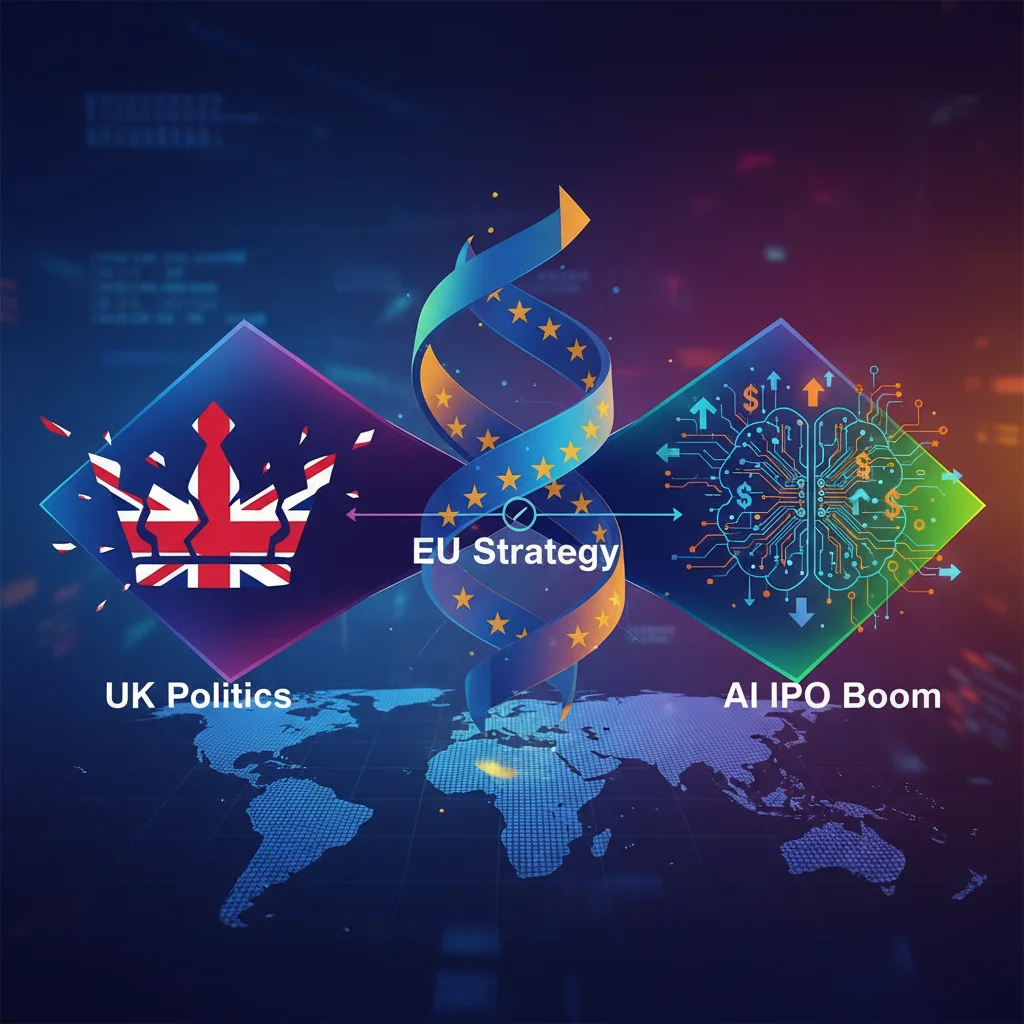
In today’s interconnected global economy, the ripples from one sector can trigger tidal waves in another. Seemingly disparate events—a political maneuver in the UK, an industrial policy shift in Brussels, and a strategic legal hire in Silicon Valley—are not isolated incidents. They are intertwined threads in a complex tapestry that investors, business leaders, and financial professionals must understand to navigate the future. This week, three such developments have emerged, each carrying profound implications for the stock market, investment strategies, and the very structure of our economic future.
We’ll delve into the political chess match in the United Kingdom, where Reform UK’s Nigel Farage is reportedly positioning for a post-election deal that could reshape the country’s economic trajectory. We’ll then cross the channel to analyze Europe’s ambitious ‘Made in Europe’ strategy, a bold attempt to reclaim industrial sovereignty that will create new winners and losers across the continent. Finally, we’ll turn to the heart of the tech revolution, where AI powerhouse Anthropic is taking concrete steps toward a blockbuster IPO, signaling a new phase in the artificial intelligence gold rush. Understanding these three stories is key to understanding where capital, policy, and technology are headed next.
The Farage Gambit: Political Risk and the UK Economic Outlook
The United Kingdom’s political scene is once again a focal point for market watchers, with renewed speculation surrounding the role of Nigel Farage and his Reform UK party. According to recent reports, key donors to Reform UK believe that Farage is anticipating a post-election deal with a potentially weakened Conservative Party (source). While the exact nature of such an arrangement remains hypothetical, the mere possibility introduces a significant variable into the UK’s economic and financial stability.
For investors, political uncertainty is a well-known antagonist. A potential pact or influence from Reform UK on a Conservative government could steer UK policy sharply to the right, with profound implications for the economy. Reform’s platform often includes calls for aggressive tax cuts, deregulation, and a harder line on immigration and net-zero policies. While proponents argue this could stimulate growth, critics warn of a “Truss 2.0” scenario, referencing the brief but chaotic premiership of Liz Truss, whose unfunded tax cuts sent the UK bond markets into a tailspin and required emergency intervention from the Bank of England.
The impact on the stock market, particularly the FTSE 250 which is more domestically focused, could be significant. Sectors sensitive to consumer spending and government policy, such as retail, construction, and renewable energy, would face a period of heightened volatility. International investors, who are crucial to the UK’s finance and banking sectors, would be forced to re-evaluate the country’s risk profile. A government perceived as fiscally adventurous could lead to a weaker pound, higher borrowing costs, and a more cautious approach to foreign direct investment. This is a classic case study in how political maneuvering directly impacts trading environments and long-term investing theses.
The Great Contraction: Is China's Investment Freeze a Crisis or a Calculated Gambit?
‘Made in Europe’: The EU’s High-Stakes Industrial Realignment
Across the English Channel, another strategic shift is underway, this one driven not by electoral politics but by long-term economic security. The European Union is doubling down on its ‘Made in Europe’ initiative, a comprehensive industrial strategy designed to bolster the continent’s manufacturing base and reduce its reliance on foreign powers, particularly China and the United States (source). This is Europe’s answer to the US Inflation Reduction Act (IRA) and China’s state-subsidized industrial might.
The strategy targets key sectors deemed critical for future growth and sovereignty: green technology (batteries, wind turbines, solar panels), semiconductors, pharmaceuticals, and digital infrastructure. The goal is to re-shore production, secure supply chains, and foster innovation within the EU bloc. This represents a monumental shift in economics, moving away from pure free-trade principles toward a more managed, protectionist-leaning model of capitalism.
For financial professionals and business leaders, this opens up a new landscape of opportunities and risks. Billions of euros in subsidies, grants, and tax incentives will flow into targeted industries, creating a powerful tailwind for companies aligned with the EU’s vision. This is a major theme for thematic investing, focusing on European green tech and semiconductor ETFs, for example. The banking sector will play a pivotal role in financing this transition, with public-private partnerships becoming increasingly common. The rise of sophisticated supply chain management, potentially leveraging financial technology (fintech) and even blockchain for transparency, will be critical to its success.
To better understand the competitive landscape, it’s helpful to compare the core tenets of these major global industrial policies.
| Policy Initiative | Primary Focus | Key Mechanisms | Target Industries |
|---|---|---|---|
| EU ‘Made in Europe’ | Strategic Autonomy & Green Transition | Subsidies, streamlined permitting, Net-Zero Industry Act, Critical Raw Materials Act | Green Tech, Semiconductors, Biotech, Raw Materials |
| US Inflation Reduction Act (IRA) | Climate Change & Domestic Manufacturing | Tax credits, consumer rebates, government loans | Electric Vehicles, Renewable Energy, Batteries |
| China’s State-Led Model | Technological Supremacy & Global Market Share | Direct state investment, subsidized loans, protected domestic market | AI, Telecom (5G), EVs, Advanced Manufacturing |
However, the strategy is not without its perils. Critics argue it could stifle competition, lead to inefficient allocation of capital, and provoke retaliatory trade measures from global partners. The success of ‘Made in Europe’ will depend on nimble execution and its ability to foster genuine innovation rather than simply propping up uncompetitive domestic industries.
The AI Chip Wars: Is Google Poised to Topple Nvidia's Trillion-Dollar Throne?
Anthropic’s IPO Signal: The AI Gold Rush Prepares for Public Scrutiny
While Europe focuses on hardware and industry, Silicon Valley is preparing for the next major event in the software revolution. Anthropic, a leading artificial intelligence firm and a chief rival to OpenAI, has reportedly hired lawyers to prepare for an Initial Public Offering (IPO) (source). This move is a clear signal that one of the most valuable private companies at the forefront of generative AI is preparing to enter the public stock market.
An Anthropic IPO would be a landmark event for the tech and finance worlds. Backed by giants like Amazon and Google, the company could command a valuation in the tens of billions of dollars, making it one of the most significant tech listings in years. For investors, it represents a pure-play opportunity to invest in the foundational layer of the AI economy—the Large Language Models (LLMs) that are set to transform countless industries.
This development has several critical implications:
- Market Barometer: The performance of an Anthropic IPO will serve as a crucial barometer for investor appetite for high-growth, high-cost AI companies. Its success—or failure—will influence the IPO plans of other AI unicorns waiting in the wings.
- Scrutiny of Financials: Moving to the public markets will force Anthropic to open its books, providing the first detailed public look at the true costs and revenue potential of developing and running cutting-edge AI models. The immense computational expense is a known factor, but the path to sustainable profitability remains a key question for the entire sector.
- Innovation in Financial Technology: The IPO process itself is a massive undertaking for the banking and fintech ecosystem. It will test valuation models for a new class of asset and push the boundaries of how the market conducts due diligence on companies whose primary assets are algorithms and data.
The rise of companies like Anthropic is fundamentally reshaping the economy. Their technology is already being integrated into everything from customer service bots to drug discovery and complex financial modeling. As this technology matures, its impact on productivity, labor markets, and corporate strategy will be immense, creating both disruptive threats and unprecedented opportunities for savvy investors and businesses.
LNG Titans at War: Venture Global Accuses Shell of a "Campaign of Sabotage"
Conclusion: Navigating a New Economic Nexus
The political intrigue in the UK, the strategic industrial planning in the EU, and the impending AI IPO boom are more than just headlines; they are powerful currents shaping the global investment landscape. They underscore a world where political risk directly impacts market stability, where national economic strategy is creating targeted investment corridors, and where technological disruption is accelerating at a breathtaking pace. For anyone involved in finance, investing, or business leadership, success no longer lies in mastering a single domain. It requires a holistic understanding of how these powerful forces interact, creating a complex but opportunity-rich environment for those prepared to navigate it.