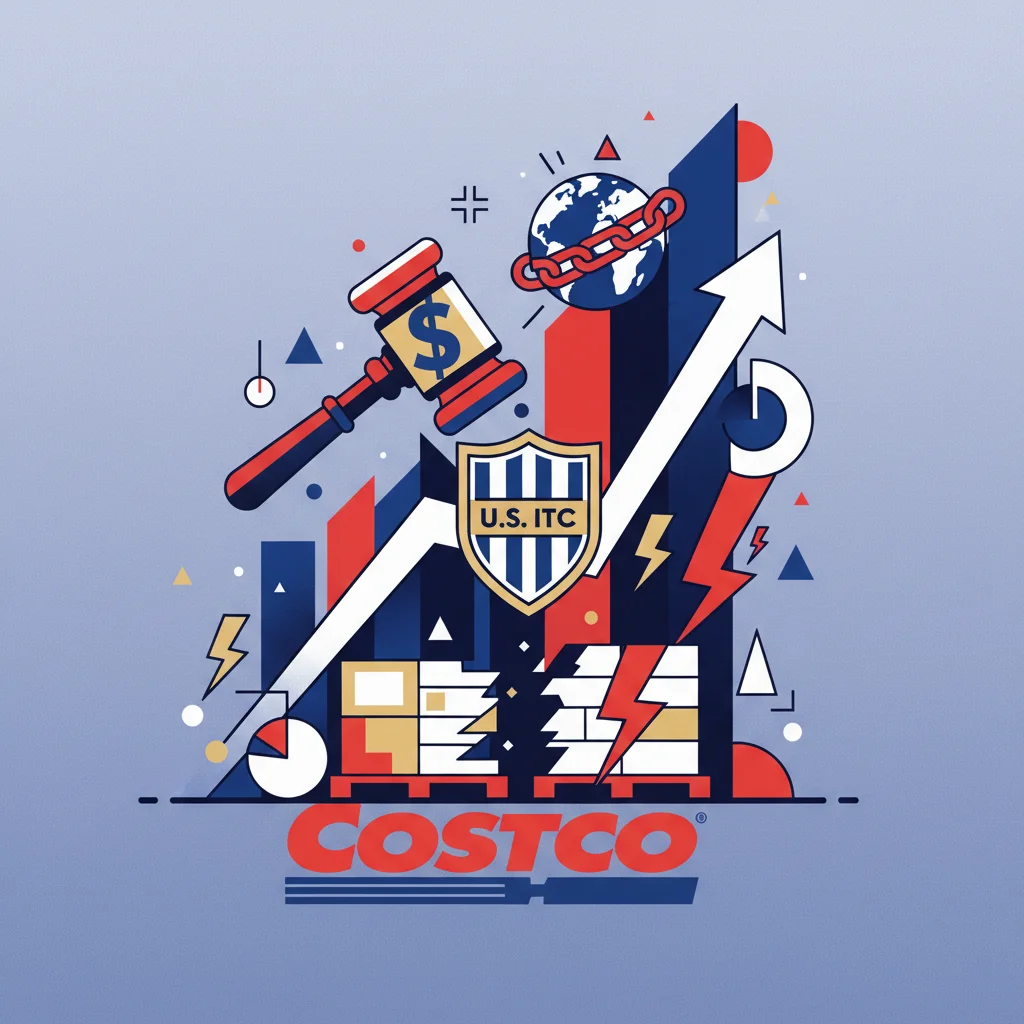
Costco’s Billion-Dollar Challenge: Inside the High-Stakes Legal Fight Over U.S. Tariffs
In the world of global commerce, few names carry the weight of Costco Wholesale. Known for its no-frills warehouses and bulk-sized bargains, the retail giant has built an empire on a foundation of ruthless efficiency and value. It’s a business model that scrutinizes every cent. So, when the company finds itself paying millions in what it deems unlawful taxes, it doesn’t just adjust its budget—it takes the U.S. government to court. This is the story of how a dispute over tariffs on goods like steel racks and aluminum foil escalated into a significant legal challenge, one that probes the very limits of presidential power and carries profound implications for the future of American trade, finance, and the broader economy.
At the heart of this conflict is a lawsuit filed by Costco against the U.S. government, seeking a “full refund” for tariffs imposed under the Trump administration. While the lawsuit might seem like a straightforward financial dispute, it’s a direct challenge to the controversial use of Section 232 of the Trade Expansion Act of 1962—a Cold War-era law that allows a president to impose tariffs on national security grounds. The core of Costco’s argument, echoed by hundreds of other American companies, is that the expansion of these tariffs was an overreach of executive authority. As two lower courts have already ruled against the administration’s use of these powers in related cases, Costco’s legal battle has become a focal point in a much larger debate about trade policy, economic stability, and the rule of law.
Understanding the Battlefield: What Are Section 232 Tariffs?
To grasp the significance of Costco’s lawsuit, one must first understand the policy at its center. Section 232 gives the President of the United States the authority to adjust imports if the Department of Commerce finds that certain products are being imported “in such quantities or under such circumstances as to threaten to impair the national security.”
Historically, this provision was used sparingly. However, in 2018, the Trump administration invoked Section 232 to impose a 25% tariff on steel and a 10% tariff on aluminum imports from most countries. The justification was that a robust domestic steel and aluminum industry was vital for national defense, including the production of tanks, ships, and aircraft. Later, these were expanded to cover “derivative” products—items made from steel and aluminum, like nails, wires, and certain car parts. It’s these derivative tariffs that directly impacted retailers like Costco, who import a vast array of finished goods.
Critics immediately questioned the “national security” rationale, especially since the tariffs applied to close allies like Canada, Mexico, and the European Union. The move sparked retaliatory tariffs, disrupted global supply chains, and ignited a firestorm of legal challenges from businesses arguing they were being unfairly penalized. For investors and finance professionals, this injected a massive dose of uncertainty into the stock market, making it difficult to forecast earnings for companies heavily reliant on global trade.
Tether's Golden Secret: How the Stablecoin Titan is Building a Bullion Empire
The Economic Fallout: Who Really Pays for Tariffs?
A common political talking point is that tariffs are paid by the exporting country. However, the overwhelming consensus among economists is that tariffs are a form of tax paid by domestic importers, who then face a difficult choice: absorb the cost and reduce profit margins, or pass the cost on to consumers through higher prices. For a low-margin, high-volume business like Costco, this dilemma is particularly acute.
Let’s break down the financial impact:
- Increased Costs of Goods Sold (COGS): The tariff is paid by Costco upon import, directly increasing the cost of inventory. This immediately squeezes gross profit margins.
- Inflationary Pressure: When these costs are passed on to consumers, it contributes to inflation, reducing the purchasing power of every dollar. For the wider economy, this can dampen consumer spending, a primary driver of GDP growth.
- Supply Chain Disruption: The sudden imposition of tariffs forces companies to scramble. They must evaluate whether to find new, non-tariffed suppliers (a costly and time-consuming process), renegotiate with existing partners, or re-shore production. This introduces significant operational risk and can cripple efficiency.
The financial technology sector has responded to this chaos with new tools. Sophisticated fintech platforms now help companies model the impact of various tariff scenarios, manage currency risk associated with shifting supply chains, and automate complex customs compliance processes. This is a clear example of how geopolitical events directly spur innovation in banking and financial technology.
To illustrate the timeline of these contentious trade actions, consider the key events that led to the current legal challenges:
| Date | Action Taken | Stated Justification | Impacted Products |
|---|---|---|---|
| March 2018 | President Trump signs proclamations imposing tariffs under Section 232. | Protecting national security by ensuring domestic production capacity. | Steel (25%) and Aluminum (10%) from most countries. |
| January 2020 | Tariffs are expanded to cover “derivative” products. | To prevent circumvention of the original tariffs through importation of downstream products. | Steel nails, wiring, certain automotive stampings; Aluminum wires and cables. |
| September 2020 | Costco and other major retailers file lawsuits at the U.S. Court of International Trade. | Argued the 2020 expansion was procedurally flawed and exceeded statutory deadlines. | Refund sought for tariffs paid on derivative products. |
| 2021-2023 | Lower courts issue rulings in similar cases, often siding with importers on procedural grounds. | Judicial review of the President’s adherence to the Trade Expansion Act’s rules. | Set legal precedent potentially strengthening Costco’s case. |
The Legal Labyrinth: A Question of Presidential Power
Costco’s legal argument doesn’t necessarily challenge the concept of national security itself. Instead, it focuses on the letter of the law. The lawsuits filed by Costco and more than 3,500 other companies, including major players like Home Depot and Tesla, primarily argue that the administration failed to follow the strict procedural deadlines laid out in the Trade Expansion Act. According to a report by the Congressional Research Service, the law sets specific timelines for the Commerce Department’s investigation and the President’s subsequent action. The plaintiffs contend that the expansion to derivative products in 2020 occurred long after these deadlines had expired, rendering the action illegal.
This is where the principle of the separation of powers comes into play. Congress grants the President authority on trade, but that authority is not unlimited. The courts are being asked to decide where the line is. The prior rulings in favor of importers from the U.S. Court of International Trade have provided a tailwind for Costco’s case. These decisions, such as in the case of PrimeSource Brands v. United States, have established that the government must adhere to the statutory process. As one trade lawyer noted, “You can’t just decide two years later to expand the scope because you don’t like the results.” A 2023 analysis by the Cato Institute highlights that these tariffs have cost American consumers and businesses over $90 billion since their inception, further fueling the argument that their economic harm outweighs any purported security benefit.
Beyond Blair: Decoding the New Labour Playbook for the UK Economy and Investors
Implications for Investors, the Economy, and the Future of Trade
The outcome of this legal saga will reverberate far beyond the courtroom and Costco’s balance sheet. It presents critical considerations for anyone involved in finance, investing, or business leadership.
For investors, the case serves as a stark reminder of the impact of political risk on portfolio performance. Companies with extensive global supply chains are particularly vulnerable. A ruling that limits presidential tariff authority could be a bullish signal for the retail and industrial sectors, potentially leading to lower costs, higher margins, and improved stock market performance. It would also make international trading patterns more predictable.
For the broader economy, the stakes are even higher. A victory for Costco and other importers could lead to the refund of billions of dollars in paid tariffs, injecting liquidity back into the business sector. More importantly, it could establish a powerful legal precedent that would constrain future administrations, regardless of political party, from using “national security” as a broad justification for protectionist trade policies. This could lead to a more stable and rules-based approach to international economics.
Finally, this case highlights the evolving nature of global trade itself. The tariff wars have accelerated trends in supply chain diversification and the adoption of financial technology. Companies are now investing heavily in systems that provide end-to-end visibility into their supply chains. Some futurists even propose that distributed ledger technologies like blockchain could one day offer an immutable, transparent record of a product’s journey, simplifying compliance and reducing fraud in an increasingly complex global trading environment.
As Costco’s case proceeds, it stands as a powerful case study in the intricate dance between corporate finance, law, and geopolitics. It’s a fight for a refund, but it’s also a fight for predictability in a volatile world. The final verdict will not only determine who was right about the tariffs but will also help define the rules of global commerce for years to come.

Related Posts

Market Relief: How a Diplomatic Handshake Averted a Transatlantic Trade War and Ignited a Stock Rally
Anatomy of a Rally: How a Diplomatic Handshake Averted a Trade War and Ignited the Stock Market