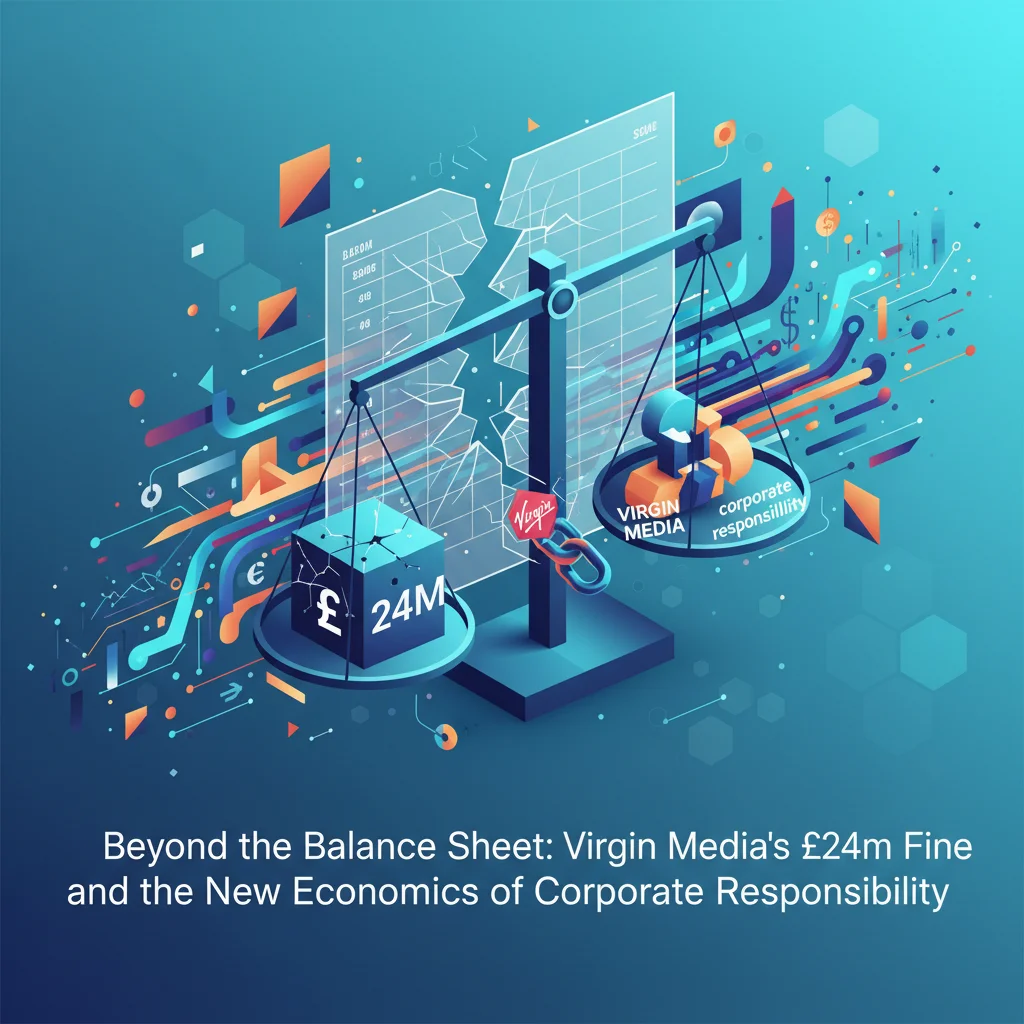
Beyond the Balance Sheet: Virgin Media’s £24m Fine and the New Economics of Corporate Responsibility
In the relentless world of modern finance, corporate headlines are often dominated by earnings reports, stock market fluctuations, and ambitious mergers. However, a recent event in the UK telecommunications sector has sent a powerful shockwave through boardrooms and investment circles, reminding us that the most significant risks—and costs—often lie far beyond the balance sheet. Ofcom, the UK’s communications regulator, has levied a staggering £24 million fine against Virgin Media. The charge? A systemic failure that left thousands of the UK’s most vulnerable citizens “at risk of harm.”
This penalty is not merely a line item on a quarterly report; it’s a landmark case study in the evolving landscape of corporate governance, investor expectations, and the tangible economic consequences of ethical lapses. For professionals in finance, investing, and business leadership, the Virgin Media case is a critical lesson in the new calculus of risk, where social responsibility is inextricably linked to financial stability.
The Anatomy of a Failure: What Exactly Happened?
At the heart of this issue is “telecare,” a service that is a lifeline for many elderly and disabled individuals. These systems use a customer’s phone line to send automated alerts to emergency services or monitoring centers if a user falls or requires urgent help. During a nationwide upgrade of its telephone network, Virgin Media was found to have woefully inadequate processes for identifying and protecting these customers. According to Ofcom’s investigation, the company failed to ensure that these life-or-death services would continue to function correctly after the switchover.
The regulator’s findings paint a picture of operational oversight that put thousands of people in a precarious position. This wasn’t a minor inconvenience; it was the potential severing of an emergency connection for those who depend on it most. The scale and severity of this oversight prompted one of the largest fines in the sector’s recent history.
To fully grasp the situation, it’s helpful to break down the key components of the regulatory action:
| Aspect of the Case | Details and Implications |
|---|---|
| Company Fined | Virgin Media |
| Regulating Body | Ofcom (The Office of Communications) |
| Fine Amount | £24 million (source) |
| Core Violation | Failure to protect vulnerable telecare customers during a network migration, leaving them at risk. |
| Underlying Cause | Lack of robust procedures to identify, manage, and support customers reliant on critical telecare services. |
| Broader Impact | Significant reputational damage, erosion of consumer trust, and a stark warning to the entire industry. |
This failure highlights a critical tension in the modern economy: the drive for technological advancement and efficiency cannot come at the expense of fundamental customer duty of care, especially when dealing with essential services.
Beyond the Rally: Why European Banks Are Sweetening the Deal for Investors
The Financial Ripple Effect: More Than Just a Fine
For a multi-billion-dollar corporation, a £24 million fine might seem like a manageable cost of doing business. However, this perspective is dangerously myopic. The true financial impact extends far beyond the initial penalty, touching upon investor confidence, brand value, and long-term market position.
Direct Impact on Corporate Finance
The immediate effect is a direct hit to the company’s bottom line. This isn’t just an operational expense; it’s a deadweight loss that reduces profits, impacts cash flow, and can affect the company’s ability to reinvest in growth or return value to shareholders. For those involved in trading the stock of Virgin Media’s parent company, Liberty Global (LBTYA), news of such a significant regulatory breach is a major red flag, potentially leading to short-term volatility and a reassessment of the company’s risk profile.
The Rise of ESG and Investor Scrutiny
Perhaps the most significant long-term consequence lies in the realm of Environmental, Social, and Governance (ESG) investing. Today’s sophisticated investors and large institutional funds increasingly use ESG criteria to evaluate the sustainability and ethical standing of their investments. The Virgin Media case is a textbook example of a failure in the “S” (Social) pillar of ESG.
This incident raises critical questions for investors:
- Does the company have adequate risk management frameworks in place?
- Is the corporate culture one that prioritizes profit over people?
- Is the board providing sufficient oversight on operational and ethical matters?
A poor ESG rating can lead to divestment by major funds, make it harder to attract capital, and ultimately depress the company’s valuation on the stock market. In an era where corporate reputation is a priceless asset, such a public failure can inflict damage that takes years and millions in marketing to repair.
The Regulatory Landscape and Its Economic Importance
Ofcom’s decisive action is part of a broader trend of muscular regulation across various sectors. From the Financial Conduct Authority (FCA) in UK banking to the SEC in the United States, regulators are demonstrating a lower tolerance for corporate negligence. This regulatory pressure is a fundamental component of a healthy market economy. It ensures a level playing field, protects consumers from harm, and forces companies to internalize the costs of their negative externalities—in this case, the risk imposed on vulnerable customers.
For business leaders, this means that compliance can no longer be viewed as a cost center. Instead, it must be seen as a strategic investment in sustainability and brand trust. The cost of non-compliance—as Virgin Media has discovered—is not just the fine itself but also the extensive resources required for remediation, internal reviews, and rebuilding a tarnished reputation. The principles of sound economics dictate that preventing a problem is almost always cheaper than fixing it after the fact.
The High-Stakes Chess Game: Decoding the Global Scramble for a Ukraine Peace Deal
Lessons for the C-Suite and the Modern Investor
The fallout from this incident offers invaluable lessons for both corporate leaders and the investment community.
For Business Leaders:
- Prioritize Risk Management: Large-scale transformation projects must have a comprehensive risk management plan that explicitly addresses the impact on all customer segments, particularly the most vulnerable.
- Embed Ethical Considerations: Corporate responsibility must be more than a slogan. It needs to be embedded in operational processes, employee training, and performance metrics.
- Invest in “RegTech”: The field of Regulatory Technology, an offshoot of financial technology, offers powerful tools to help companies monitor compliance and manage obligations in real-time. Investing in such systems can prevent costly human and procedural errors.
For Investors:
- Look Beyond the Numbers: Financial statements alone do not tell the whole story. Scrutinize a company’s regulatory history, customer satisfaction scores, and ESG reports.
- Price-In Regulatory Risk: In sectors with heavy oversight like telecoms and finance, regulatory risk is a significant and quantifiable factor. An investment thesis that ignores this is incomplete.
- Engage with Companies: Shareholder activism and engagement can be powerful forces for encouraging better corporate behavior. Questioning board members on their oversight of social and operational risks is a crucial part of modern due diligence.
The Path Forward: Can Technology Be Part of the Solution?
While a technological upgrade was the catalyst for this failure, advanced technology also holds the key to preventing future incidents. Imagine a system where a customer’s “vulnerable” status is cryptographically secured and flagged across all operational platforms. Advanced AI could model the potential impact of network changes on these specific users, alerting engineers before a single line is switched.
Looking further ahead, one could even theorize a role for distributed ledger technology. A private blockchain could, for instance, create an immutable, auditable record of a vulnerable customer’s service agreement and consent. Any proposed change to their service would require a verified entry on the ledger, creating a transparent trail for regulators and ensuring that agreed-upon protections are never accidentally overridden. While still conceptual for this use case, it points to a future where technology is used not just for efficiency, but for enforcing trust and compliance.
EU vs. China: A New Economic Iron Curtain? What Investors Need to Know
Ultimately, the Virgin Media fine is a watershed moment. It signals a clear shift in expectations from regulators and the public. In the 21st-century economy, a company’s value is no longer measured by its financial capital alone, but by its social and ethical capital as well. The £24 million penalty is a loud and clear message: neglecting the duty of care is a liability that no company can afford.