China’s Green Paradox: Decarbonization Dream or Coal-Fired Reality?
The Great Contradiction: Unpacking China’s Climate Strategy
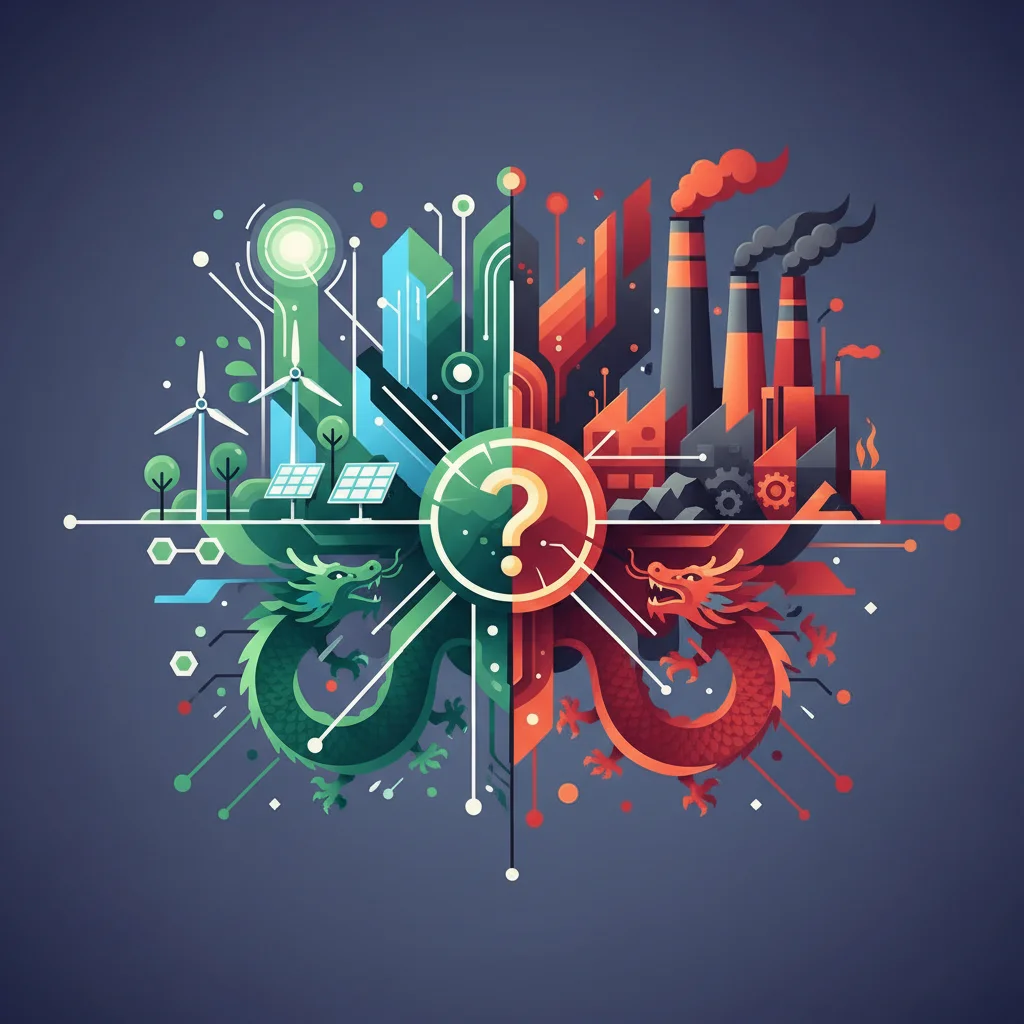
In the global discourse on climate change, China presents a fascinating and deeply complex paradox. On one hand, the nation is an undisputed titan of renewable energy, installing more solar and wind capacity than the rest of the world combined. On the other, it continues to build and operate a fleet of coal-fired power plants that dwarfs any other nation’s. This duality has led many, including Mihir Torsekar in a recent letter to the Financial Times, to question the sincerity of China’s decarbonization efforts, labeling them as mere “smoke and mirrors.”
But is it that simple? To dismiss China’s strategy as a mere illusion is to overlook the intricate web of economic priorities, geopolitical ambitions, and immense internal pressures that shape its energy policy. For investors, finance professionals, and business leaders, understanding this paradox is not just an academic exercise—it’s critical for navigating one of the most significant economic transformations of the 21st century. This analysis moves beyond the headlines to dissect the dual tracks of China’s energy strategy, exploring the powerful forces driving both its green revolution and its enduring reliance on coal.
The “Green” Side: A Renewable Energy Superpower in the Making
China’s achievements in the renewable sector are nothing short of staggering. The country has strategically positioned itself as the global leader in the production and deployment of green technology, a move driven by a desire for technological supremacy, energy independence, and dominance over future global supply chains. The sheer scale of this investment has fundamentally altered the global economics of clean energy.
Consider the numbers. In 2023 alone, China installed an astonishing 216.9 gigawatts (GW) of new solar capacity, more than the entire accumulated solar capacity of the United States. Its total renewable capacity now exceeds 1,450 GW, accounting for over half of the country’s total installed power capacity (source). This aggressive expansion extends to wind power, hydropower, and a commanding lead in the electric vehicle (EV) and battery storage markets. For the global stock market, this has created a new class of investment giants in sectors from solar panel manufacturing to lithium-ion battery production.
This green push is not solely about environmentalism; it is a core component of China’s industrial and economic strategy. By controlling the manufacturing and technology behind the green transition, Beijing aims to secure a critical role in the future global economy, reducing its reliance on foreign energy imports and exporting its technology worldwide. This has profound implications for international finance and trade, as nations become increasingly dependent on Chinese supply chains for their own green transitions.
The “Smoke”: An Unshakeable Addiction to Coal
Herein lies the contradiction. While China champions its green credentials on the world stage, it simultaneously green-lights new coal projects at a breathtaking pace. This isn’t a secret; it’s a stated policy designed to ensure energy security and power its colossal industrial base. While the West focuses on decommissioning coal plants, China is building them to act as a baseload power source that guarantees stability as the grid incorporates more intermittent renewables like solar and wind.
According to analysis from the Centre for Research on Energy and Clean Air (CREA), China permitted two new coal power plants per week in 2022 and began construction on 50 GW of new coal power in the first half of 2023 alone (source). This expansion is designed to prevent the kind of power shortages that have crippled its industrial provinces in recent years.
To put this dual-track approach into perspective, the following table illustrates the scale of both renewable and coal capacity additions, showcasing the parallel investments that define China’s energy landscape.
| Energy Source | Capacity Added in 2023 (GW) | Primary Strategic Driver |
|---|---|---|
| Solar Power | 216.9 GW | Technological Leadership, Export Economy |
| Wind Power | 75.9 GW | Energy Diversification, Manufacturing Scale |
| Coal Power (New Construction Started) | ~70 GW | Energy Security, Grid Stability |
This data highlights that China is not choosing between renewables and coal; it is choosing both. The overarching goal is to power its economy and maintain social stability at all costs. For the financial world, this means that investments tied to China’s economy are simultaneously exposed to both the upside of the green transition and the persistent risks of a carbon-intensive energy backbone.
Beyond the Grid: Why Solving the FT Crossword is Your Secret Weapon in Finance
Decoding the Master Plan: Energy Security Over Ideology
The core of China’s strategy can be summarized in one phrase: energy security. Unlike Western nations, which have largely post-industrial economies, China remains the workshop of the world. Its economic model depends on energy-intensive heavy industry and manufacturing. Any disruption to the power supply has immediate and severe consequences for its GDP and, by extension, social stability—the ultimate priority for the Chinese Communist Party.
Therefore, China’s approach is pragmatic rather than ideological. Renewables are pursued for their long-term economic and strategic benefits, while coal is retained for its short-term reliability. The government’s plan is not to simply shut down coal plants but to have them play a different role, shifting from providing baseload power to providing flexible backup power that can be ramped up when the sun isn’t shining or the wind isn’t blowing. This is a fundamental rewiring of the energy economy.
This strategy also involves a focus on reducing “carbon intensity” (emissions per unit of GDP) rather than absolute emissions in the near term. As the economy grows, and the share of renewables in the energy mix increases, the carbon intensity will fall, even if absolute emissions don’t peak until closer to the 2030 target. It’s a long-term game, and understanding this timeline is crucial for any long-term investing strategy.
Implications for Global Finance and Investing
For those in finance, banking, and investment, China’s paradoxical energy policy creates a landscape of both immense opportunity and significant risk.
The Opportunities:
- Green Technology Leadership: Chinese companies dominate the global supply chains for solar panels, wind turbines, and EV batteries. Investing in these market leaders remains a compelling, if volatile, proposition on the global stock market.
- Green Finance and Banking: China is building the world’s largest carbon trading market. While still nascent, it represents a massive future opportunity for financial innovation, trading, and the development of new financial products.
- Fintech and Blockchain Applications: There is a growing need for robust systems to track and verify carbon emissions and credits. Financial technology, including blockchain, could play a crucial role in bringing transparency to China’s complex energy and industrial systems.
The Risks:
- Policy Whiplash: Beijing’s policies can change rapidly. A sudden shift in subsidies, regulations, or strategic priorities could dramatically impact the profitability of investments in either the green or traditional energy sectors.
- Geopolitical Tensions: The West’s increasing desire to de-risk its supply chains and build its own green tech manufacturing base could lead to trade wars, tariffs, and a bifurcation of the global economy, impacting Chinese exports.
- The Carbon Bubble: The vast state-backed investment in coal assets represents a potential long-term financial risk. If global climate pressures or technological breakthroughs accelerate the transition away from coal, these assets could become stranded, leading to significant write-downs.
The £20 Billion Question: Can the UK Tame Its Nuclear Power Costs Before They Derail Its Economy?
Conclusion: Beyond Smoke and Mirrors
To label China’s decarbonization journey as simple “smoke and mirrors” is to apply a Western lens to a uniquely Chinese set of challenges and ambitions. The reality is far more nuanced. China is simultaneously running a sprint to dominate the technologies of the future while hedging its bets with the reliable energy sources of the past. It is a calculated, state-driven strategy where economic stability and energy security are the non-negotiable foundations upon which a greener future is being built.
For the global investor, analyst, or business leader, the key is to embrace this complexity. It requires moving beyond headline numbers and understanding the deep-seated economic and political drivers at play. China’s path will be paved with both green steel and black coal for years to come. Navigating this paradox—recognizing both the genuine green revolution and the persistent coal-fired reality—will be the defining challenge and opportunity in the global economy for the foreseeable future.