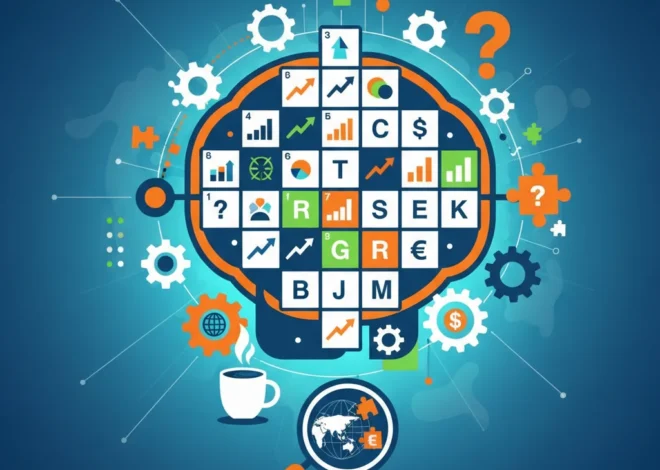
Beyond the Grid: What the FT Crossword Reveals About Mastering Modern Finance
The Unlikely Training Ground for Financial Acumen
What do a master investor navigating the volatile currents of the stock market and a cryptic crossword enthusiast staring down a grid of empty white squares have in common? On the surface, very little. One world is defined by high-stakes trading, complex economic models, and the relentless pursuit of alpha. The other is a quiet, intellectual pastime, a battle of wits between setter and solver. Yet, beneath the surface lies a profound connection. The cognitive agility, pattern recognition, and strategic patience required to conquer a notoriously difficult puzzle, such as the Financial Times Crossword, are the very same skills that underpin success in the multifaceted world of modern finance.
In an industry increasingly dominated by algorithms and quantitative analysis, it’s easy to overlook the human element—the subtle art of interpretation, the flash of insight that connects disparate data points, and the disciplined mindset that weathers market storms. These are not skills learned from a textbook or a terminal. They are honed through practice, and surprisingly, the humble crossword provides a formidable training ground. This exploration delves into the unexpected parallels between solving cryptic clues and making sound financial decisions, revealing how this classic puzzle can sharpen the minds of investors, traders, and business leaders alike.
Decoding the Clues: Pattern Recognition in Markets and Words
At its core, both successful investing and crossword solving are exercises in pattern recognition. A cryptic clue is a masterclass in misdirection, a puzzle wrapped in an enigma. It presents information in a fragmented, often misleading way, and the solver’s task is to see through the noise to find the underlying logic. Consider the process: you identify the definition, parse the wordplay, and test hypotheses until a coherent answer emerges that satisfies all constraints of the clue and the intersecting letters in the grid.
This is a direct analogue to technical analysis in the world of trading. An analyst looks at a stock chart not as a random series of price movements, but as a story told in patterns—head and shoulders, double tops, golden crosses. They are searching for signals amidst the noise of daily market fluctuations. Similarly, a fundamental investor sifts through earnings reports, management commentary, and macroeconomic data, looking for the underlying narrative of a company’s health and prospects. They are, in essence, solving for ‘x’—the intrinsic value—based on a collection of complex, interconnected clues about the broader economy.
The ability to recognize these patterns before they are obvious to the wider market is what separates the most successful participants from the rest. It requires a mind trained to look beyond the literal and to synthesize information from multiple, seemingly unrelated sources—a skill that every completed crossword grid reinforces.
The £20 Billion Question: Can the UK Tame Its Nuclear Power Costs Before They Derail Its Economy?
Lateral Thinking: The Engine of Fintech and Financial Innovation
Cryptic crosswords are infamous for demanding lateral thinking. The answer is rarely the most obvious interpretation of the words on the page. Solvers must think around corners, consider double meanings, and deconstruct language in unconventional ways. This “aha!” moment, when a convoluted clue suddenly snaps into focus, is the product of a flexible and creative mind.
This same cognitive leap is the driving force behind innovation in finance and financial technology. The pioneers of fintech didn’t just digitize existing banking processes; they fundamentally re-imagined them. They asked questions that required lateral leaps: What if a loan could be peer-to-peer? What if a payment system could bypass traditional banking infrastructure? The rise of blockchain technology is perhaps the ultimate example—a completely novel solution to the age-old problem of trust and verification in transactions, born from a radical rethinking of ledgers and databases.
An investor who only thinks in linear, conventional ways will likely only achieve average returns. The greatest opportunities often lie in contrarian bets or in identifying emerging sectors that defy traditional categorization. This requires the mental agility to challenge assumptions and envision possibilities that are not yet priced into the stock market. Engaging with puzzles that force the brain out of its conventional ruts is a powerful way to cultivate this innovative mindset.
Building a Coherent Grid: Portfolio Construction and Systemic Thinking
A crossword is more than a list of individual clues; it’s an interconnected system. The answer to 1-Across drastically affects the possibilities for 2-Down, 3-Down, and so on. A solver cannot work in a vacuum. They must constantly think about the entire grid, making sure each new entry fits logically with the existing structure. Sometimes, a confident answer must be abandoned because it renders an intersecting clue impossible to solve. This is systemic thinking in its purest form.
The parallel to portfolio management is striking. An investor doesn’t simply buy a collection of “good” stocks. They construct a portfolio where the pieces work together to achieve a specific goal, whether it’s growth, income, or capital preservation. They must consider correlation, risk exposure, and diversification. Adding a high-growth tech stock (a “confident answer”) might increase expected returns, but how does it impact the portfolio’s overall volatility? Does it complement or clash with existing holdings in the energy or consumer staples sectors? As the principles of Modern Portfolio Theory illustrate, the interaction between assets is often more important than the performance of any single asset (source).
This holistic perspective is essential for success in all areas of finance and economics. A central banker cannot set interest rates without considering the ripple effects on employment, inflation, and international trade. A CEO cannot make a major acquisition without analyzing its impact on company culture, supply chains, and the competitive landscape. The discipline of ensuring every piece fits within the larger puzzle is a critical, and often underestimated, executive function.
From Flowers to Fabs: Japan's High-Stakes Bet to Reclaim its Global Tech Crown
To better illustrate this synergy, consider the direct mapping of skills between these two domains:
| Cognitive Skill | Application in Crosswords | Application in Finance & Investing |
|---|---|---|
| Pattern Recognition | Identifying hidden structures and wordplay in cryptic clues. | Recognizing chart patterns, economic cycles, and emerging market trends. |
| Systemic Thinking | Understanding how each answer affects the entire grid. | Constructing a diversified portfolio and analyzing systemic risk. |
| Lexical Precision | Mastering vocabulary and the subtle nuances of language. | Understanding the precise language of contracts, regulations, and financial reports. |
| Disciplined Patience | Working through difficult clues without giving up; returning to them later. | Adhering to a long-term investment strategy and avoiding panic-selling. |
| Hypothesis Testing | Penciling in a potential answer and testing if it fits with other clues. | Modeling different economic scenarios or valuing a company under various assumptions. |
The Virtue of Patience: A Long-Term View in a Short-Term World
Finally, completing a challenging crossword, a feat that can sometimes take hours or even days, is a profound lesson in patience and persistence. Some clues resist immediate solution. The solver must be willing to put the puzzle aside and return to it with a fresh perspective. The satisfaction comes not from instant gratification, but from the diligent, methodical process of chipping away at a complex problem until it is solved.
This is perhaps the most important, and most difficult, lesson for anyone involved in the financial markets. The constant stream of real-time data, breaking news, and price alerts creates an environment that encourages impulsive, short-term action. Yet, a vast body of evidence shows that the most reliable path to wealth creation is long-term investing—a strategy that requires immense patience and the emotional fortitude to ignore market noise. The discipline cultivated by tackling a multi-day puzzle like the FT Crossword Number 18,227 directly counters the modern world’s demand for immediacy.
It teaches us to trust the process, to stick with a sound strategy even when progress seems slow, and to understand that the most rewarding solutions often take time to reveal themselves. Whether you’re waiting for a value stock to be recognized by the market or for the answer to 17-Down to finally click, the underlying principle is the same: persistence pays.
The Chancellor's Tightrope: Decoding the Upcoming Budget's Impact on UK Business and Finance
Conclusion: Sharpening Your Greatest Financial Asset
While a crossword will never replace rigorous financial analysis or a deep understanding of economics, its value as a cognitive enhancement tool should not be underestimated. It is a gymnasium for the mind, strengthening the very faculties that are critical for navigating the complexities of the modern financial landscape. From the pattern-matching of a day trader to the systemic thinking of a portfolio manager and the creative problem-solving of a fintech innovator, the parallels are as clear as they are compelling.
So, the next time you see someone engrossed in a crossword, don’t dismiss it as mere recreation. They may be sharpening their most valuable financial asset: their mind. In a world of increasing complexity, the ability to think clearly, creatively, and patiently is the ultimate competitive edge. And sometimes, the path to achieving it begins with nothing more than a pen, a grid, and the first clue.