The Toy Swap Economy: What a Local Event Reveals About the Future of Finance, Fintech, and Investing
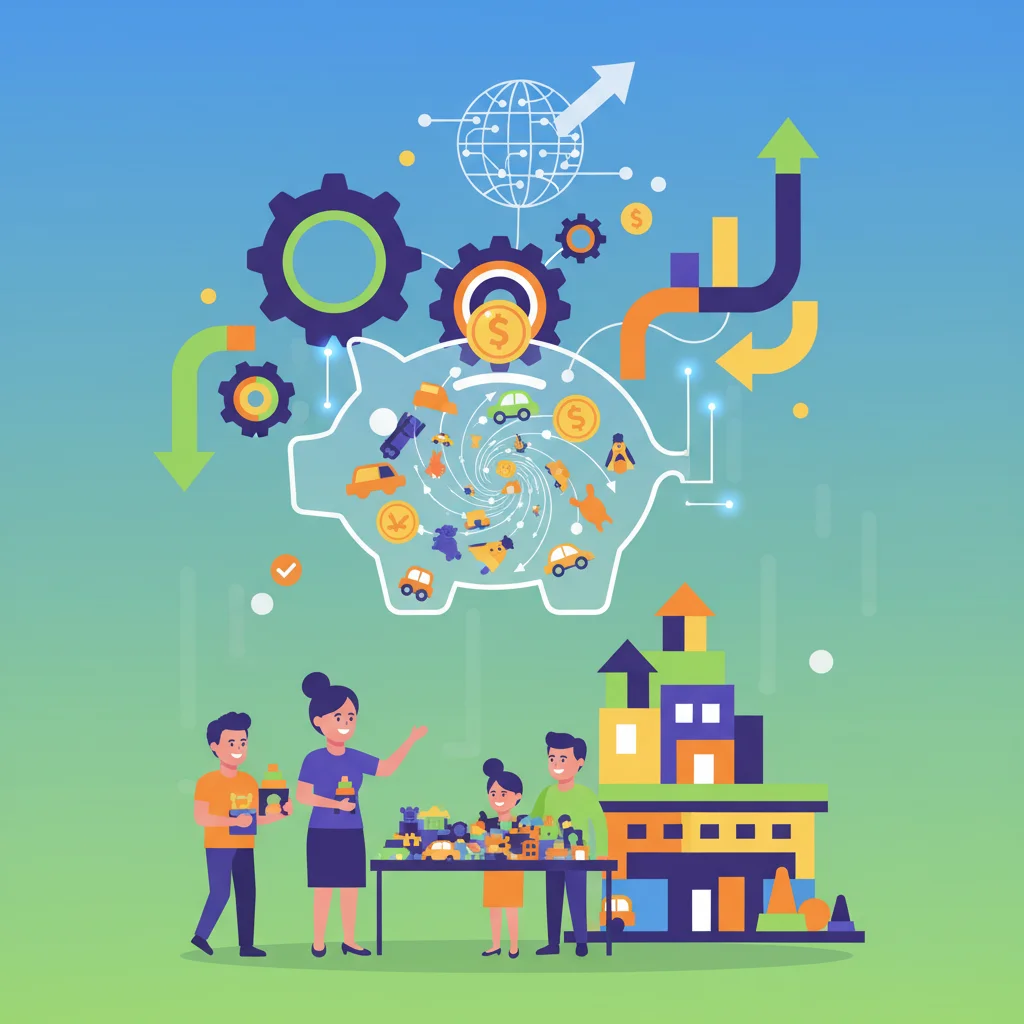
In a community center in Hesters Way, a small-scale event is quietly unfolding. Tzara Spurrier, a mother known online as GlosBudgetMum, is hosting a free toy swap to help local families manage the rising costs of Christmas. As reported by the BBC, this initiative is a direct, practical response to economic pressure. While it may seem like a simple act of community kindness, for astute observers in the world of finance and business, it represents something far more profound. This single event is a microcosm of powerful, converging trends that are reshaping our global economy, influencing investment strategies, and challenging the very foundations of traditional banking and commerce.
What can a humble toy swap teach a seasoned investor or a fintech innovator? The answer is: everything. It’s a real-world demonstration of the circular economy, a grassroots reaction to macroeconomic forces, and a precursor to the decentralized, peer-to-peer systems that are set to define the next era of financial technology. By examining this event through a financial lens, we can uncover critical insights into consumer behavior, sustainable business models, and the emerging technologies poised to capture immense value.
The Macroeconomic Pressure Cooker: Why Community Initiatives Matter
Ms. Spurrier’s toy swap did not emerge in a vacuum. It is a direct consequence of a challenging global economic environment. For months, households worldwide have been grappling with persistent inflation, stagnant wage growth, and rising interest rates. These are not abstract concepts discussed only in boardrooms or on trading floors; they are tangible pressures that dictate household budgets. In the UK, for example, the Consumer Prices Index including owner occupiers’ housing costs (CPIH) rose by 6.3% in the 12 months to October 2023, creating a significant cost-of-living crisis (source: ONS). This economic strain forces consumers to seek alternative ways to acquire goods and services, moving beyond traditional retail models.
This shift in consumer behavior has direct implications for the broader economy and the stock market. Companies reliant on high-volume, discretionary consumer spending may face headwinds as families prioritize essentials and seek value through second-hand markets, swaps, and rentals. The toy swap is a leading indicator of a more resourceful, resilient, and community-oriented consumer, one that the financial world must understand and adapt to. The principles of modern economics teach us that markets are driven by supply and demand, but also by ingenuity in the face of scarcity. This is that ingenuity in action.
Cracks in the Golden Empire: Is Mining Giant Barrick Gold on the Brink of a Break-Up?
The Circular Economy: From Niche Concept to Investment Megatrend
At its core, the toy swap is a perfect illustration of the circular economy. Unlike the traditional linear model of “take-make-dispose,” a circular model is designed to be restorative and regenerative. It emphasizes keeping products and materials in use for as long as possible, extracting the maximum value from them while in use, and then recovering and regenerating them at the end of their service life.
The business case for this model is becoming undeniable. A report by the Ellen MacArthur Foundation estimates that the circular economy represents a $4.5 trillion economic opportunity by 2030 by reducing waste, creating new jobs, and fostering innovation (source: Accenture). For investors, this signals a paradigm shift. Companies that build circularity into their business models are not just ethically appealing; they are increasingly financially robust, with more resilient supply chains and stronger brand loyalty.
The table below illustrates the fundamental differences between the linear and circular economic models, highlighting the opportunities inherent in the latter.
| Aspect | Linear Economy (“Take-Make-Dispose”) | Circular Economy (The “Toy Swap” Model) |
|---|---|---|
| Resource Model | Extraction of finite raw materials | Use of renewable, reused, and recycled inputs |
| Production Model | Produce new, sell more, encourage replacement | Design for durability, repair, and reuse |
| Value Proposition | Value is in ownership of a new product | Value is in access, performance, and longevity |
| End-of-Life | Product is discarded as waste (landfill) | Product is returned, refurbished, or remanufactured |
| Financial Implication | High material costs, supply chain vulnerability | Lower input costs, new revenue streams (e.g., servicing) |
The Digital Transformation: How Fintech and Blockchain Can Scale Community Action
While a local toy swap is powerful, its impact is limited by geography. This is where financial technology enters the picture. The principles of sharing, swapping, and peer-to-peer exchange are the very foundation of some of the most successful fintech platforms today. Companies like Vinted, Depop, and Olio have built multi-billion dollar businesses by creating digital marketplaces that do exactly what the toy swap does, but at a global scale.
This is just the beginning. The next evolution of the sharing economy could be powered by blockchain technology. Imagine a decentralized platform where physical goods, like toys, are assigned a unique digital token (a non-fungible token, or NFT). This token could record the item’s entire history: its original purchase, repairs, and every time it was swapped or sold. This creates a transparent, auditable record of an item’s lifecycle, building trust and value in the second-hand market.
Furthermore, such a system could facilitate more complex forms of trading. Instead of a direct one-for-one swap, participants could trade tokens representing fractional ownership or differing values, creating a truly fluid and efficient marketplace for physical assets. This isn’t science fiction; it’s the logical extension of applying decentralized finance (DeFi) principles to the physical world. This system removes the need for a central intermediary, reducing costs and empowering individuals—a digital reflection of the community-led ethos of the Hesters Way toy swap.
Beyond the Headlines: The Economic Shockwaves of West Bank Instability for Investors
Rethinking Investing and Banking for a New Economy
The rise of these trends has profound implications for the worlds of investing and banking.
For investors, the key takeaway is the need to look beyond traditional metrics. The growth of the circular economy and peer-to-peer platforms represents a massive, and still largely untapped, investment opportunity. This goes hand-in-hand with the explosion in ESG investing. Assets in sustainable funds hit $2.5 trillion in 2023, reflecting a massive shift in capital towards companies with strong environmental and social credentials (source: Morningstar). Initiatives like the toy swap are real-world data points proving that the ‘S’ (Social) and ‘E’ (Environmental) in ESG are not just ethical concerns but powerful drivers of economic activity.
The table below showcases the projected growth in dedicated ESG assets under management, underscoring the financial momentum behind this shift.
| Region | 2022 ESG AUM (USD Trillions) | 2026 Projected ESG AUM (USD Trillions) | Projected Growth Rate |
|---|---|---|---|
| Europe | $10.5 | $19.6 | 86.7% |
| United States | $8.4 | $10.5 | 25.0% |
| Asia-Pacific | $1.2 | $3.3 | 175.0% |
| Global Total | $20.1 | $33.9 | 68.6% |
For the banking sector, the challenge is to evolve. Traditional banking models are built around financing the linear economy: loans for new manufacturing, capital for retail expansion, and consumer credit for new purchases. The new economy requires new financial products: micro-loans for repair businesses, venture capital for circular-by-design startups, and payment platforms that facilitate seamless peer-to-peer transactions. Banks that fail to adapt risk becoming obsolete, while those that embrace this new economic model will finance the next generation of resilient, sustainable growth.
The 'True Faith' Principle: How One Catalyst Can Redefine a Company's Economic Trajectory
Conclusion: The View from the Community Hall
The story of the Hesters Way toy swap is more than just a heartwarming local news item. It is a powerful signal from the economic front lines. It demonstrates a consumer base that is adaptive, resourceful, and increasingly skeptical of the hyper-consumerist models of the past. It validates the immense potential of the circular economy and showcases the human-centric need that a new generation of fintech and even blockchain solutions are striving to meet.
For leaders in finance, investing, and business, the lesson is clear: the most significant economic indicators are not always found in quarterly earnings reports or central bank announcements. Sometimes, they are found in a community hall, where the simple exchange of a used toy signals a tectonic shift in how we produce, consume, and value the world around us. The future of the economy is being built not just from the top down, but from the ground up.