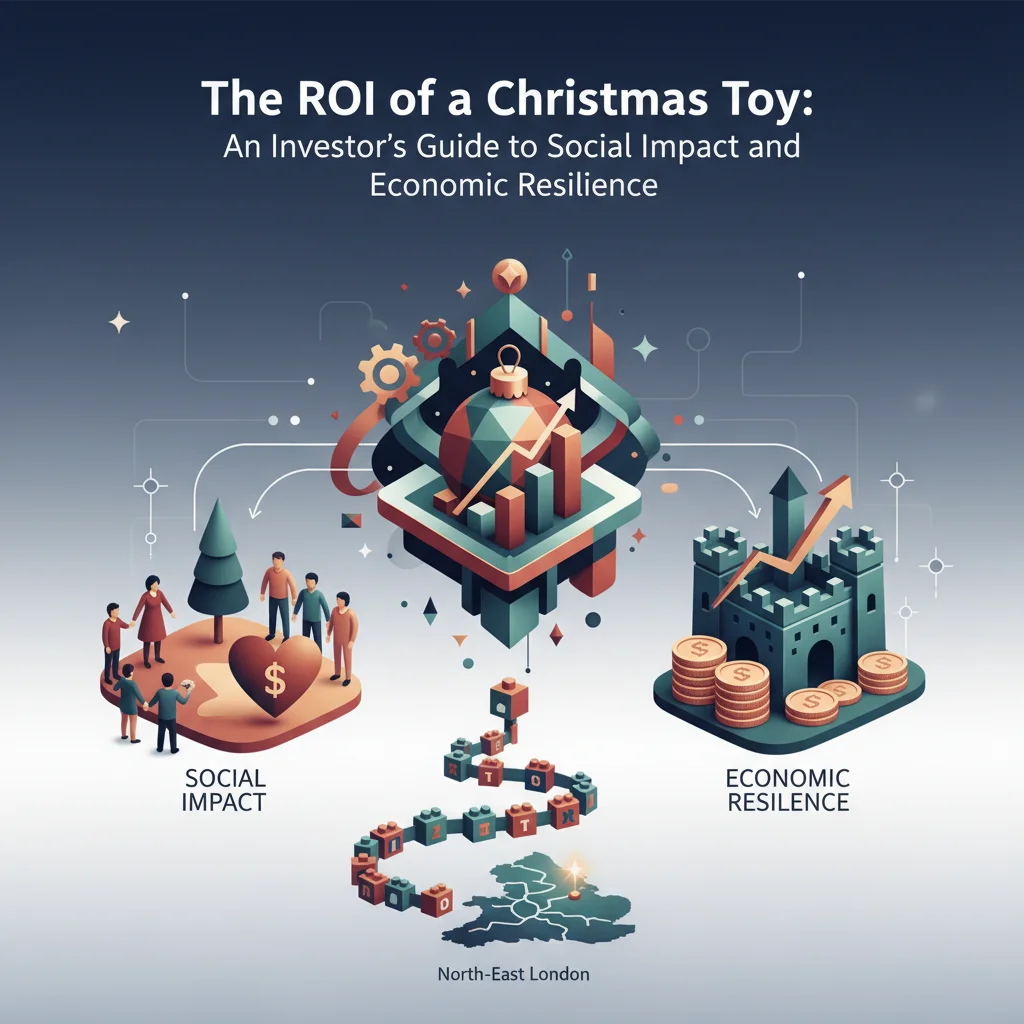
The ROI of a Christmas Toy: An Investor’s Guide to Social Impact and Economic Resilience
In a quiet corner of north-east London, a project is underway that, on its surface, seems far removed from the high-stakes world of finance and investing. A local toy appeal is urging donations to ensure that thousands of children receive a present this Christmas. According to the BBC report, the goal is simple and profoundly human: to bring joy to children during the festive season. For the business leader, the investor, or the finance professional, it’s easy to view such initiatives as purely philanthropic—a matter for the heart, not the portfolio.
This perspective, however, misses a crucial point. Initiatives like this are not merely charitable footnotes; they are sensitive barometers of our economic health and powerful case studies in the evolving landscape of corporate responsibility, financial technology, and sustainable investing. They represent the micro-level consequences of macro-economic trends and offer a glimpse into the future of value creation. The simple act of donating a toy is the starting point for a complex and compelling discussion about the intricate connections between community well-being, economic stability, and long-term financial strategy.
In this analysis, we will deconstruct the humble toy appeal, examining it through the lens of a financial analyst. We will explore the tangible economic ripple effects of localized giving, dissect its role in the modern ESG investment thesis, and investigate how cutting-edge financial technology is poised to revolutionize the entire philanthropic sector. This is not just a story about charity; it’s a story about the future of the economy and the changing definition of a sound investment.
The Macroeconomics of a Micro-Donation
At first glance, a charitable donation appears to be a simple, one-way transfer of value. In reality, it is the beginning of a powerful economic chain reaction. When a community’s most vulnerable members are supported, the benefits extend far beyond the immediate recipients. This concept, often discussed in development economics, has direct relevance to developed economies grappling with inequality.
A stable household is the bedrock of a stable economy. For a family struggling to make ends meet, the relief provided by a toy appeal can free up scarce resources for essentials like heating, food, or transportation. This isn’t just a social benefit; it’s an economic one. Money that would have been spent on a gift can now re-enter the local economy as a purchase at a local grocer or a payment to a utility company. This phenomenon, known as the “local multiplier effect,” suggests that money spent locally circulates within the community, generating additional business revenue and income. According to research from the Harvard Business School, investing in social programs can yield substantial long-term economic returns by improving health, education, and employment outcomes.
For investors and business leaders, these are not abstract concepts. The economic health of the communities where a company operates directly impacts its success. A community with high levels of poverty and instability is a community with a less resilient workforce, lower consumer spending power, and greater social friction. Therefore, corporate participation in initiatives like the north-east London toy appeal is not just philanthropy; it is a strategic investment in the operational environment. It helps build a more stable consumer base and a more reliable local talent pool, mitigating long-term business risks.
Cracks in the Golden Empire: Is Mining Giant Barrick Gold on the Brink of a Break-Up?
From PR Stunt to Portfolio Staple: The Rise of “S” in ESG
For decades, corporate charity was often relegated to the public relations department—a way to generate positive press releases. Today, the framework of Environmental, Social, and Governance (ESG) investing has fundamentally changed this dynamic. Investors are increasingly scrutinizing companies not just on their balance sheets, but on their societal impact. The “S” in ESG, representing social criteria, is perhaps the most complex to quantify, yet it is gaining significant traction.
Social factors encompass a wide range of issues, from a company’s labor practices and data privacy policies to its relationship with the community in which it operates. A toy drive is a perfect micro-example of the “S” in action. A company that encourages and facilitates employee participation in such an event is sending a powerful signal to the market about its corporate culture and values. This has several direct implications for the stock market and corporate valuation:
- Talent Acquisition and Retention: A strong sense of corporate purpose is a major driver for today’s workforce, particularly among millennials and Gen Z. Companies with robust and authentic CSR programs are better positioned to attract and retain top talent, reducing recruitment costs and improving productivity.
- Brand Loyalty and Customer Goodwill: Consumers are increasingly making purchasing decisions based on a company’s ethical stance. Supporting local communities builds a “goodwill asset” that can translate into stronger brand loyalty and pricing power.
- Risk Mitigation: Companies that are deeply integrated and respected within their communities are less likely to face regulatory hurdles, protests, or negative media campaigns. This social “license to operate” is an invaluable, though often intangible, asset.
Corporate involvement can take many forms, each with different levels of engagement and impact. Below is a comparison of common corporate giving models:
| Model of Corporate Giving | Description | Key Benefit for the Business |
|---|---|---|
| Direct Financial Donation | A straightforward monetary contribution to the non-profit organization. | Simple, efficient, and provides the charity with maximum flexibility. |
| Employee Gift Matching | The company matches donations made by its employees, often on a 1:1 or 2:1 basis. | Boosts employee engagement and morale while amplifying the overall impact. |
| In-Kind Donations | Donating goods or services (e.g., a toy company donating toys, a logistics firm handling delivery). | Leverages core business competencies and can be more cost-effective than cash. |
| Paid Volunteer Time | Allowing employees to use paid work hours to volunteer for the cause. | Demonstrates a deep commitment and fosters team-building and leadership skills. |
For the modern investor, analyzing a company’s approach to these activities is becoming a standard part of due diligence. It’s a proxy for management quality and long-term strategic thinking.
Fintech and Blockchain: The Future of Philanthropy
The challenges facing charitable organizations are immense. Logistics, transparency, and administrative overhead can consume a significant portion of donations, reducing the total impact. This is where financial technology is emerging as a game-changer, promising to bring the efficiency and transparency of modern trading platforms to the world of giving.
Imagine the north-east London toy appeal powered by next-generation fintech:
- Blockchain for Transparency: One of the biggest hurdles in charity is donor confidence. Where does the money actually go? Blockchain technology can provide a solution. A donation could be converted into a stablecoin on a private ledger. Every step of the process—from the initial donation to the charity’s purchase of a toy from a wholesaler to its final delivery to a family—could be recorded as a transaction on an immutable chain. Donors could, in theory, track their specific contribution in real-time, ensuring it reached its intended destination. This level of transparency, as detailed by institutions like the World Bank, could revolutionize donor trust and dramatically increase giving.
- AI-Powered Logistics and Allocation: How does the organization know which children need gifts the most? How do they manage inventory and distribution efficiently? Artificial intelligence and machine learning algorithms could analyze anonymized demographic and geographic data to identify areas of greatest need, optimize delivery routes, and ensure fair and equitable distribution, minimizing waste and maximizing impact.
- Micro-Donations and Embedded Banking: The future of fundraising isn’t just about large galas; it’s about seamless, frictionless micro-donations. Financial technology enables this through “round-up” features in banking apps, where users can automatically donate the spare change from their daily purchases. Trading platforms could integrate features allowing investors to donate a tiny fraction of their capital gains. This “embedded finance” approach makes giving an effortless and continuous part of everyday economic activity.
Beyond the Headlines: The Economic Shockwaves of West Bank Instability for Investors
These technological advancements are not science fiction; they are actively being developed and deployed. They represent a fundamental shift in the “banking” of philanthropy, moving it from an analog, often inefficient system to a digitized, transparent, and highly efficient one. For fintech investors, the non-profit sector represents a vast, underserved market ripe for technological disruption.
From Charity to Systemic Investment: A Call to Action
A toy appeal, while vital, is ultimately a treatment for a symptom, not a cure for the underlying disease. The need for such drives points to deeper systemic issues within our economy: wage stagnation, inflation, and a lack of economic mobility. While the financial industry cannot solve these problems alone, it has a critical and powerful role to play in fostering a more inclusive and resilient economy.
This is where the conversation evolves from charity to impact investing. Impact investments are made with the explicit intention of generating positive, measurable social and environmental impact alongside a financial return. Instead of simply donating to a toy drive, an impact investor might fund a social enterprise that provides job training and placement for low-income parents in north-east London. A venture capital fund might invest in an ed-tech startup that provides affordable tutoring to disadvantaged children, improving their long-term economic prospects.
This approach transforms the dynamic from a short-term handout to a long-term, sustainable investment in human capital. It aligns the powerful engine of the capital markets with the goal of solving society’s most pressing challenges. It requires a more sophisticated understanding of economics, where social progress and financial returns are not seen as mutually exclusive, but as mutually reinforcing.
Conclusion: The Compounding Return of a Single Toy
The journey from a single toy in north-east London has taken us through the intricacies of macroeconomics, ESG portfolio construction, the frontiers of financial technology, and the philosophy of impact investing. It demonstrates that in today’s interconnected world, there is no clear line between a social issue and a financial one.
The toy appeal is a poignant reminder that the health of our stock market is inextricably linked to the health of our main streets. For the astute investor, the innovative banker, and the forward-thinking business leader, the call to donate is also a call to analyze. It’s an invitation to recognize that investments in community stability, employee well-being, and social infrastructure are not costs to be minimized, but essential strategies for building durable, long-term value. The most profound returns are often found not in complex trading algorithms, but in the simple act of ensuring a child has a reason to be joyful—an investment that compounds across generations.

Related Posts
The Politicization of the Portfolio: How State Interference Puts US Companies and Investors at Risk

Bitcoin at a Crossroads: Is a Final Price Shakeout the Launchpad for New All-Time Highs?