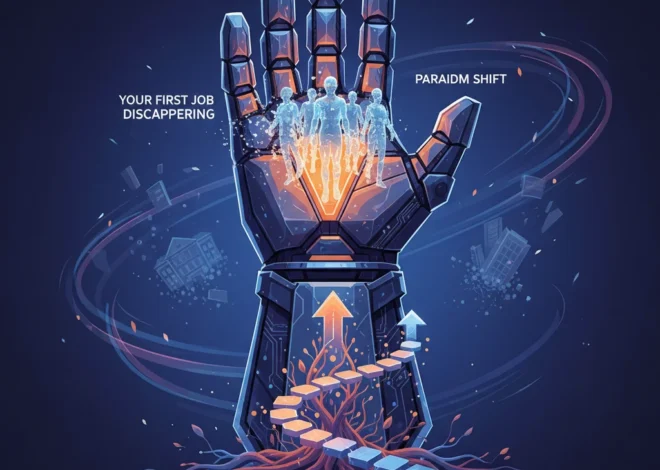
The Trojan Horse of Recruitment: This Startup is Training AI to Do Your Job
Imagine a recruitment company that isn’t just trying to find your next job, but is also meticulously studying how you do it. A company that watches every keystroke, every line of code, and every decision you make—not to evaluate you, but to teach an artificial intelligence how to do it without you. This isn’t a scene from a sci-fi thriller; it’s the audacious business model of Mercor, a tech startup that’s blurring the lines between a talent marketplace and an AI training ground.
On the surface, Mercor looks like many other platforms connecting skilled professionals with companies that need them. But beneath this familiar exterior lies a revolutionary and potentially disruptive engine. They are building a future where your digital replacement is being trained by your own work, and it’s a development that every developer, entrepreneur, and tech professional needs to watch closely.
Beyond the Resume: What is Mercor, Really?
At its core, Mercor operates on a fascinating dual-purpose model. For companies, it’s a source of vetted, high-quality talent for roles in software engineering, data analysis, and more. For professionals, it’s a gateway to freelance gigs and contract work. So far, so standard. But the real innovation is happening in the background.
The company has attracted tens of thousands of professionals to its platform. As these experts tackle complex tasks—writing code, debugging software, analyzing datasets—Mercor’s system is a silent, diligent student. It captures a rich stream of data on how human experts solve real-world problems. This isn’t just about the final product; it’s about the entire process, the digital breadcrumbs of expertise left behind with every action.
This data becomes the fuel for their primary ambition: to build and train highly capable AI agents. These aren’t just chatbots that can answer questions. They are sophisticated systems designed to perform end-to-end job functions. Think of it as a global, digital apprenticeship program where the human workers are the masters, and the AI is the apprentice, learning to replicate and eventually automate their craft. This ambitious vision has already attracted significant attention, with Mercor raising $3.5 million in seed funding to turn this concept into a reality.
From Chatbots to Coworkers: How the AI Learns
The current generation of AI, dominated by Large Language Models (LLMs) like GPT-4, is incredibly powerful at understanding and generating text. However, they often lack the ability to *act*—to take a complex goal, break it down into steps, and execute those steps within a digital environment. This is the gap Mercor aims to bridge.
Their approach to machine learning is grounded in what’s known as “imitation learning.” By observing top-tier developers, the AI learns not just the “what” (the correct code) but the “how” (the process of debugging, refactoring, and problem-solving). This involves analyzing:
- Code Commits and Diffs: Understanding how code evolves from a problem to a solution.
- Tool Usage: Observing how developers interact with IDEs, terminals, and other software.
- Problem-Solving Patterns: Identifying the logical steps a human takes to overcome a challenge.
This methodology allows them to fine-tune general-purpose AI models into specialized “AI agents” capable of tackling specific professional tasks. The ultimate goal is to create a powerful piece of SaaS (Software as a Service) where a company can subscribe to an AI software engineer just as they would subscribe to a cloud computing service.
To understand the leap this represents, let’s compare a standard LLM with the kind of AI agent Mercor is building.
| Capability | Standard LLM (e.g., ChatGPT) | Mercor’s Goal: The AI Agent |
|---|---|---|
| Primary Function | Generates text, code snippets, and answers based on prompts. | Executes multi-step tasks, interacts with software tools, and completes entire projects. |
| Learning Method | Trained on vast internet text and data to predict the next word. | Fine-tuned on real-world human actions to learn workflows and problem-solving strategies. |
| Interaction Model | Conversational; requires continuous human input and guidance. | Autonomous; given a high-level goal, it can plan and execute the necessary steps. |
| Output | A piece of text or code. | A completed task, a functioning application, or a resolved bug in a codebase. |
The EU's Digital Wall: Why Brussels Is Moving to Ban Huawei and ZTE from Critical Infrastructure
The ethical questions are profound. Are the professionals on the platform fully aware they are training their potential replacements? Even if they are, the economic incentive to take on work today might outweigh the long-term risk. This model creates a powerful flywheel: the more human experts work, the smarter the AI gets, reducing the need for human experts. It’s a brilliant business strategy, but it forces a difficult conversation about the future value of human labor in a world of increasingly competent AI agents. This isn’t just about efficiency; it’s about the economic structure of our society.
The Business of Automation: A New Paradigm for Startups and Enterprises
For the roughly 400 active clients on Mercor’s platform, the value proposition is compelling and multifaceted. Initially, they get access to a flexible pool of human talent. But the long-term vision offers something far more transformative: a dramatic reduction in labor costs through automation.
Imagine a startup that needs to build a new feature. Instead of a lengthy hiring process, they could deploy an AI agent to handle 80% of the programming, with a human engineer overseeing the final 20%. This hybrid model offers the best of both worlds: the speed and cost-effectiveness of AI combined with the critical thinking and quality assurance of a human expert. As the technology matures, that percentage could shift even further toward full automation.
This model represents a significant piece of innovation in the tech industry, moving beyond simple task automation (like scheduling emails) to complex cognitive automation (like writing and debugging entire software modules). For entrepreneurs and established companies alike, this could mean:
- Faster Development Cycles: AI agents can work 24/7 without burnout.
- Lower Operational Costs: Reducing reliance on expensive human talent for routine tasks.
- Scalability on Demand: Spinning up a team of AI agents is far easier than hiring a team of humans.
Of course, this also raises new challenges, particularly in cybersecurity. Giving an AI agent access to sensitive codebases and internal systems requires robust security protocols to prevent misuse or breaches. The integrity and security of these autonomous agents will be paramount to their adoption.
The Great AI Chip Standoff: Why China Just Put Nvidia's H200 on Ice
The Great Debate: Augmentation vs. Outright Replacement
The rise of platforms like Mercor forces us to confront the central question of the AI era: will this technology augment human capabilities or render them obsolete?
The optimistic view—the “augmentation” argument—is that AI agents will become powerful tools, not replacements. They will handle the repetitive, tedious, and time-consuming aspects of a job. For a software developer, this might mean the AI writes boilerplate code, runs tests, and drafts documentation, freeing up the human to focus on system architecture, creative problem-solving, and strategic innovation. In this scenario, the human becomes a conductor, orchestrating a team of highly efficient AI assistants.
However, the “replacement” argument is impossible to ignore, especially given Mercor’s explicit goal of training AI to perform entire job functions. When an AI can independently take a project from specification to completion, it moves beyond being a mere tool. It becomes a direct substitute for a human worker, and a significantly cheaper one at that. For many businesses, especially competitive startups where every dollar counts, the economic logic will be irresistible.
The truth will likely lie somewhere in the middle. Certain roles and tasks will be fully automated, while new roles focused on AI management, oversight, and strategy will emerge. The key for professionals will be to adapt, upskill, and learn how to leverage these powerful new forms of artificial intelligence rather than compete against them.
The .1 Billion Voice: How ElevenLabs is Redefining AI and Becoming a Tech Unicorn
The Future is Already Here, It’s Just Unevenly Distributed
Mercor is not an outlier; it’s a harbinger of a profound shift in the nature of work. The concept of using human labor to generate the data needed to automate that same labor is a powerful and scalable one. We are moving from an era where we used machines to automate physical tasks to one where we use software and AI to automate cognitive ones.
The story of this recruitment company is a microcosm of the larger technological revolution unfolding around us. It’s a story of ambition, innovation, and uncomfortable questions. Whether you see it as a thrilling leap forward in productivity or a concerning step towards a jobless future, one thing is certain: the line between human and artificial workers is getting blurrier by the day, and we are all part of the experiment.