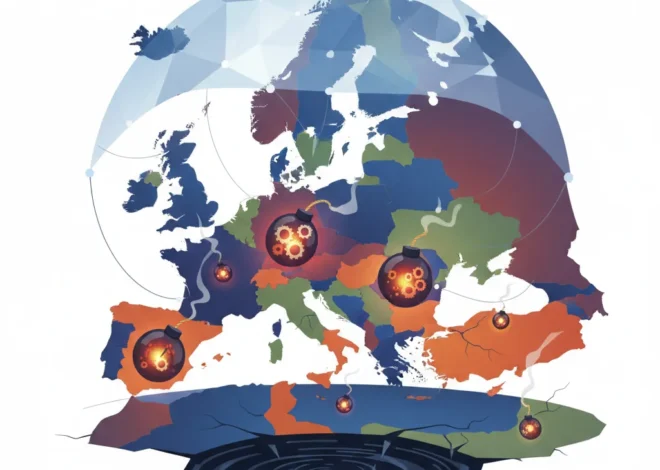
The Great European Divide: Why Dinner Table Talk is Shaping the Future of Finance
Imagine two dinner tables on a typical Tuesday evening. One is in Palo Alto, California. The conversation buzzes with talk of a friend’s startup closing a Series A round, a debate on the latest tech IPO, and the merits of a new cryptocurrency. Risk is a protagonist, failure a learning experience, and the stock market a common language.
Now, picture a similar table in Paris, France. The conversation is rich with culture, politics, and philosophy. But when the topic of personal finance arises, a subtle discomfort descends. Money is a private affair, investing is for the specialists, and discussing one’s salary is considered a social faux pas. This isn’t a caricature; it’s a reflection of a deep-seated cultural chasm that Robert Mathur recently highlighted in a letter to the Financial Times. This “dinner table divide” is more than just a matter of social etiquette; it’s a powerful undercurrent shaping Europe’s entire economic landscape, from its startup scene to its capital markets.
This cultural reticence towards open financial discourse has profound implications for the continent’s ability to compete on a global scale. It influences everything from venture capital allocation and retail investing to the adoption of disruptive financial technology. As we stand at a crossroads of economic uncertainty and technological revolution, understanding and addressing this divide is no longer optional—it’s critical for Europe’s future prosperity.
From Conversation to Capital: The Tangible Economic Cost of Silence
The difference in dinner table conversation is not merely academic; it translates into starkly different economic realities. A culture that openly discusses and embraces financial risk is one that naturally fosters a more dynamic and robust economy. In the Anglo-Saxon model, particularly in the United States, this manifests as a deep and liquid pool of venture capital, a public obsession with the stock market, and a celebrated “fail fast” entrepreneurial spirit.
In contrast, much of continental Europe operates on a foundation of risk aversion. This preference for stability over speculation has historical roots, but its modern-day consequences are clear. It leads to a less vibrant startup ecosystem, an over-reliance on traditional bank lending, and significantly lower participation in equity markets by the general public. While the social safety nets in Europe are often stronger, this financial conservatism can stifle innovation and wealth creation for the average citizen.
The data paints a clear picture of this divergence. While Europe has made strides, it continues to lag behind the US in key metrics that fuel economic growth. A recent analysis shows that European venture capital investment, while growing, is still only a fraction of that seen in the US. In 2022, US startups raised over $230 billion, whereas European counterparts raised closer to $85 billion (source). This funding gap directly impacts the continent’s ability to produce globally competitive tech giants.
Let’s examine a side-by-side comparison of key financial indicators that highlight this divide:
| Metric | United States | Germany | France |
|---|---|---|---|
| Household Stock Market Participation | ~ 58% | ~ 17.5% | ~ 15% |
| Venture Capital Investment (as % of GDP) | 0.72% | 0.28% | 0.35% |
| Number of “Unicorn” Startups (Valued >$1B) | 650+ | 60+ | 30+ |
Note: Figures are illustrative estimates based on recent market trends to demonstrate the scale of the divide.
This table reveals a fundamental difference in how capital is formed and deployed. The low household participation in the stock market across Germany and France means that a vast portion of the population is not participating in the wealth-generating potential of the modern economy. Instead, savings are often held in low-yield bank accounts, which benefits the traditional banking sector but does little to fuel the high-risk, high-reward ventures that drive technological progress.
The Investor's Dilemma: Decoding Modern Finance Like a Crossword Polymath
The Historical Roots of Europe’s Financial Conservatism
To understand why this divide exists, we must look to history. Europe’s current financial culture is not an accident but a product of its unique and often turbulent 20th-century experience. Several key factors have shaped this risk-averse mindset:
- The Memory of Trauma: For Germany, the hyperinflation of the Weimar Republic in the 1920s is a deep-seated national trauma. It instilled a profound fear of financial volatility and a cultural preference for tangible assets and stable savings, a sentiment that echoes in the country’s economic policy and household behavior to this day. This “inflation-angst” makes the perceived chaos of the stock market a much harder sell.
- The Primacy of the State and Banks: In countries like France, the post-war economic model was built around strong state direction (“dirigisme”) and large, systemically important banks. The economy was rebuilt through state-led industrial policy and financing from major banking institutions, not through a vibrant public stock market. This created a system where the primary relationship for both individuals and businesses was with their bank, not the capital markets.
- Strong Social Safety Nets: Robust welfare states, while providing crucial social stability, can also reduce the perceived necessity for individual risk-taking. When healthcare, pensions, and unemployment are largely state-guaranteed, the psychological impetus to build personal wealth through high-risk investing is diminished compared to a system like the US, where individuals bear more of that responsibility.
These historical forces created a financial ecosystem that prioritizes preservation of capital over growth. The continent’s economics became dominated by a powerful banking sector, which naturally prefers debt financing (loans) over equity financing (selling ownership), as it is a less risky and more controllable model for the lender.
Bitcoin's Road to 0K: The Critical Support Level That Could Define the Next Bull Run
Fintech and Blockchain: A Digital Assault on Old Norms
Just as these historical patterns seem intractable, a powerful new force is emerging: financial technology. The rise of fintech is not just a technological shift; it’s a cultural one. It directly challenges the traditional gatekeepers of finance and empowers individuals in ways that were previously unimaginable.
Startups across Europe are lowering the barriers to entry for investing. Commission-free trading apps like Trade Republic and Bitpanda are making the stock market accessible with just a few taps on a smartphone. This democratization of finance is crucial. When a young person in Berlin or Madrid can invest €50 in a global ETF or a fractional share of a US tech company, it fundamentally changes their relationship with the global economy.
Furthermore, the advent of blockchain technology and cryptocurrencies represents an even more radical departure from the old world. Blockchain offers a decentralized alternative to the entire state-and-bank-led financial system. While still volatile and evolving, its core ethos of transparency, disintermediation, and individual sovereignty directly confronts the opaque and paternalistic nature of traditional European banking. The growth of crypto adoption among younger Europeans, with some reports suggesting over 10% of millennials in some countries own digital assets (source), indicates a hunger for new financial paradigms.
This wave of financial technology is forcing a conversation that was once taboo. Online communities, social media influencers, and educational platforms are creating a new “digital dinner table” where discussions about trading strategies, tokenomics, and personal finance are constant and open. This digital movement is a powerful counter-narrative to the culture of financial silence.
Bridging the Divide: A Roadmap for a More Dynamic Europe
While technology is a powerful catalyst, it cannot single-handedly bridge this deep-seated cultural divide. A concerted effort from policymakers, educators, and business leaders is required to foster a more dynamic investment culture in Europe. The path forward includes several key initiatives:
- Championing Financial Literacy: The single most important step is to integrate comprehensive financial education into school curriculums from an early age. Understanding concepts like compound interest, risk diversification, and the basics of the stock market should be as fundamental as learning history or science.
- Accelerating the Capital Markets Union (CMU): The EU’s long-standing project to create a single market for capital must be prioritized. Simplifying cross-border investment, harmonizing insolvency laws, and making it easier for startups to access funding from across the bloc are essential steps to creating a deeper, more liquid pool of capital.
- Incentivizing Retail Investment: Governments can implement tax-advantaged investment accounts, similar to the 401(k) in the US or the ISA in the UK, to encourage long-term investing by the general public. This would not only help individuals build wealth but also channel domestic savings into the productive economy.
The Hunter Becomes the Hunted: When Tech's Greatest Disruptors Face Disruption
Ultimately, the conversation must change. It must become normal, even celebrated, to discuss business ideas, to analyze market trends, and to share both financial successes and failures openly. The “dinner table divide” is a symbol of a larger choice facing Europe: to remain beholden to a comfortable but stagnant past, or to embrace the risks and rewards of a more dynamic and innovative future. The continent’s long-term economic health depends on which path it chooses.