The Air Fryer Economy: What a Simple Kitchen Appliance Reveals About Market Trends, Fintech, and the Future of Investing
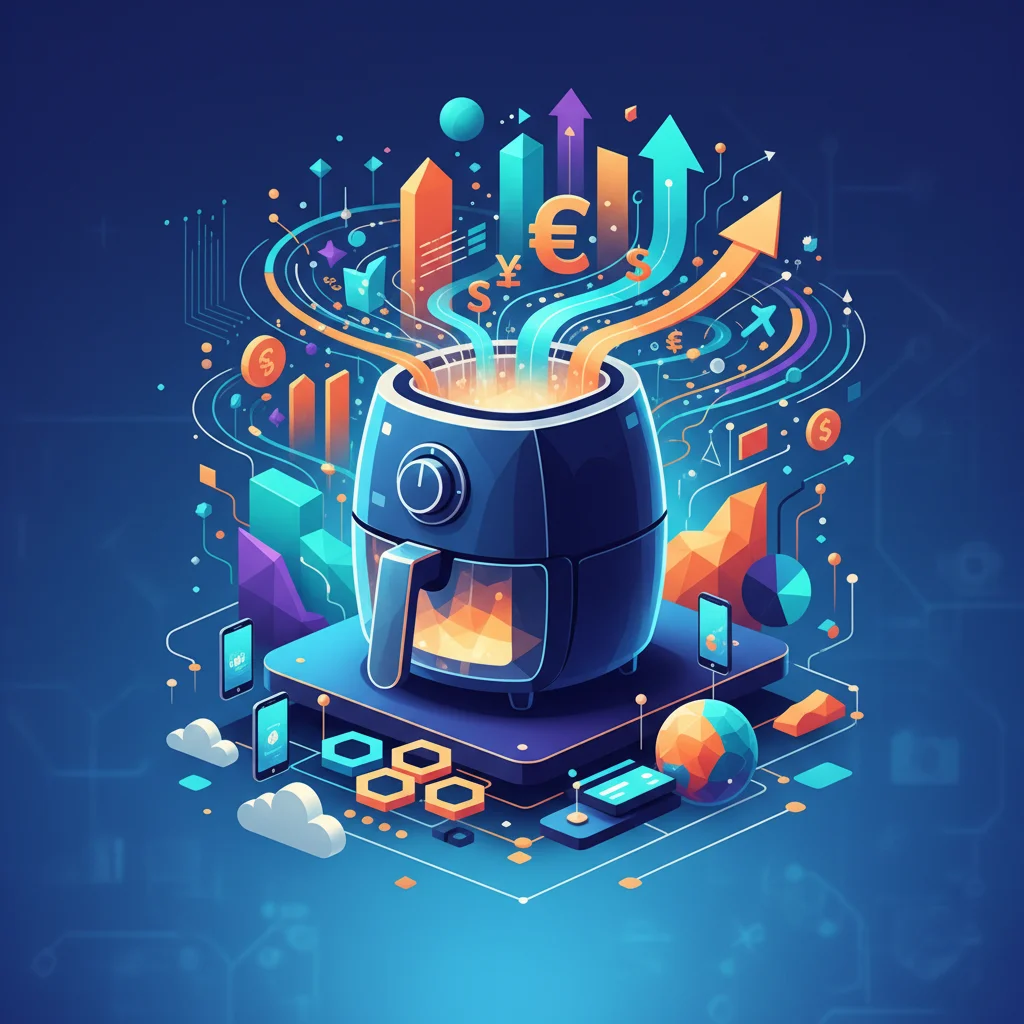
In the world of high finance and complex economic modeling, the most telling indicators often come from unexpected places. While analysts pore over quarterly earnings reports and central bank minutes, a small community group in Stoke-on-Trent, UK, is providing a powerful, tangible signal about the state of our economy. The initiative, run by Meir Matters, gives local residents free air fryers after they complete a healthy cooking course. On the surface, it’s a feel-good local news story. But for astute investors, finance professionals, and business leaders, it’s a canary in the coal mine—a micro-event that reveals macro truths about consumer behavior, economic pressure, and emerging investment opportunities.
This single act of community support, initially focused on slow cookers and now air fryers as reported by the BBC, is more than just charity. It is a direct response to the intense pressures of the modern household economy. It’s a story about energy costs, food inflation, health, and financial resilience. By deconstructing this initiative, we can uncover critical insights into the real-world impacts of monetary policy, the growing importance of social-impact investing, and the immense potential for financial technology to address fundamental human needs.
The Air Fryer as a Macroeconomic Indicator
At first glance, an air fryer is about cooking with less oil. But the decision by Meir Matters to provide these specific appliances is a calculated economic one. The primary driver is not just health, but cost efficiency. An air fryer can be significantly cheaper to run than a conventional oven, a crucial factor for households grappling with soaring energy prices. This simple fact connects a local community kitchen to the global energy markets and national inflation statistics.
For years, the global economy has been shaped by an era of low inflation and accommodative monetary policy. However, recent supply chain shocks, geopolitical tensions, and shifts in energy markets have led to a persistent cost-of-living crisis in many developed nations. In the UK, for instance, electricity prices for consumers have seen dramatic increases. According to the UK Parliament, between January 2022 and January 2023, domestic electricity prices rose by an unprecedented 67%. When households are forced to choose between heating and eating, the energy consumption of a kitchen appliance is no longer a trivial matter; it’s a critical component of their financial survival.
The Meir Matters initiative demonstrates that for a growing segment of the population, the real economy is a daily battle of optimization. They are not trading stocks or analyzing market futures; they are calculating the pence-per-hour difference between an oven and an air fryer. This grassroots response is a lagging indicator of policy impact and a leading indicator of future consumer behavior. Businesses that fail to recognize this shift—from aspirational consumption to pragmatic efficiency—will struggle. The demand for energy-efficient, cost-saving products is not a fleeting trend but a fundamental realignment of consumer priorities, directly impacting sectors from consumer durables to utilities and retail.
The Milk Market Meltdown: Why a Dairy Crisis is a Red Flag for the Global Economy
Investing in Resilience: The Financial Case for Community Capital
From an investor’s perspective, it’s easy to dismiss a small-scale community project as irrelevant to the broader stock market. This is a mistake. The work of groups like Meir Matters can be analyzed through the lens of Environmental, Social, and Governance (ESG) investing, representing a micro-form of investment in community capital with tangible, long-term financial returns.
Let’s break down the potential ROI of this “air fryer investment.” The initial outlay is the cost of the appliances. The returns, however, are multifaceted and compound over time. They include:
- Reduced Household Financial Strain: Lower energy bills free up disposable income, which can be spent elsewhere in the local economy or used to pay down debt, improving creditworthiness and financial stability.
- Improved Public Health Outcomes: Healthier cooking methods can lead to a reduction in diet-related illnesses like obesity and type 2 diabetes. This translates into lower long-term costs for public healthcare systems, a burden ultimately borne by taxpayers and the economy at large. The economic burden of obesity-related conditions is staggering, costing the NHS an estimated £6.5 billion a year.
- Enhanced Community Cohesion: Programs that build skills and provide resources strengthen social bonds, creating more resilient and stable communities, which are more attractive for long-term business investment.
To visualize the direct financial impact, consider a simplified cost-benefit analysis for a single household receiving an air fryer.
| Metric | Estimated Financial Impact (Annual) |
|---|---|
| Initial Investment (One-Time Cost) | ~£75 (Average Air Fryer Cost) |
| Energy Savings | ~£150-£200 (Based on studies showing air fryers can be up to 75% cheaper to run than electric ovens) |
| Potential Long-Term Healthcare Savings | Variable, but significant reduction in risk for costly chronic diseases. |
| Net First-Year Financial Benefit | Positive ROI |
This simple table illustrates that the initiative is not a handout but a high-yield investment in efficiency and well-being. For the finance industry, this model presents a powerful lesson. The principles of value investing—finding undervalued assets with strong long-term potential—apply just as much to community capital as they do to the stock market. Corporations and investment funds that integrate this type of hyper-local social impact into their ESG strategies are not just engaging in philanthropy; they are making a shrewd investment in the stability and prosperity of their future customer base and operating environments.
The Fintech Response: Scaling Solutions for the Real Economy
While community action is powerful, it is often limited by scale. This is where financial technology can and must play a transformative role. The core problems that the air fryer project addresses—financial literacy, access to efficient tools, and budget management—are precisely the areas where fintech innovation can have the greatest impact. The challenge for the financial technology sector is to move beyond optimizing high-frequency trading algorithms and focus on developing tools that solve real-world economic friction for the majority.
Consider the possibilities:
- Smart Banking for Energy Efficiency: Imagine a banking app that integrates with smart-meter data to provide real-time coaching on energy consumption. It could analyze a user’s cooking habits and recommend, with precise financial calculations, whether an investment in an air fryer or microwave would pay for itself. This turns a bank from a passive holder of funds into an active partner in financial well-being.
- Micro-lending and “Appliance-as-a-Service”: For many, even the upfront cost of an energy-efficient appliance is a barrier. Fintech platforms could offer zero-interest micro-loans specifically for green-certified home goods, with repayments structured to be less than the monthly energy savings, ensuring immediate positive cash flow for the user.
- Blockchain for Transparent Aid: For charitable and government programs, ensuring funds are used as intended is a major challenge. A blockchain-based system could be used to issue digital vouchers specifically for “energy-saving appliances.” This would provide complete transparency and accountability, showing donors and taxpayers that their capital was deployed effectively, building trust and encouraging further investment in social programs. A 2022 report by Deloitte highlights how blockchain can enhance transparency and efficiency in the non-profit sector.
These fintech solutions are not science fiction; they are logical extensions of existing technologies. By focusing on the tangible problems of the “Air Fryer Economy,” the financial technology industry can unlock a massive, underserved market and create products that generate both profit and profound social impact. This represents a paradigm shift from abstract financial instruments to technology that improves day-to-day economic life.
Beyond the Farmgate: The Brutal Economics of the Milk Price Crisis
A New Synthesis for a New Economy
The journey from a community kitchen in Stoke-on-Trent to the frontiers of fintech and impact investing reveals a crucial truth: our economic, social, and technological systems are deeply interconnected. The humble air fryer serves as a powerful symbol of this new reality.
It represents a household’s response to macroeconomic pressures dictated by central banking and global economics. It is a tangible asset whose distribution can be viewed as a form of high-impact social investing. And it is a problem statement that should be driving the next wave of innovation in financial technology.
For business leaders, the lesson is to pay attention to the granular shifts in consumer needs, where efficiency and value are replacing brand and aspiration. For investors, the takeaway is that ESG and impact metrics are not just “nice-to-haves” but are becoming essential tools for identifying long-term, resilient investments. For innovators in banking and fintech, the opportunity is to build the tools that bridge the gap between financial systems and the real-world challenges of a population under pressure.
A Dangerous Game: When Politics and Central Banking Collide
Ultimately, the most sophisticated analysis of the stock market or trading strategies is incomplete if it ignores the fundamental economic realities faced by ordinary people. The story of the free air fryers is a reminder that the most powerful forces in the economy are not always found on a Bloomberg terminal, but in the quiet, resilient, and innovative ways people adapt to the world around them.

Related Posts
From Crypto Chaos to a $4B IPO: Why Ledger’s Wall Street Move Signals a New Era for Digital Security