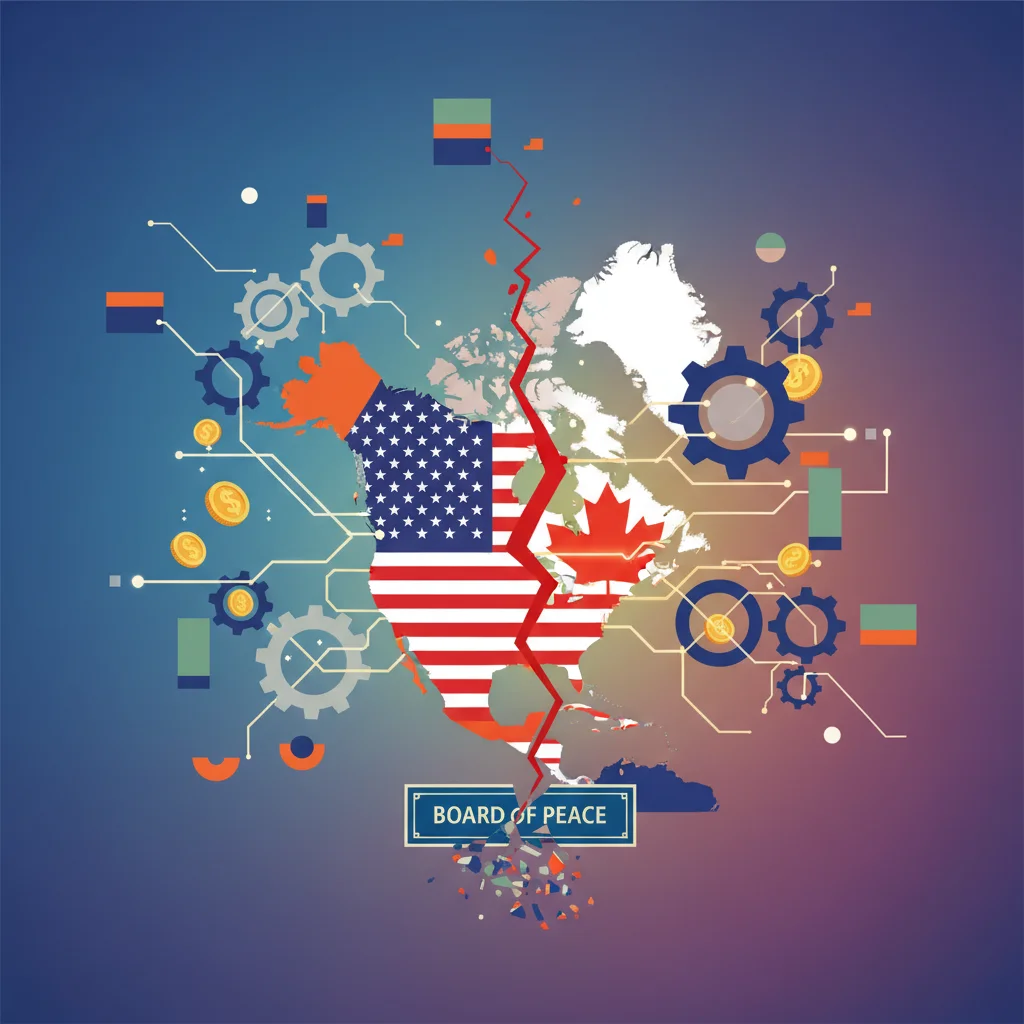
A Alliance Unravels: The Economic Tremors of the US-Canada “Board of Peace” Fallout
In a geopolitical maneuver that has sent quiet shockwaves through diplomatic and financial circles, the United States has rescinded its invitation to Canada to join the newly formed “Board of Peace.” The development, first reported by the Financial Times, marks a significant and unexpected fracture in one of the world’s most stable alliances. Initially conceived as a focused international body to broker a lasting ceasefire in Gaza, the Board’s mandate has reportedly expanded, a shift that appears to be at the heart of this diplomatic rift.
For investors, business leaders, and financial professionals, this is far more than a foreign policy headline. It is a stark reminder that geopolitical risk is not an abstract concept but a potent, market-moving force. The exclusion of a key G7 partner from a major international initiative signals a potential realignment of global power dynamics, with profound implications for trade, the economy, and investment strategies. This move forces us to look beyond the quarterly earnings reports and stock market charts to the very foundations of international cooperation that underpin the global financial system.
From Humanitarian Mission to Geopolitical Power Play
To understand the gravity of this situation, we must first examine the evolution of the “Board of Peace” itself. When first proposed, its mission was clear and widely supported: to leverage international influence to end the devastating war in Gaza. This humanitarian-centric goal garnered broad consensus, and Canada, with its long history of peacekeeping and multilateral diplomacy, was seen as a natural and essential partner.
However, in recent weeks, discussions surrounding the Board’s charter have pivoted dramatically. Sources suggest its role has been broadened to address a wider range of global conflicts, potentially endowing it with significant powers, including the coordination of sanctions, the oversight of international aid, and the authority to intervene in regional disputes. This transformation from a specific crisis-response team to a permanent, powerful organ of global governance changes the calculus entirely. What was once a tool for peace is now being forged into a weapon of international policy, and it appears the United States is being highly selective about who gets to wield it.
This strategic pivot raises critical questions about the future of international economics and finance. A body with the power to direct sanctions can instantly reshape investment landscapes, disrupt supply chains, and create immense volatility in the trading markets. The decision to exclude Canada suggests a potential divergence in economic and foreign policy priorities between the two neighbors, a worrying development for the deeply integrated North American economy.
India's Economic Paradox: Navigating Job Scarcity Amidst Record Growth
The Economic Dominoes: Why a Diplomatic Snub Matters for Your Portfolio
The U.S.-Canada relationship is the bedrock of the North American economy. With over $2 billion in goods and services crossing the border daily, the two nations are more than just allies; they are inextricably linked economic partners. Any perceived instability in this relationship can trigger a cascade of negative consequences that directly impact finance and investing.
Below is a snapshot of the deep economic interdependence that is now facing a new layer of uncertainty.
| Economic Interdependence Metric | Key Facts & Figures | Potential Impact of Diplomatic Friction |
|---|---|---|
| Bilateral Trade | Over $790 billion in goods and services annually, one of an largest trading relationships in the world (source). | Medium to High: Uncertainty could delay cross-border investments, complicate supply chain logistics, and lead to non-tariff barriers. |
| Integrated Supply Chains | Automotive, energy, and manufacturing sectors are deeply integrated. Parts and resources cross the border multiple times before a final product is assembled. | High: Any disruption poses a significant threat to major industries, potentially increasing costs and impacting corporate earnings. |
| Foreign Direct Investment (FDI) | The U.S. and Canada are each other’s largest sources of FDI, supporting millions of jobs in both countries (source). | Medium: A souring relationship could make investors hesitant to commit long-term capital, slowing economic growth and innovation. |
| Energy Cooperation | Canada is the largest and most reliable foreign supplier of energy to the United States, including oil, natural gas, and electricity. | High: Geopolitical friction could impact future energy projects and agreements, affecting energy prices and market stability. |
The stock market, an instrument finely tuned to sentiment and future expectations, will not ignore these signals. Companies with significant cross-border operations may see their risk profiles re-evaluated by analysts. The Canadian dollar could face pressure against its US counterpart, impacting everything from import/export pricing to the returns on foreign investments. This single diplomatic decision has the potential to introduce a new “risk premium” on North American assets, a factor that every investor must now consider.
Fintech, Blockchain, and the New Frontier of Global Governance
Beyond the immediate economic fallout, there is a deeper, more technologically advanced layer to this story. A modern “Board of Peace,” with a mandate to enforce sanctions and manage aid, would almost certainly not operate on paper ledgers and legacy banking systems. Its architecture would be a frontier of financial technology.
Consider the possibilities:
- Sanctions Enforcement: The Board could pioneer a new international standard for digital asset tracking, using blockchain technology to monitor and freeze the assets of designated entities in real-time. This would be a massive leap in the effectiveness of economic statecraft.
- Transparent Aid Distribution: Utilizing fintech platforms and potentially a centralized digital currency, the Board could ensure that humanitarian aid reaches its intended recipients directly, cutting through corruption and inefficiency.
- Economic Data Analysis: The Board would become a hub for real-time economic data, using AI and machine learning to predict conflict hotspots based on illicit financial flows and other economic indicators.
By excluding Canada from this table, the U.S. is not just making a diplomatic statement; it is potentially sidelining a key partner from the development of the next generation of global financial and security infrastructure. The rules for 21st-century international banking, trading, and economic monitoring are being written, and Canada has just lost its seat. This has long-term implications for Canada’s fintech sector and its ability to shape the digital architecture of the global economy.
India's 0M Bet on Rare Earths: A New Magnet for Global Investors?
For financial technology professionals and investors in the space, this highlights a new and powerful trend: the fusion of geopolitics and fintech. The technologies being developed in startup incubators and blockchain labs are no longer just tools for commerce; they are becoming instruments of international power. The nations that design and control these systems will hold immense influence over the future of the global economy.
Navigating the New Geopolitical Reality
The withdrawal of Canada’s invitation to the “Board of Peace” is a watershed moment. It serves as a powerful case study in how quickly the political landscape can shift and why a sophisticated understanding of international relations is now an indispensable part of modern finance and investing.
For business leaders, this event underscores the urgent need to build more resilient supply chains and to diversify geopolitical risk. For investors, it is a call to look beyond traditional financial metrics and incorporate a dynamic assessment of global politics into their decision-making frameworks. The principles of economics are constant, but the political ground upon which the global economy is built is clearly shifting.
As this story unfolds, the markets will be watching closely for the reactions from Ottawa and other world capitals. Will this be a temporary disagreement or the beginning of a more profound and lasting divergence? The answer will have significant consequences for the stability of the North American economic bloc and the wider global order. In this new environment, staying informed is not just good practice—it’s the most critical component of any sound financial strategy.
The End of an Era: Unpacking the Financial Force of Kathleen Kennedy's Lucasfilm Departure