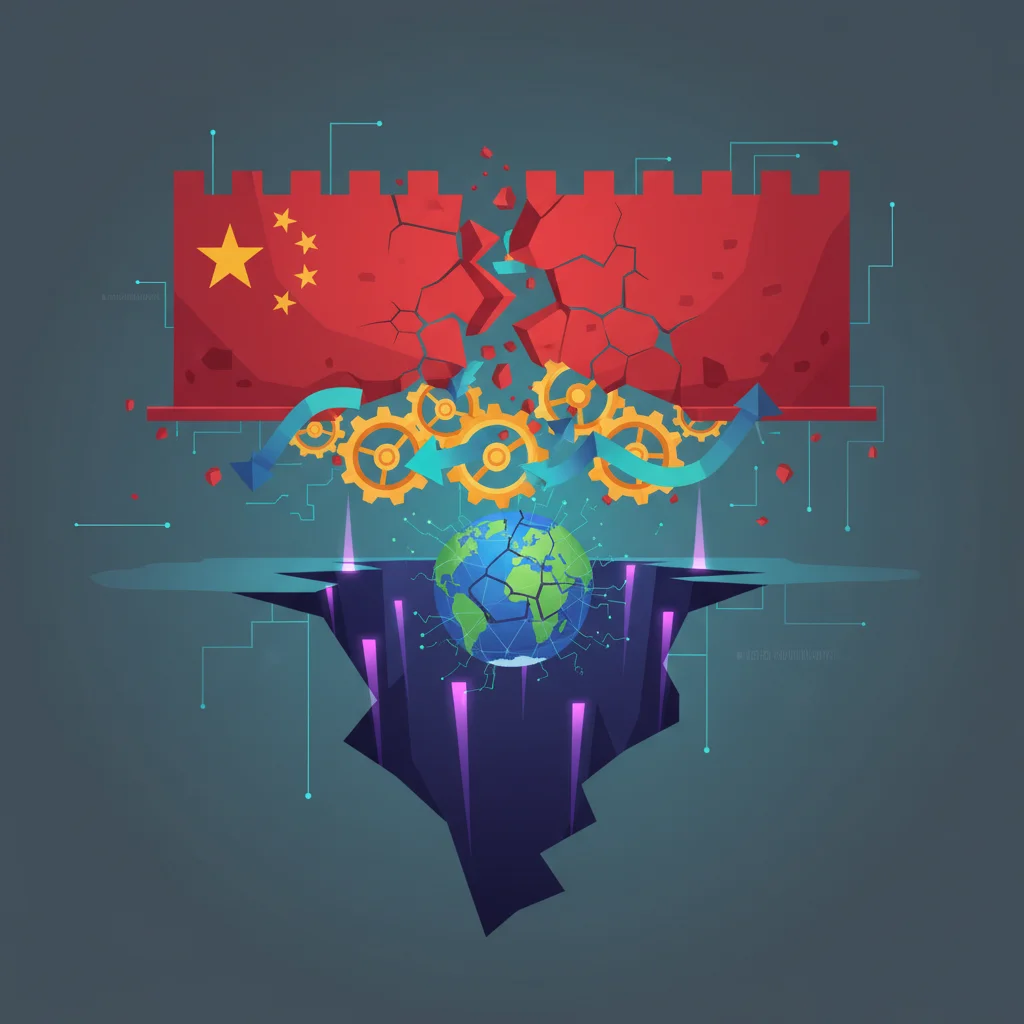
The Great Reversal: How Xi’s China Shattered the Global Economic Dream
The End of an Era: Why the China You Knew is Gone
For decades, a powerful narrative captivated the world of global finance and business: the inevitable rise of China. This wasn’t just a story of economic growth; it was a belief system. Fueled by Deng Xiaoping’s “reform and opening up” policies, China transformed from an isolated, impoverished nation into the world’s factory and a burgeoning hub of technological innovation. Investors, CEOs, and economists operated on a core assumption: as China’s economy matured, its political and social systems would gradually liberalize, converging with the Western model. This was the “China Dream” sold to the world—a promise of stability, predictable growth, and immense opportunity.
However, as detailed in a penetrating analysis by Minxin Pei for the Financial Times, that dream is not just fading; it has been systematically dismantled. Under the rule of Xi Jinping, the clock has been turned back. The institutional guardrails painstakingly erected to prevent a return to Mao-style dictatorship have been torn down, replaced by a new, technologically-enhanced form of totalitarianism. For anyone involved in international finance, investing, or business strategy, understanding this profound reversal is no longer optional—it is critical for survival and success in a new and treacherous geopolitical landscape.
Deng’s Pragmatic Blueprint: The Foundation of China’s Economic Miracle
To grasp the magnitude of the current shift, one must first appreciate the system Xi Jinping has overturned. After the catastrophic chaos of the Mao era, Deng Xiaoping and his successors instituted a series of ingenious political reforms designed to ensure stability and prevent the concentration of absolute power in one individual. These weren’t democratic reforms in the Western sense, but they created a predictable and durable authoritarian system that fostered incredible economic dynamism.
The key pillars of this system included:
- Collective Leadership: Power was shared among a small group in the Politburo Standing Committee, forcing consensus and preventing the whims of a single leader from destabilizing the state.
- Mandatory Retirement & Term Limits: Deng established strict age limits for senior officials and a two-term limit for the presidency, ensuring a regular and orderly transition of power. This single reform was a radical departure from the “leader-for-life” model that had preceded it.
- A Degree of Party-State Separation: While the Chinese Communist Party (CCP) remained supreme, efforts were made to professionalize the state bureaucracy, allowing technocrats to manage the complex mechanics of a growing economy without constant ideological interference.
This political framework was the bedrock upon which China’s modern economy was built. It gave foreign investors the confidence to pour trillions into the country, knowing that the rules of the game were relatively stable. It allowed the Chinese stock market to flourish and created the space for a vibrant private sector—including world-leading fintech and financial technology companies—to emerge. The system was designed to prioritize pragmatic economics over rigid ideology, a formula that delivered an unprecedented four decades of growth.
The Xi Jinping Revolution: Deconstruction and Centralization
Beginning with his ascent to power in 2012, Xi Jinping has systematically hollowed out and demolished each of Deng’s pillars. His tenure has been marked by a relentless consolidation of power, culminating in the creation of a personalistic dictatorship unseen since Mao.
The most symbolic and consequential move was the abolition of presidential term limits in 2018, effectively paving the way for him to rule for life. But the changes run far deeper. The anti-corruption campaign, while popular publicly, became a powerful tool to eliminate political rivals and enforce absolute loyalty. The principle of collective leadership has been replaced by the singular authority of Xi, who has been elevated to the status of “core leader.” The Party is no longer just a guiding force; it is now explicitly and intrusively involved in every facet of society, from corporate boardrooms to social media.
Below is a comparison of the two distinct eras, highlighting the dramatic policy reversals that have reshaped China’s political and economic landscape.
| Policy Area | Deng & Successors Era (1978-2012) | Xi Jinping Era (2012-Present) |
|---|---|---|
| Leadership Model | Collective leadership, consensus-based | Personalistic rule, loyalty to the “core leader” |
| Power Transition | Institutionalized with term and age limits | Term limits abolished, succession uncertain |
| Economic Priority | Pragmatic growth, “getting rich is glorious” | National security, self-reliance, “common prosperity” |
| Role of Private Sector | Encouraged and given space to grow | Subject to intense regulatory scrutiny and Party control |
| Global Integration | Integration into the global economy and institutions | Assertive nationalism, “wolf warrior” diplomacy |
The Economic Price of Ideology
The replacement of economic pragmatism with ideological rigidity has had profound and chilling effects on China’s economy. The mantra has shifted from “growth at all costs” to “security above all.” This has manifested in a series of sweeping regulatory crackdowns that have wiped out trillions of dollars in market value and sowed unprecedented uncertainty.
The “common prosperity” drive, for example, led to the overnight decimation of the private tutoring industry. The push for data security and Party control over technology resulted in a sustained assault on China’s most innovative companies, including Alibaba and Tencent. This has had a devastating impact on the fintech sector, once a crown jewel of the Chinese economy. The environment that allowed for rapid innovation in financial technology and even exploration of blockchain applications has been replaced by one of fear and compliance. Entrepreneurs and venture capitalists now operate under the constant threat of arbitrary state intervention (source).
This new paradigm has shaken the foundations of the Chinese stock market. International investors are re-evaluating their exposure, struggling to price in a level of political risk that is opaque and unpredictable. The banking sector, increasingly directed to serve state objectives rather than market principles, faces mounting pressure from the implosion of the property market—another crisis exacerbated by abrupt and poorly executed policy shifts.
Navigating the New China: A Playbook for Investors and Business Leaders
The era of treating China as just another emerging market is definitively over. Operating successfully in Xi’s China requires a radically different approach, one that acknowledges the primacy of politics over economics.
- Prioritize Political Risk Analysis: Your China strategy team must now include political scientists and CCP experts, not just economists. Understanding the ideological winds blowing from Beijing is paramount for any form of capital allocation, from public market trading to direct investment.
- Re-evaluate Sector Exposure: Sectors deemed “strategic” by the Party (such as semiconductors, AI, and green energy) may receive state support, but they also come with heavy state control. Consumer-facing sectors, particularly in technology and culture, are highly vulnerable to sudden regulatory crackdowns based on shifting ideological campaigns.
- Prepare for Decoupling: The drive for “self-reliance” in China and growing security concerns in the West are accelerating a technological and financial decoupling. Businesses must build resilient supply chains and data management strategies that can withstand this divergence.
- Discount for Unpredictability: Financial models must incorporate a significant “unpredictability premium.” The rules can and will change without warning, directly impacting asset values. The stable environment that underpinned decades of investing is gone, and risk models must be updated accordingly.
The China Dream, as the world understood it, was a promise of convergence. It was a bet that economic integration would inevitably lead to a more open, predictable, and market-oriented China. That bet has failed. Xi Jinping has placed the country on a different path—one that prioritizes absolute Party control, ideological purity, and national security over the dynamic, often chaotic, forces of free-market capitalism. For the global financial community, the challenge is not to wish for a return to the past, but to understand and adapt to the stark realities of the present.
When Titans Tango: Why the Rio Tinto-BHP Alliance is a Game-Changer for the Global Economy
The journey from Deng’s reforms to Xi’s totalitarianism is a cautionary tale. It demonstrates that the trajectory of history is not always linear and that the foundations of economic prosperity can be undone by political ambition. As we look to the future of the global economy, navigating our relationship with this new China will be the defining challenge of our time.

Related Posts

Collision Course: Why Europe’s Carmakers Are Divided on a “Made in Europe” Future

The Great Rupture: Mark Carney’s Blueprint for Navigating a Fractured Global Economy
