Anatomy of a Rally: How a Diplomatic Handshake Averted a Trade War and Ignited the Stock Market
In the world of finance and investing, markets are often described as being driven by fundamentals—earnings reports, economic data, and interest rates. Yet, there are moments when the entire financial ecosystem holds its breath, not for a data release from the Federal Reserve, but for a headline, a tweet, or a single diplomatic statement. One such moment perfectly illustrates the immense power of political rhetoric over the modern economy, where the threat of a new trade war front was dismantled in a single news cycle, sending US stocks soaring.
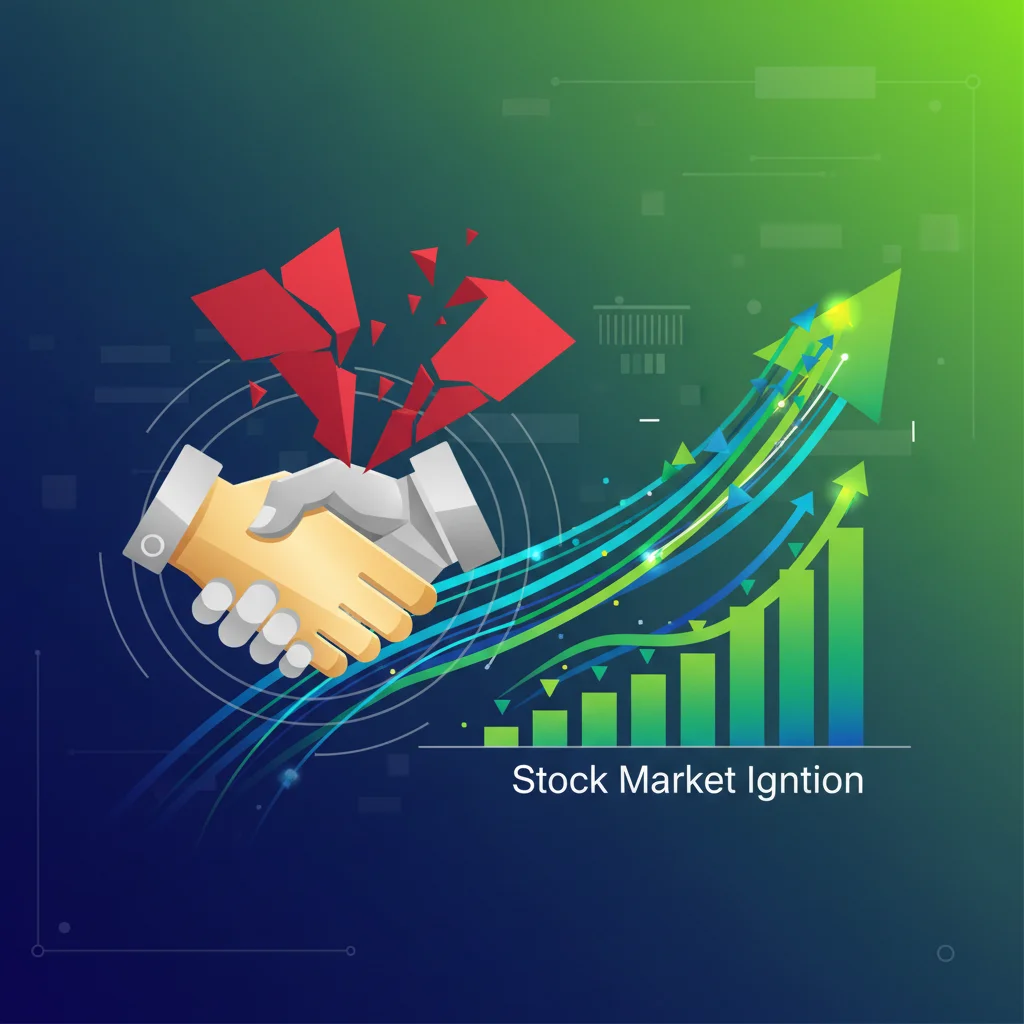
The event in question was a brief announcement that then-US President Donald Trump was pulling back from the threat of new levies against the European Union. The reason cited? A “productive meeting” with Mark Rutte, the Prime Minister of the Netherlands, as reported by the Financial Times. On the surface, it was a minor diplomatic update. In the context of a global economy fraught with trade tensions, however, it was the flick of a switch that turned fear into optimism, unleashing a powerful rally across the stock market.
This post will dissect that market reaction, exploring the intricate connections between geopolitical posturing, economic stability, and investor psychology. We will delve into why a seemingly small de-escalation had such a profound impact, what it tells us about the nature of today’s global economy, and the crucial lessons it holds for investors, business leaders, and finance professionals navigating an increasingly uncertain world.
The Brink of a New Front: Understanding the Threat
To appreciate the market’s relief, we must first understand the tension that preceded it. The period was characterized by a multi-front trade war, primarily between the US and China, but with constant threats simmering against other major trading partners, including the European Union. The primary weapon in this conflict was the tariff—a tax on imported goods designed to protect domestic industries but which often results in retaliatory measures, disrupted supply chains, and higher costs for businesses and consumers.
The looming threat against the EU specifically targeted key sectors, with the automotive industry being a primary focus. The prospect of new tariffs on European cars and auto parts sent shivers through a globally integrated industry. For companies like Volkswagen, BMW, and their vast network of suppliers, such levies would have meant billions in new costs, potentially leading to lower sales, reduced profits, and workforce adjustments. This uncertainty doesn’t just impact corporate boardrooms; it freezes investment, stalls hiring, and dampens consumer confidence, creating a drag on the entire economy.
The pullback, therefore, was more than just a cancelled tax. It was a signal that diplomacy could prevail and that a damaging and costly escalation in the economic conflict with a key ally was, for the moment, off the table. The market, which abhors uncertainty above all else, responded with a collective sigh of relief.
Spring in Their Step: Why UK Property Market Optimism is a Bellwether for the Broader Economy
Decoding the Rally: A Surge of Optimism
The reaction on Wall Street was immediate and unequivocal. The removal of a significant downside risk prompted a classic “risk-on” shift in the stock market. Investors, who had been cautiously positioning themselves for negative news, rapidly moved capital back into equities and away from safer assets like government bonds. This surge in buying pressure propelled major indices upward.
To illustrate the market’s enthusiastic response, let’s examine the performance of the major US indices on the day the news broke, August 21, 2019. The relief was palpable across the board.
| Index | Opening Price | Closing Price | Daily Change (%) |
|---|---|---|---|
| S&P 500 | 2,921.43 | 2,924.43 | +0.82% |
| Dow Jones Industrial Average | 26,160.89 | 26,202.73 | +0.93% |
| Nasdaq Composite | 8,004.16 | 8,020.21 | +0.90% |
Market data reflects performance on August 21, 2019, showcasing the broad-based rally following the de-escalation of trade threats. Data sourced from historical market reports (source).
This rally was not just about the numbers; it was about sentiment. The key drivers included:
- Reduced Tail Risk: A full-blown trade war with the EU represented a “tail risk”—a low-probability but high-impact event. Taking it off the table allowed investors to re-evaluate corporate earnings projections without this significant negative variable.
- Sector-Specific Relief: Shares of multinational industrial companies, automakers, and manufacturers, which were most exposed to the proposed tariffs, saw some of the strongest gains.
- Boost to Global Growth Prospects: An open conflict between two of the world’s largest economic blocs would have had severe repercussions for global GDP. The de-escalation renewed hopes that global economic momentum could be sustained.
The Broader Economic Ripples: Beyond Equities
The impact of trade policy extends far beyond the stock market. The averted crisis had significant implications for other areas of the financial world and the real economy.
First, consider the banking and corporate finance sectors. Persistent trade uncertainty makes it incredibly difficult for businesses to make long-term capital expenditure decisions. A company is far less likely to invest in a new factory or supply chain if it fears that a new tariff could render the investment unprofitable overnight. A study from the International Monetary Fund highlighted that global trade policy uncertainty was a major factor weighing on business investment and economic growth during that period (source). The pullback on levies provided a window of clarity, allowing businesses to plan with slightly more confidence.
Second, the currency and bond markets also reacted. In times of heightened geopolitical risk, investors often flock to the US dollar as a safe-haven asset. A de-escalation can reverse this trend, causing the dollar to weaken against other currencies like the Euro as investor appetite for risk returns. Similarly, bond yields, which tend to fall when investors seek safety, may rise as money flows out of bonds and back into the stock market.
This interconnectedness highlights how a single political decision can trigger a cascade of adjustments across the entire financial system, influencing everything from international trade flows to the interest rates on personal loans.
Solving the Financial Grid: What the FT Crossword Teaches Us About Modern Investing
The Role of Financial Technology in an Instant-Reaction World
The speed and magnitude of the market’s reaction are also a testament to the evolution of modern trading and financial technology (fintech). In today’s markets, news is disseminated globally in milliseconds, and algorithmic trading systems are programmed to react instantly.
High-Frequency Trading (HFT) platforms, which execute millions of orders per second, can analyze headlines and social media sentiment to trade on news before human investors have even finished reading the first sentence. This use of advanced financial technology can amplify volatility, turning small ripples of news into significant market waves. While this provides liquidity, it also contributes to the sharp, knee-jerk reactions we witnessed.
Furthermore, the proliferation of fintech-powered retail investing apps means more individuals are directly exposed to this volatility. While democratizing access to the stock market is a positive development, it also means that the psychological component of market swings is magnified.
Looking ahead, emerging technologies like blockchain could play a future role in mitigating some trade-related friction. By creating transparent and immutable records of supply chains, blockchain could make it easier to verify the origin of goods and streamline customs processes, although its widespread adoption in international trade remains a long-term prospect.
Heathrow's £33 Billion Gambit: A High-Stakes Bet on the UK's Economic Future
Conclusion: A Lasting Lesson in Market Dynamics
The market rally following the averted trade escalation serves as a powerful case study for anyone involved in finance, economics, or business. It reminds us that in a deeply interconnected global economy, political stability and predictable trade policy are not just abstract concepts; they are foundational pillars of market confidence and economic growth.
For investors, the lesson is the critical need to diversify and to develop a strategy that can withstand sudden shocks from non-financial events. For business leaders, it underscores the importance of building resilient supply chains and hedging against geopolitical risk. And for policymakers, it is a stark reminder that words and actions have immediate and far-reaching economic consequences.
Ultimately, the story of this rally is not just about a single day’s trading. It’s about the delicate balance between political power and economic prosperity, and how quickly that balance can be tipped—for better or for worse—by a single, productive conversation.

Related Posts

The Ultimate Acquisition Target: Deconstructing the Geopolitical Finance Behind Buying Greenland

Market Relief: How a Diplomatic Handshake Averted a Transatlantic Trade War and Ignited a Stock Rally