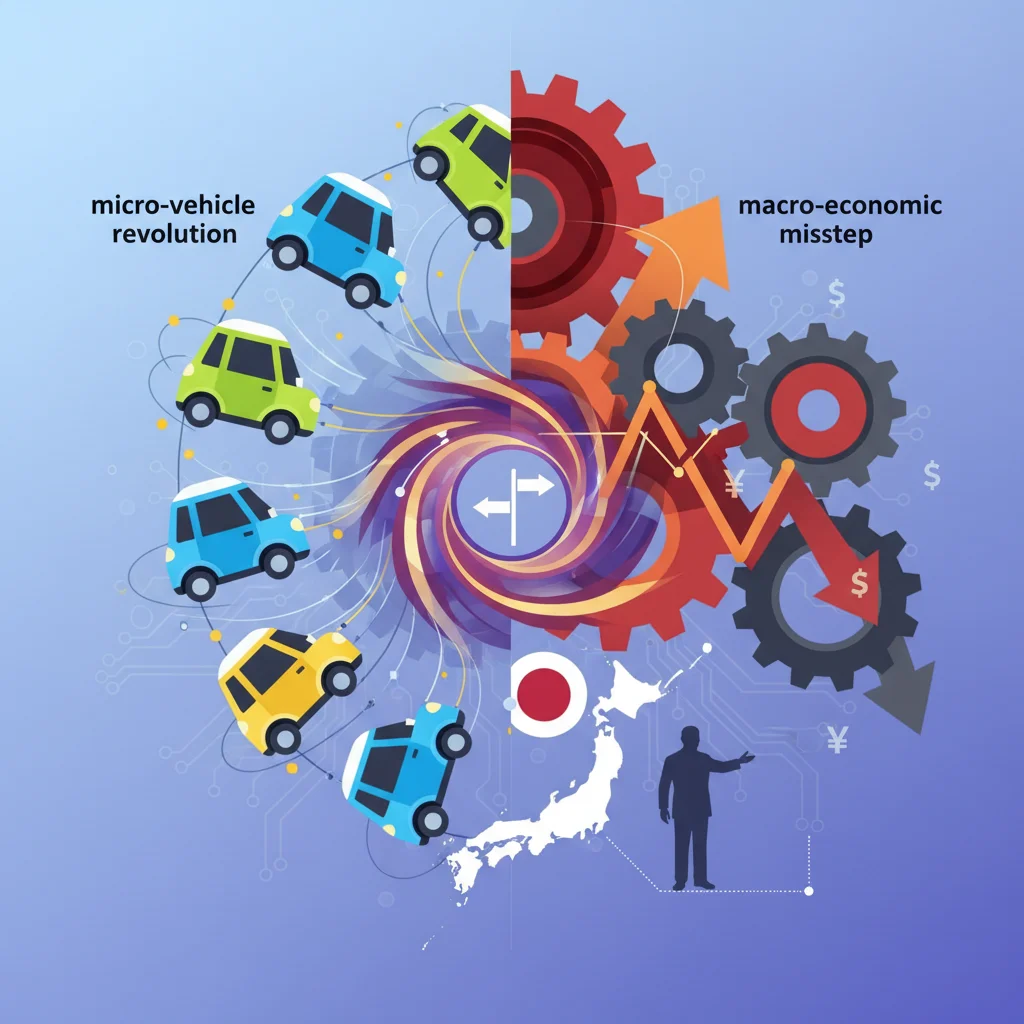
The Kei Car Conundrum: A Micro-Vehicle Revolution or a Macro-Economic Misstep?
A Surprising Proposal: Could Japanese Micro-Cars Redefine American Roads?
In a move that caught many market analysts by surprise, former President Donald Trump has signaled a desire to introduce Japanese “Kei cars” to the American market. These diminutive vehicles, a common sight on the bustling streets of Tokyo and Osaka, represent a stark contrast to the large SUVs and trucks that dominate U.S. highways. The proposal, initially reported by the BBC, opens a fascinating debate that extends far beyond automotive design. It forces us to ask critical questions about the future of American transportation, consumer finance, and the broader economy. Is this a forward-thinking solution to vehicle affordability and urban congestion, or a policy dead-end that misunderstands the American consumer and the realities of the global stock market?
For investors, finance professionals, and business leaders, this isn’t just about small cars. It’s a case study in potential market disruption, regulatory challenges, and the intricate dance between political rhetoric and economic reality. The introduction of an entirely new vehicle class could ripple through everything from automaker stocks and supply chain logistics to consumer lending and the insurance industry. Analyzing this proposal requires a deep dive into the economics of the automotive sector, the psychology of the American buyer, and the powerful inertia of a century of industrial development.
Understanding the Kei Car: A Masterclass in Efficiency
Before dissecting the financial implications, it’s crucial to understand what a Kei car is. The term, short for keijidōsha (軽自動車), translates to “light automobile.” This vehicle class was created by the Japanese government in the post-World War II era to mobilize its population with affordable, tax-incentivized transportation. To qualify for these benefits, vehicles must adhere to strict size and engine-capacity regulations. According to the Japan Light Motor Vehicle and Motorcycle Association, current standards limit engine displacement to 660cc (less than half the size of a typical subcompact’s engine), power to 63 horsepower, and dimensions to a maximum of 3.4 meters in length and 1.48 meters in width.
The result is a marvel of packaging and efficiency. These vehicles are perfect for navigating Japan’s narrow streets and are remarkably fuel-efficient. However, their design philosophy is diametrically opposed to the American automotive ethos. To put this into perspective, let’s compare a popular Kei car with one of America’s best-selling vehicles.
The table below illustrates the dramatic difference in scale between a typical Kei car, the Honda N-Box, and America’s perennial best-seller, the Ford F-150.
| Specification | Honda N-Box (Kei Car) | Ford F-150 (Full-Size Truck) |
|---|---|---|
| Engine Displacement | 658cc | 2,700cc – 5,000cc+ |
| Horsepower | ~58-63 hp | ~325-450+ hp |
| Length | 11.1 feet (3.4m) | 17.4 – 20.9 feet (5.3m – 6.4m) |
| Width | 4.8 feet (1.48m) | 6.7 feet (2.0m) |
| Approx. Curb Weight | ~2,000 lbs | ~4,000 – 5,500 lbs |
This comparison highlights the fundamental challenge. We are not just talking about a smaller car; we are talking about a completely different category of personal transportation, one designed for a vastly different environment and consumer priority set.
The Hundred Billion Dollar Question: Is Big Tech Building AI's Future on an Outdated Blueprint?
The Economic Bull Case: Affordability, Efficiency, and Market Disruption
Proponents of this idea argue that Kei cars could address a significant pain point in the U.S. economy: vehicle affordability. As new and used car prices have soared, a large segment of the population is being priced out of reliable transportation. The average transaction price for a new vehicle in the U.S. recently hovered around $48,000, according to Kelley Blue Book. Kei cars, which often sell for the equivalent of $10,000 to $15,000 new in Japan, could present a radical alternative.
From an investing perspective, this could be a seismic event. If a Japanese automaker were to successfully penetrate the U.S. market with a Kei car, it could unlock a new demographic of buyers. This would undoubtedly impact the stock market, potentially boosting the valuations of companies like Suzuki and Daihatsu (a Toyota subsidiary) while putting pressure on domestic automakers focused on higher-margin trucks and SUVs. Traders and investors would need to re-evaluate their positions in the automotive sector, analyzing which companies are agile enough to adapt.
Furthermore, the rise of a new, ultra-affordable vehicle segment would create opportunities in the financial technology and banking sectors. Fintech firms could pioneer new micro-loan products tailored for these vehicles, while insurance companies would need to develop new risk models. The entire ecosystem of consumer auto finance would have to evolve, potentially leading to innovative financial technology solutions that lower the barrier to car ownership. This move could stimulate a corner of the economy that has been struggling with inflation and high interest rates.
The Wall of Reality: Regulation, Culture, and Consumer Tastes
Despite the intriguing economic arguments, the path for Kei cars in America is fraught with obstacles that could render the entire proposal moot. The single greatest hurdle is regulatory compliance. U.S. safety standards, managed by the National Highway Traffic Safety Administration (NHTSA), are among the most stringent in the world. Kei cars, designed for lower-speed Japanese roads, would likely require a complete and costly re-engineering to meet American crash-test and safety-feature mandates. Their small crumple zones and light weight present significant challenges in a market dominated by 5,000-pound vehicles.
Then there is the issue of consumer preference. For decades, the trend in the U.S. has been toward larger vehicles. Light trucks and SUVs now account for nearly 80% of new vehicle sales (source: EPA). American consumers value space, power, and the perceived safety of a large vehicle. Convincing a family in suburban Texas to trade their Ford Explorer for a Daihatsu Tanto is an immense marketing challenge that may be impossible to overcome.
The business and finance logistics are equally daunting. Establishing a new sales and service network across the country would require billions in capital investment. This is a massive risk for any company, especially when the target market’s size and willingness to buy are complete unknowns. From a corporate finance standpoint, the return on investment is highly speculative, making it a tough sell to any board of directors.
Beyond the Hype: Contextualizing Automotive Disruption
Whether or not Kei cars ever arrive on American shores, the conversation itself is a valuable indicator of the pressures facing the global automotive industry. The proposal taps into a broader theme of disruption, where established models are being challenged by new technology, economic pressures, and shifting consumer needs.
This is happening across the board. The transition to electric vehicles (EVs) is forcing a complete overhaul of manufacturing and supply chains. The development of autonomous driving is changing the very definition of mobility. Even the way parts and vehicles are tracked is being re-imagined. For instance, the complexity of global automotive supply chains has led some in the industry to explore advanced financial technology, including the potential use of blockchain for ensuring parts provenance and creating a transparent, immutable ledger from factory to showroom. Introducing a new vehicle class like Kei cars would further strain these systems, demanding even more robust and transparent tracking.
This proposal, therefore, should be viewed within this wider context. It is a symptom of an industry in flux. The core tenets of the 20th-century auto business—internal combustion engines, dealer-based sales, and a focus on size and power—are all being questioned. The economics of personal transportation are at an inflection point.
Beyond the Headline: Why a US Bill to Prevent Annexing Greenland Matters for Your Portfolio
Conclusion: A Niche Novelty or the Next Big Thing?
The idea of bringing Japanese Kei cars to the United States is a fascinating thought experiment with profound implications for the American economy, finance, and investing. On one hand, it offers a potential solution to the vehicle affordability crisis, a chance to reduce emissions, and an opportunity for market disruption that could reward agile investors and financial technology innovators. On the other hand, it faces a nearly insurmountable wall of regulatory hurdles, deeply entrenched consumer preferences, and immense logistical costs.
For business leaders and finance professionals, the key takeaway is not to start placing bets on Kei car stocks just yet. Instead, it is to recognize the underlying tensions this proposal exposes. The demand for affordable, efficient transportation is real and growing. The rigid structure of the U.S. auto market, with its high barriers to entry and focus on high-margin vehicles, may be more brittle than it appears. While a full-scale invasion of micro-cars is unlikely, the pressure they represent could accelerate other innovations—from smaller, more affordable EVs to new models of vehicle financing and ownership. The smart money will be watching not for the arrival of the cars themselves, but for how the industry responds to the questions they force us to ask.

Related Posts

Collision Course: Why Europe’s Carmakers Are Divided on a “Made in Europe” Future

Anatomy of a Rally: How a Diplomatic Handshake Averted a Trade War and Ignited the Stock Market