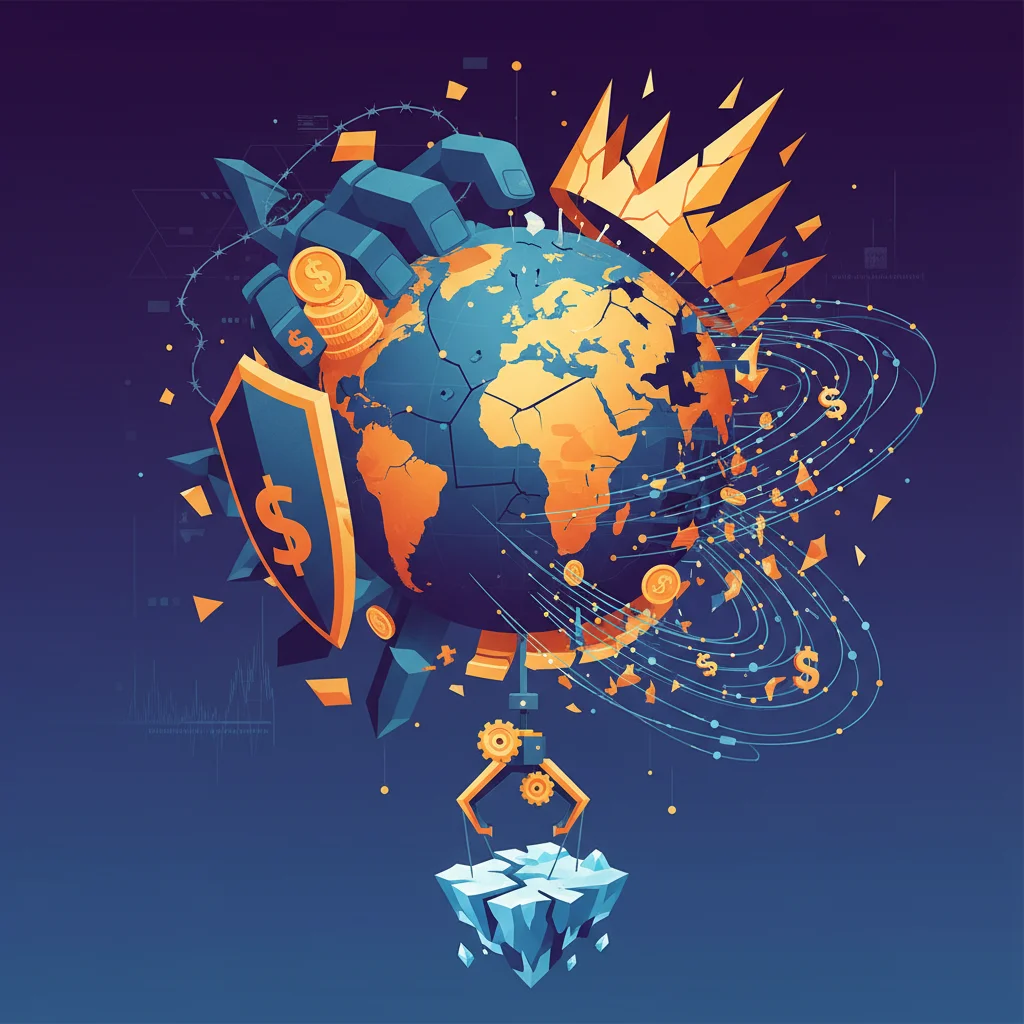
The Price of Protection: How Trump’s Transactional Foreign Policy is Reshaping the Global Economy
A New World Order, or a New World of Chaos?
In the grand theater of global politics, rhetoric often serves as a prelude to action. But when then-President Donald Trump mused about purchasing Greenland and openly questioned the value of long-standing alliances like NATO, it signaled more than just a shift in tone. It represented a seismic crack in the very foundation of the post-World War II international order. As Faisal Islam of the BBC noted, these moves were “without parallel,” leaving allied leaders baffled and financial markets on edge. This wasn’t just politics; it was the introduction of a brutally transactional, zero-sum calculus into a system built on mutual trust and shared values. For investors, business leaders, and anyone involved in the global economy, understanding this paradigm shift is no longer optional—it’s essential for survival.
For over 70 years, the world operated on a framework of established alliances, trade agreements, and international institutions. This system, while imperfect, provided a crucial element for economic growth: predictability. It allowed businesses to build global supply chains, investors to allocate capital across borders, and the banking sector to facilitate a massive expansion of global trade. The core assumption was that alliances were about shared security and values, not a line item on a balance sheet. Trump’s approach fundamentally challenged this, reframing alliances as protection-for-hire arrangements and trade as a battle to be won rather than a mutually beneficial exchange. This blog post will deconstruct the economic and financial implications of this “America First” doctrine, exploring its impact on everything from the stock market to the future of financial technology.
The Economics of Alliances: Deconstructing the NATO 2% Debate
At the heart of the controversy is the persistent criticism of NATO allies for failing to meet a defense spending target of 2% of their GDP. This figure, agreed upon in 2014, became a central talking point, used to portray European allies as freeloaders on American military might. From a purely accounting perspective, the argument has a certain simplistic appeal. The United States spends a significantly higher percentage of its massive GDP on defense than most of its allies, shouldering a disproportionate share of the collective security burden.
However, this transactional view ignores the multifaceted nature of the alliance’s value. The traditional perspective is that US military presence and security guarantees in Europe and Asia are not charity; they are strategic investments that have paid enormous dividends. They created a stable environment that prevented major power conflicts, secured vital sea lanes for trade, and fostered the growth of prosperous, democratic trading partners. This stability has been the bedrock upon which the modern global economy was built, directly benefiting American corporations and investors. Treating this complex symbiotic relationship as a simple fee-for-service model fundamentally misunderstands its economic and strategic importance.
To put the numbers in context, let’s examine the defense spending of several key NATO members as a percentage of their GDP. The data reveals a more nuanced picture than the political rhetoric often suggests.
| Country | Defense Spending (% of GDP) | Status Relative to 2% Guideline |
|---|---|---|
| United States | 3.49% | Exceeds Guideline |
| Poland | 3.90% | Exceeds Guideline |
| United Kingdom | 2.07% | Meets Guideline |
| France | 1.90% | Below Guideline |
| Germany | 1.57% | Below Guideline |
| Italy | 1.46% | Below Guideline |
| Canada | 1.38% | Below Guideline |
Data sourced from the official NATO “Defence Expenditure” report released in July 2023.
As the table shows, while several major economies like Germany and Canada fall short, others, particularly those on NATO’s eastern flank like Poland, have significantly exceeded the target in response to regional threats. The debate forces a critical question for the world of finance: How do you price the risk of a weakened security alliance? The answer is with higher volatility and a risk premium on assets in potentially affected regions.
The .6 Billion Casino Showdown: How Bain Capital Seized a Native American Dream in South Korea
Weaponizing the Economy: When Trade Becomes a Battlefield
The philosophy of treating allies as transactional partners isn’t confined to military spending; its most immediate impact has been felt in the realm of international trade. The imposition of tariffs on steel and aluminum, even on close allies like Canada and the European Union, under the guise of “national security,” demonstrated a willingness to use economic coercion as a primary tool of foreign policy. This approach conflates trade deficits with economic loss, a view most economists dispute, and treats global commerce as a zero-sum game.
For investors and business leaders, this has introduced a crippling level of uncertainty. The stock market, which abhors uncertainty, has repeatedly reacted with sharp downturns to threats of new tariffs or the escalation of trade disputes. Corporations that spent decades optimizing global supply chains for efficiency suddenly faced a new, unpredictable variable: political risk. A factory in Germany or a supplier in Mexico could see its business model upended overnight by a single tweet. This forces businesses to rethink their strategies, prioritizing resilience over pure efficiency. This might mean on-shoring production, diversifying suppliers, or holding larger inventories—all of which increase costs and can act as a drag on the broader economy.
The impact on the investing landscape is profound. Geopolitical risk analysis, once a niche field, has become a mainstream requirement for portfolio managers. Analysts now spend as much time dissecting political speeches as they do corporate earnings reports. The “Trump put” — the idea that the president wouldn’t let the market fall too far — was replaced by the “Trump volatility,” where market-moving headlines could emerge at any moment. This environment rewards nimble trading strategies but punishes long-term investors who rely on a stable and predictable policy environment.
Maersk's Green Gambit: Why a Pivot to Ethanol Could Reshape Global Trade and Sideline Beijing
The Greenland Gambit: The Ultimate Transactional Worldview
Perhaps no single event encapsulated this transactional worldview more starkly than the proposal to buy Greenland from Denmark. While initially dismissed as absurd, the idea was a logical extension of the underlying philosophy. Greenland possesses immense strategic value: it’s a critical location for military early-warning systems, sits astride emerging Arctic shipping routes, and is believed to hold vast reserves of rare earth minerals, which are vital for modern technology. According to a 2021 report by the Geological Survey of Denmark and Greenland, the island’s potential for critical minerals is a key factor in its growing geopolitical importance.
Approaching a sovereign, allied nation and offering to purchase a semi-autonomous part of its territory as if it were a piece of corporate real estate was a stunning departure from diplomatic norms. It reduced a nation’s people, culture, and self-determination to a mere asset to be acquired. For the financial world, it was a bizarre case study in geopolitical M&A, highlighting a mindset where everything—alliances, sovereignty, international law—has a price tag and is up for negotiation.
Navigating the New Reality: A Guide for Investors and Leaders
So, what are the actionable takeaways from this new era of geopolitical hardball? The old playbook, which assumed a stable, rules-based international order, is no longer sufficient. A new approach is required.
- Integrate Geopolitical Risk: Investors and businesses must systematically integrate geopolitical risk into their decision-making processes. This is no longer a “black swan” event but a persistent feature of the market landscape.
- Prioritize Supply Chain Resilience: The pursuit of maximum efficiency must be balanced with the need for resilience. Diversifying suppliers geographically and building in redundancies is now a critical cost of doing business.
- Focus on Currency Diversification: The weaponization of economic policy and the questioning of the U.S. security umbrella could, in the long run, erode the dominance of the dollar. Investors should consider greater diversification in their currency exposure.
- Identify Geopolitical Alpha: In this volatile environment, there are also opportunities. Sophisticated investors can find “geopolitical alpha” by correctly predicting the market impact of political shifts or by investing in sectors poised to benefit from new trends, such as defense, cybersecurity, or domestic manufacturing.
The shift towards a transactional foreign policy has fundamentally altered the risk calculus for the global economy. The stability that investors and businesses took for granted for decades has been replaced by a new era of unpredictability. While the immediate shocks of tariffs and threats can be measured in stock market points and GDP percentages, the long-term cost of eroded trust and fractured alliances is far more difficult to quantify, but almost certainly greater.
The Unregulated Stock Market for Concert Tickets: Why Ed Sheeran's Battle is a Fintech Wake-Up Call
Conclusion: The Unpayable Price of Mistrust
The world described by Faisal Islam, where a US president’s threats can baffle allies and roil markets, is a world where the fundamental assumptions of global economics and finance are being tested. The move away from a system of shared values and mutual security towards a transactional, “what’s in it for me” model introduces a level of systemic risk that cannot be easily hedged. Alliances, like trust in financial markets, are built over decades but can be shattered in moments. The ultimate question for the global community is whether the perceived short-term gains of this approach are worth the long-term price of a more fragmented, unstable, and less prosperous world.