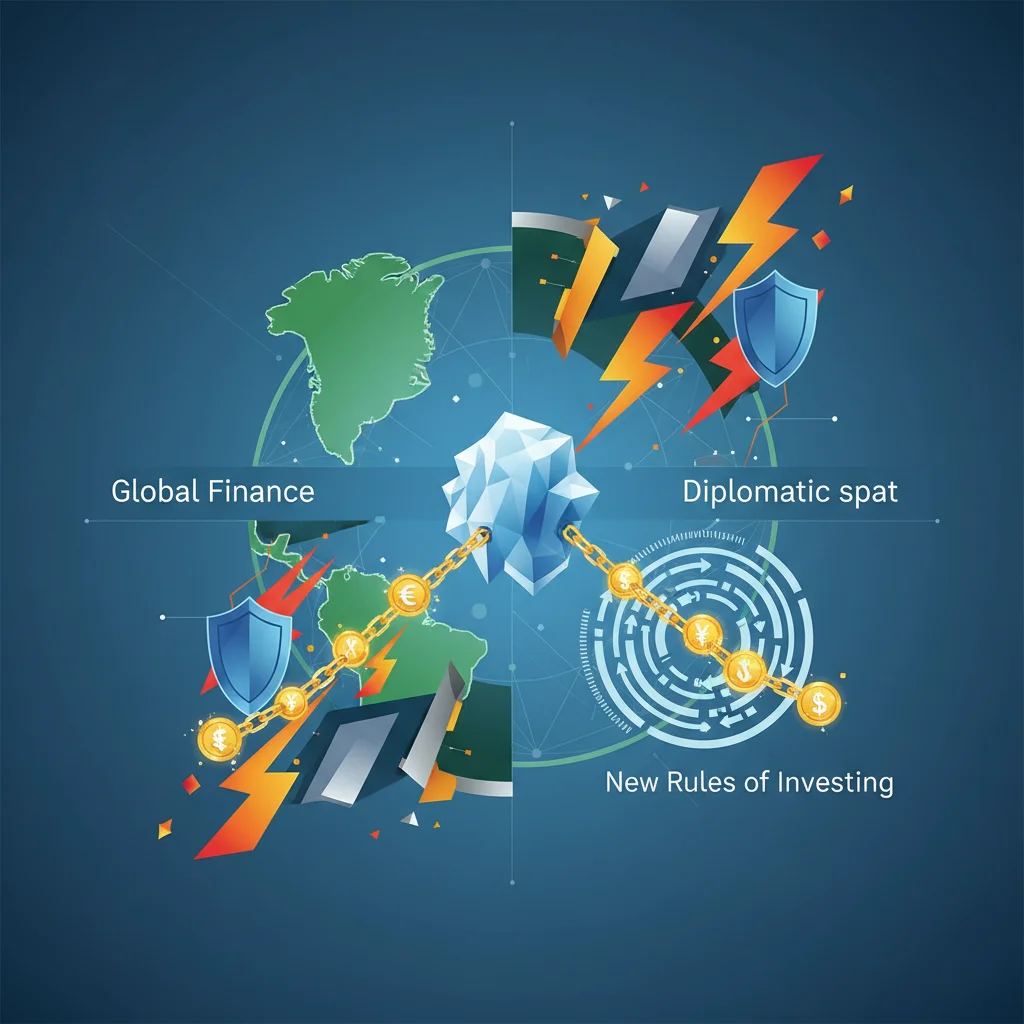
The Greenland Gambit: How a Diplomatic Spat Reveals the New Rules of Global Finance and Investing
In the high-stakes theater of global politics, opening acts can sometimes seem absurd, only to reveal a profound and unsettling plot. Such was the case when a seemingly bizarre proposition—the United States purchasing Greenland—escalated into a stark threat of economic warfare. When former U.S. President Donald Trump floated the idea, it was met with disbelief and a firm rejection from Copenhagen. Danish Prime Minister Mette Frederiksen’s response to the subsequent threat of tariffs was equally blunt: “Europe won’t be blackmailed.”
While the headlines have faded, the incident serves as a crucial case study for investors, finance professionals, and business leaders. It’s a powerful illustration of the new global landscape, where sovereign territory, critical resources, and economic policy are becoming increasingly intertwined and weaponized. This isn’t just a diplomatic curiosity; it’s a flashing red light on the dashboard of the global economy, signaling deep shifts in how power is projected and how markets will be forced to react. To understand the future of international investing and finance, we must dissect the layers of this Greenland gambit—from its geopolitical roots to its surprising implications for financial technology.
The Strategic Prize: Why Greenland is More Than Just Ice
To dismiss the interest in Greenland as a mere whim is to misunderstand its immense strategic value, a value that is appreciating rapidly due to climate change and technological demand. For centuries, Greenland’s potential was locked beneath a thick sheet of ice. Today, as that ice recedes, it is revealing a treasure trove of resources and strategic advantages that are central to 21st-century economics.
First, there is its geostrategic location. Greenland sits at the nexus of the Arctic and Atlantic oceans, forming a critical node in what could become the world’s next major shipping lanes. The Northern Sea Route, made navigable by melting ice, could slash transit times between Asia and Europe. For a global superpower, a significant presence in Greenland is a foothold in the future of global trade and naval positioning. This is underscored by the long-standing presence of the Pituffik Space Base (formerly Thule Air Base), a U.S. military installation that has been a cornerstone of North American defense since the Cold War.
Second, and perhaps more critically for the modern economy, is Greenland’s immense and largely untapped mineral wealth. The territory is believed to hold one of the world’s largest deposits of rare earth elements (REEs). These 17 metals are the lifeblood of modern technology, essential for everything from smartphones and electric vehicles to advanced defense systems and wind turbines. With China currently dominating over 80% of the global REE supply chain, securing a stable, alternative source is a matter of profound economic and national security. A 2023 agreement between the U.S. Geological Survey and its Danish/Greenlandic counterparts to map these critical mineral resources highlights just how seriously this potential is being taken at the state level.
This confluence of geographic positioning and resource wealth makes Greenland a pivotal piece on the global chessboard. The interest is not just a real estate transaction; it’s a strategic move to secure supply chains, project power, and gain an economic edge for the next century.
The Unseen Tax: How Soaring Energy Prices Are Reshaping the American Economy and Your Portfolio
Economic Statecraft: When Tariffs Become a Foreign Policy Tool
The threat to impose tariffs if the Greenland proposal was rebuffed is a textbook example of economic statecraft—the use of economic instruments to achieve foreign policy objectives. This tactic blurs the lines between trade policy and national security, creating significant volatility for the stock market and global commerce. For investors and business leaders, understanding this dynamic is no longer optional.
A tariff is essentially a tax on imported goods. In theory, it protects domestic industries. In practice, when used as a coercive tool, it triggers a cascade of negative consequences:
- Supply Chain Disruption: Companies relying on international supply chains face sudden cost increases, forcing them to either absorb the cost (hitting profit margins) or pass it on to consumers (fueling inflation).
- Market Volatility: The uncertainty created by tariff threats sends shockwaves through financial markets. Sectors directly affected, such as automotive, manufacturing, and technology, can see sharp declines in their stock valuations.
- Retaliatory Measures: The targeted nation or bloc, in this case Europe, rarely absorbs the blow passively. They retaliate with their own tariffs, leading to a tit-for-tat trade war that harms all parties involved and slows global economic growth.
To illustrate the potential fallout, consider the sectors that would be most vulnerable in a renewed U.S.-Europe trade dispute. The following table outlines some of the key areas and the potential implications for investors.
| Sector | Potential Impact on Businesses | Considerations for Investors |
|---|---|---|
| Automotive | Increased costs for European car manufacturers (e.g., VW, BMW, Mercedes) exporting to the U.S. and for U.S. manufacturers using European parts. | Negative pressure on auto stocks; potential pivot to companies with localized supply chains. Heightened risk in the sector. |
| Aerospace | Disruption for companies like Airbus and Boeing, which rely on transatlantic supply chains for parts and components. | Increased volatility for aerospace and defense stocks. Diversification away from companies heavily exposed to single-market trade policies becomes key. |
| Technology & Electronics | Higher costs for consumer electronics and components, particularly those containing rare earth elements processed in Europe. | Focus on companies with diversified REE sourcing. Potential opportunities in North American mining and processing firms. |
| Agriculture & Food | European luxury goods (wines, cheeses) and U.S. agricultural exports (soybeans, corn) become targets for retaliatory tariffs. | Risk for agricultural commodity trading. Potential benefit for domestic producers in the short term, but long-term instability is a major concern. |
The Digital Response: How Geopolitical Friction Fuels Fintech and Blockchain Innovation
While the immediate impacts of such disputes are felt in traditional markets, the secondary effects are accelerating innovation in the world of finance and technology. Heightened geopolitical risk creates specific problems that fintech and blockchain are uniquely positioned to solve.
One of the most significant challenges is supply chain opacity. When trade routes are stable and trust is high, the financial and logistical mechanics of moving goods are straightforward. But in a world of tariffs and sanctions, provenance and transparency become paramount. This is where blockchain technology enters the picture. By creating an immutable, decentralized ledger, a blockchain can track a product—from a rare earth mineral mined in Greenland to a microchip in a server—at every step of its journey. This offers several advantages:
- Verifiable Provenance: Companies can prove their materials are not sourced from sanctioned regions, helping them navigate complex regulatory environments.
- Enhanced Efficiency: Smart contracts can automate payments and customs clearance as goods cross borders, reducing friction in a high-friction world.
- Risk Mitigation: For the banking sector, financing trade becomes less risky when the location and status of the underlying assets are transparent and verifiable on a shared ledger.
Furthermore, the use of economic pressure by a dominant currency power (in this case, the U.S. dollar) inevitably encourages other nations to seek alternatives. This accelerates research and development into Central Bank Digital Currencies (CBDCs) and other digital payment rails that could reduce reliance on the SWIFT system and the dollar. The weaponization of economics is, ironically, a powerful catalyst for the very financial technology that could one day decentralize economic power.
The Hidden Tax on Shareholder Value: Why a Google Lawsuit Is a Critical Red Flag for Investors
The Investor’s Playbook for an Unpredictable World
So, how should investors and financial professionals navigate this volatile intersection of politics and finance? The old rules of simply diversifying across asset classes are no longer sufficient. A new, more sophisticated approach to risk management is required.
- Geopolitical Diversification: Beyond diversifying across stocks and bonds, consider diversifying across geopolitical lines. Over-concentration in any single country or region, no matter how stable it seems, is a significant risk. This includes diversifying supply chains for businesses and investment exposure for portfolios.
- Invest in Resilience and Adaptation: Look for companies that are building resilience into their operations. This could include firms specializing in supply chain logistics technology, cybersecurity (as economic conflict often spills into the digital realm), or domestic resource production. These are the companies that will thrive on volatility.
- Monitor Political Risk as a Key Metric: Incorporate geopolitical risk analysis into your core investing and trading strategies. Follow think tank reports, monitor legislative developments related to trade, and understand the political pressures in the key markets where you are invested.
- Focus on Inelastic Demand: In times of uncertainty, sectors with inelastic demand—such as healthcare, essential consumer staples, and regulated utilities—tend to be more resilient than those tied to discretionary spending or complex global supply chains.
Conclusion: The New Reality of Global Capital
The saga over Greenland was more than a political spectacle; it was a clear signal of a paradigm shift. The post-Cold War consensus of ever-freer trade and global integration is fracturing, replaced by a multipolar world characterized by great power competition and the strategic use of economic leverage. For those in the world of finance, this is the new reality. Success will no longer be determined solely by understanding balance sheets and market trends, but by an ability to understand the complex, often-irrational, and immensely powerful forces of geopolitics. The Greenland gambit may have failed, but the game it represents is just getting started.