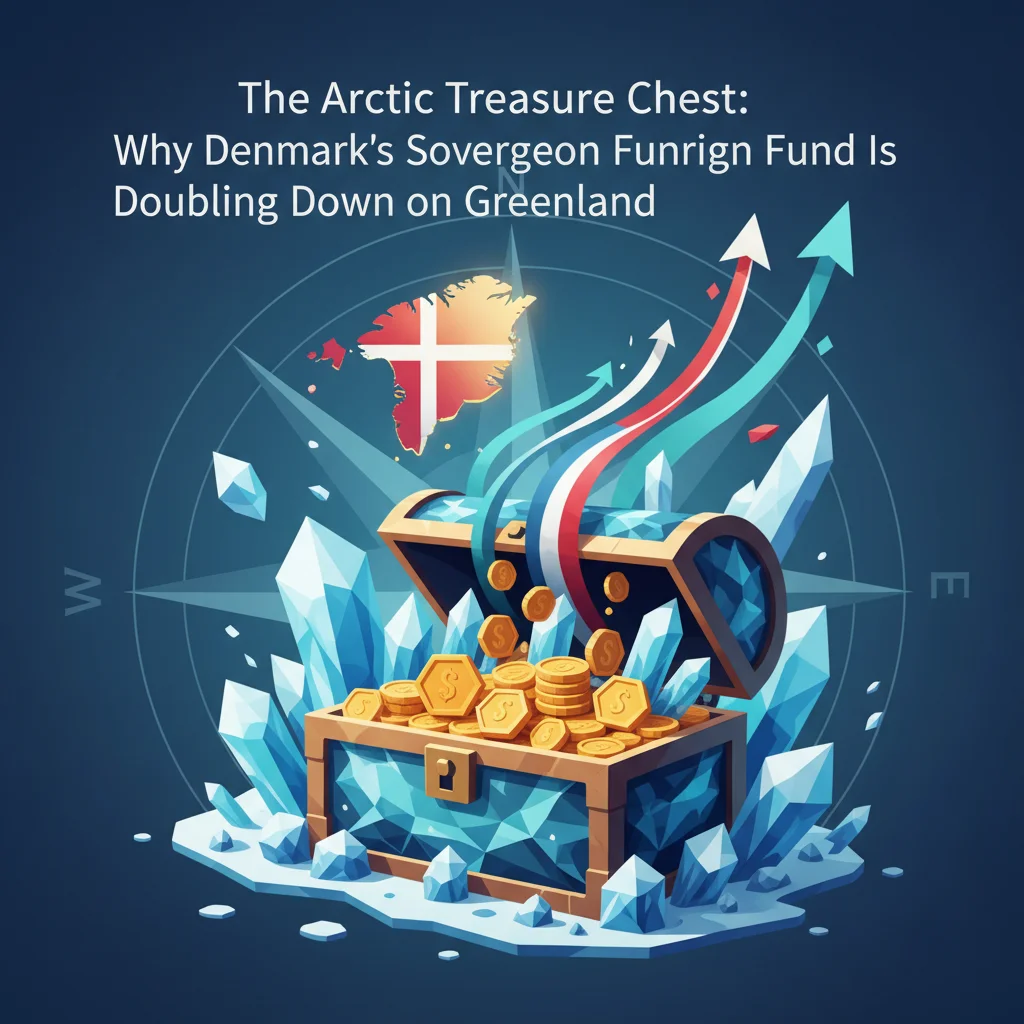
The Arctic Treasure Chest: Why Denmark’s Sovereign Fund Is Doubling Down on Greenland
In the world of high finance, capital flows toward opportunity. But sometimes, that flow signals more than just a promising balance sheet; it reveals the redrawing of the world’s geopolitical and economic map. A recent declaration from Denmark’s Export and Investment Fund (EIFO) is one such signal. The fund’s CEO, Peder Lundquist, has stated that EIFO possesses a “huge appetite” to invest in Greenland, signaling a pivotal moment for the Arctic island’s future and the global race for resources.
This isn’t just another portfolio diversification strategy. It’s a calculated move at the intersection of international economics, climate change, and strategic sovereignty. As the Arctic ice recedes, it’s uncovering not just new shipping lanes but a vast, untapped wealth of critical minerals—the very building blocks of our modern green and digital economy. EIFO’s commitment to be a “long-term reliable partner” is Denmark’s clear statement of intent: to lead the sustainable development of this new frontier and, in doing so, secure its strategic interests in an increasingly contested region.
This blog post will delve into the multifaceted implications of EIFO’s Greenland focus. We’ll explore the economic potential that has captured the attention of Danish investors, the immense geopolitical stakes at play, and the complex financial and technological frameworks required to turn Arctic potential into tangible prosperity. For investors, business leaders, and anyone interested in the future of the global economy, this is a development that demands attention.
Understanding the Key Player: Denmark’s EIFO
Before dissecting the opportunity in Greenland, it’s crucial to understand the entity behind this “huge appetite.” Denmark’s Export and Investment Fund (EIFO) is not a typical venture capital firm. It is Denmark’s national promotional bank and export credit agency rolled into one powerful entity. Formed from a merger of several state-backed financial bodies, EIFO’s mandate is twofold: to generate a competitive financial return and, equally important, to support Danish strategic interests at home and abroad.
With a total business volume in the triple-digit billions of Danish kroner, EIFO provides loans, guarantees, and equity investments to support Danish companies, drive the green transition, and promote Danish exports. Its involvement in Greenland is therefore a powerful tool of economic statecraft. By providing patient, long-term capital, EIFO can de-risk projects for private investors, ensure development aligns with Danish and European standards (particularly on environmental and social governance), and anchor Greenland’s burgeoning economy more firmly with its partners in the West.
From Caracas to Beirut: Unpacking the Shadow Economy Linking Venezuela and Hezbollah
Greenland: A Treasure Trove of Opportunity and Challenge
For centuries, Greenland has been a remote, ice-covered expanse. Today, it stands at the precipice of an economic transformation. EIFO’s interest is a testament to the island’s immense, multifaceted potential.
The Mineral Wealth: Powering the Future Economy
The primary driver of this investment appetite is Greenland’s staggering mineral wealth. The island is believed to hold some of the world’s largest untapped deposits of rare earth elements (REEs). These 17 metallic elements are not necessarily “rare,” but they are difficult to mine and process economically. They are also indispensable to modern technology. From the powerful magnets in wind turbines and electric vehicle motors to the components in smartphones, laptops, and advanced defense systems, REEs are the lifeblood of the 21st-century economy.
Currently, China dominates the global REE supply chain, a fact that has caused significant concern among Western governments. Developing a stable, reliable, and ethically sourced supply of these materials from a politically aligned region like Greenland is a top strategic priority. EIFO’s investment can provide the foundational capital to explore and develop these resources, creating a crucial alternative for global supply chains and boosting the entire green energy sector.
Beyond Mining: A Diversified Arctic Economy
While minerals grab the headlines, the investment potential extends far beyond mining. Key sectors include:
- Fisheries: Already the backbone of Greenland’s economy, there is potential for investment in modernizing the fleet, processing facilities, and sustainable aquaculture.
- Renewable Energy: Greenland’s vast hydropower potential could not only power its own industries but potentially export energy or produce green hydrogen.
- Tourism: The unique, pristine Arctic landscape offers incredible potential for high-value, sustainable eco-tourism.
- Infrastructure: Developing ports, airports, and housing is a prerequisite for any economic growth and represents a massive investment opportunity in itself.
The following table breaks down the key investment sectors, their potential, and the inherent risks that investors like EIFO must navigate.
| Investment Sector | Opportunity | Key Risks & Challenges |
|---|---|---|
| Critical Minerals (REEs) | Secure a Western-aligned supply chain for green tech and defense; high potential returns. | High upfront capital costs, environmental impact, price volatility in the global stock market, technical challenges. |
| Renewable Energy | Vast untapped hydropower potential; opportunity for green hydrogen production. | Extreme climate conditions, high infrastructure costs, connecting to potential export markets. |
| Infrastructure & Logistics | Foundational need for ports, housing, and airports to support all other sectors. | Massive capital requirements, long ROI horizons, harsh construction environment. |
| Fisheries & Aquaculture | Modernize an existing core industry; expand into sustainable aquaculture. | Climate change impacting fish stocks, international competition, sustainability regulations. |
The Financial Technology and Economic Implications
Unlocking Greenland’s potential requires more than just capital; it demands sophisticated financial instruments and a forward-thinking approach to economics. This is where modern finance, including financial technology (fintech), plays a crucial role.
The scale of these projects—from deep-earth mines to sprawling port facilities—necessitates complex project finance structures. EIFO’s role will be to act as a cornerstone investor, using its government backing to attract private capital from banking institutions and institutional investors. The economics of these ventures are long-term, requiring patient capital that can withstand the volatility often seen in commodity trading and the broader stock market.
Furthermore, financial technology can be a significant enabler. For instance, the challenge of ensuring that minerals are sourced ethically and sustainably is a perfect use case for blockchain technology. A distributed ledger could create an immutable record of a mineral’s journey from a Greenlandic mine to a European factory, providing the transparency that ESG-conscious investors and consumers demand. This isn’t just a theoretical application; it’s a practical solution that could give Greenlandic resources a significant premium on the global market.
From a macroeconomic perspective, this investment could fundamentally reshape Greenland’s economy. It offers a path to reduce its reliance on an annual block grant from Denmark, fostering greater economic independence. According to the Financial Times report, this strategic partnership is precisely what EIFO aims to build. A thriving, diversified economy in Greenland is not just good for its residents; it’s a strategic asset for Denmark and its allies.
The Billion Tsunami: Why Corporate America is Rushing to Borrow in an AI-Fueled Debt Frenzy
Navigating the Arctic Paradox: Risks and Responsibilities
The path to unlocking Greenland’s wealth is fraught with challenges. The “Arctic Paradox” is the central dilemma: the climate change that is making these resources accessible is the very phenomenon that sustainable development aims to combat. Mining and industrial activity in a pristine and fragile ecosystem carry immense environmental risks. Any misstep could have devastating and irreversible consequences.
Therefore, EIFO and its partners must champion the highest possible standards of environmental protection. This means investing in cutting-edge green mining technologies, ensuring minimal disruption to local ecosystems, and working in close partnership with the local Inuit communities, for whom the land and sea are a way of life. The social license to operate in Greenland is just as important as any government permit.
Political risk is also a factor. Greenland has a robust movement for full independence from Denmark. While EIFO’s investment is framed as a partnership, it must be managed carefully to empower, not overwhelm, Greenland’s government and people. The goal must be to create a relationship built on mutual economic benefit, not dependence.
The Trump Paradox: Decoding the Threat and Promise for Defense Industry Investors
The Final Word: A New Chapter for the Arctic
EIFO’s declared “huge appetite” for investing in Greenland is far more than a financial headline. It is a clear and powerful signal that the Arctic is open for business, but on new terms. This is not a 19th-century gold rush; it is a 21st-century strategic investment initiative defined by the imperatives of the green transition, supply chain resilience, and complex geopolitics.
The convergence of state-backed finance, technological innovation, and strategic foresight represents a new model for economic development in sensitive regions. For investors, the message is clear: the opportunities are immense, but they are inextricably linked with environmental and social responsibility. For the world, the development of Greenland under the stewardship of partners like EIFO could provide a new, stable source of the materials essential for a sustainable future. The ice is melting, and a new economic world is taking shape. Denmark is ensuring it has a front-row seat.

Related Posts
China’s Trillion-Dollar Pivot: What the 2025 Belt and Road Spending Surge Means for the Global Economy
The Gaza Reconstruction Fund: Is Trump’s “Board of Peace” the New Frontier for Geopolitical Investing?