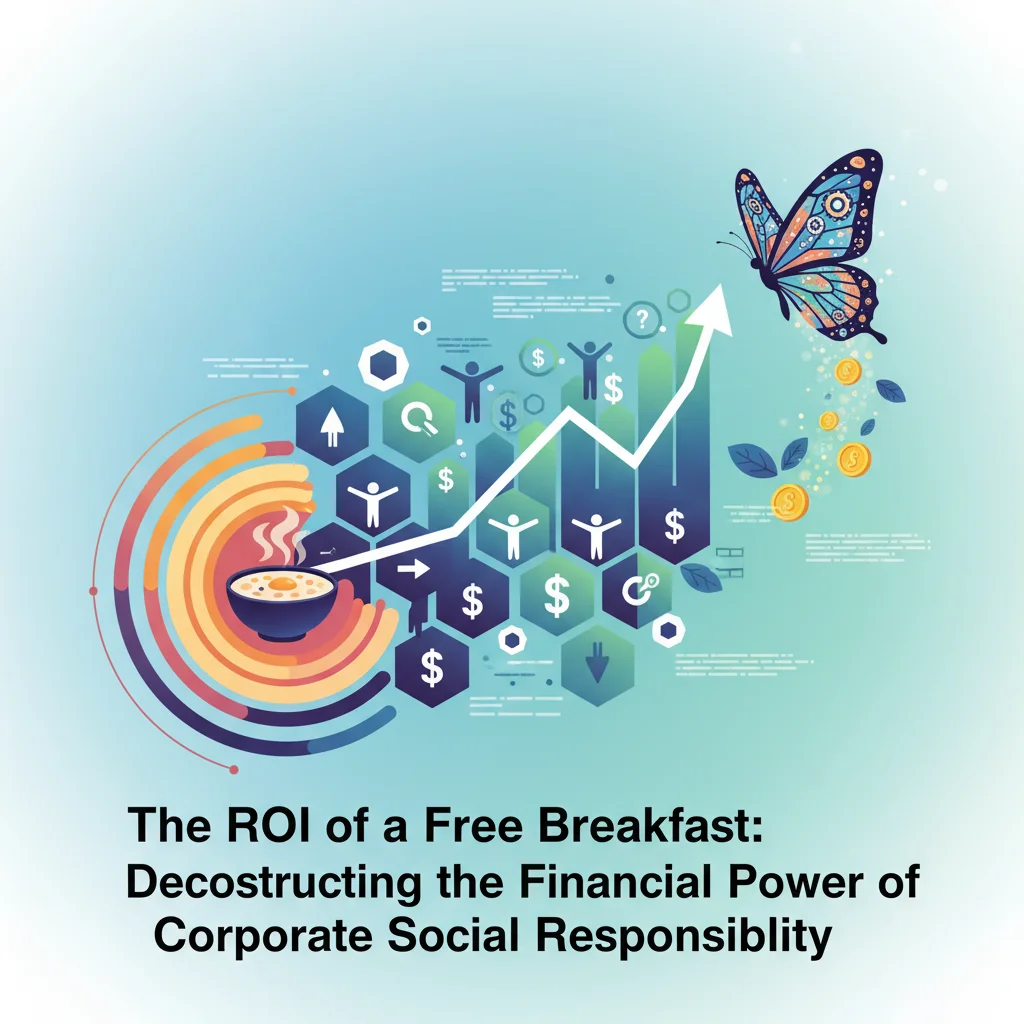
The ROI of a Free Breakfast: Deconstructing the Financial Power of Corporate Social Responsibility
The Butterfly Effect of a Simple Meal
In a quiet corner of a local community, the Hummingbird Cafe has begun offering free hot breakfasts to vulnerable people, a simple act of kindness aimed at supporting those who might otherwise go without. On the surface, this is a heartwarming local news story—a testament to community spirit. But for astute business leaders, investors, and finance professionals, it represents a microcosm of one of the most significant shifts in the modern economy: the rise of Corporate Social Responsibility (CSR) as a powerful driver of financial performance and long-term value. This single cafe’s decision provides a powerful lens through which we can analyze the tangible connections between social good, brand equity, economic stability, and even stock market valuation.
For decades, the prevailing economic theory, championed by economists like Milton Friedman, was that the sole social responsibility of a business is to increase its profits. Today, that paradigm is being fundamentally challenged. A new generation of consumers, employees, and investors is demanding more. They are increasingly directing their money, talent, and loyalty toward companies that demonstrate a genuine commitment to a “double bottom line”—one that measures both profit and purpose. The story of the Hummingbird Cafe is not just about charity; it’s a case study in building a resilient, trusted brand in an era of conscious capitalism. It forces us to ask a critical question: Is doing good for the community also good for the balance sheet?
ESG Investing: Turning Corporate Virtue into Market Value
The evolution from a niche concept to a mainstream financial strategy is best exemplified by the explosion of Environmental, Social, and Governance (ESG) investing. Investors are no longer just looking at price-to-earnings ratios or dividend yields; they are scrutinizing a company’s environmental impact, its labor practices, its board diversity, and its community engagement. The “S” in ESG—Social—is precisely where initiatives like the Hummingbird Cafe’s breakfast program create tangible, albeit sometimes difficult to quantify, value.
How does this translate into financial returns? The logic is compelling:
- Brand Loyalty and Customer Acquisition: Consumers are more likely to support businesses they perceive as ethical. A 2021 study found that 83% of consumers think companies should be actively shaping ESG best practices (source). This loyalty translates into higher customer retention and lower acquisition costs.
- Talent Attraction and Retention: The best and brightest in the workforce, particularly millennials and Gen Z, want to work for companies that align with their values. A strong CSR program becomes a competitive advantage in the war for talent, reducing costly employee turnover.
- Risk Mitigation: Companies with strong ESG profiles are often better managed and more attuned to long-term risks, from regulatory changes to supply chain disruptions and reputational damage. This operational resilience is highly attractive to long-term investors.
- Access to Capital: A growing pool of capital is specifically earmarked for ESG-compliant companies. From specialized mutual funds to institutional mandates, strong social performance can unlock new avenues of funding and potentially lower the cost of capital.
The performance of ESG-focused funds further supports this thesis. While performance can fluctuate with market conditions, numerous analyses suggest that companies with high ESG ratings have, over the long term, exhibited lower volatility and have often matched or outperformed their non-ESG counterparts. This fundamentally refutes the outdated notion that social responsibility comes at the expense of shareholder returns. The Great Retail Divide: Why Food Feasted and Fashion Famished in the UK's Christmas Showdown
Quantifying the Impact: A Comparative Analysis
To visualize the financial implications, let’s compare two hypothetical small-to-medium enterprises (SMEs): one that actively invests in community-based CSR and one that focuses purely on traditional financial metrics.
| Performance Metric | “Community-First” SME | “Profit-First” SME | Long-Term Financial Implication |
|---|---|---|---|
| Annual Employee Turnover | 10% | 25% | Reduced recruitment and training costs, higher institutional knowledge. |
| Customer Retention Rate | 85% | 60% | Higher lifetime customer value and lower marketing spend. |
| Local Media Mentions (Positive) | 20+ per year | 1-2 per year | Increased brand awareness and earned media value, reducing ad budget. |
| Access to Impact Investing Funds | Eligible | Ineligible | Diversified and potentially lower-cost sources of capital for growth. |
The Role of Financial Technology in Scaling Social Impact
While a local cafe relies on its direct community, the principles of its actions can be amplified globally through innovations in financial technology (fintech). The same forces disrupting traditional banking and trading are creating powerful new tools for channeling capital toward socially productive ends.
Consider the potential applications of fintech and even blockchain in this context:
- Micro-Donations and “Round-Up” Platforms: Fintech applications that allow users to round up their daily purchases and donate the change to causes they care about are democratizing philanthropy. A platform could easily partner with a network of local businesses like the Hummingbird Cafe, creating a steady stream of micro-funding for their social initiatives.
- Social Impact Bonds (SIBs): These are complex financial instruments where private investors fund social programs, and the government pays a return on investment if the programs are successful in delivering measurable outcomes. Fintech platforms can streamline the administration, measurement, and trading of these bonds, making them more accessible to a wider range of investors.
- Transparent Supply Chains with Blockchain: For larger-scale charitable efforts, blockchain technology offers an immutable ledger to track donations and resources. An investor or donor could, in theory, use a blockchain-based system to verify that their $10 donation intended for a meal program was actually used to purchase food and serve a meal, drastically increasing transparency and trust. This technology could transform how we audit and value the “S” in ESG.
- Crowdfunding for Social Enterprise: Platforms like Kickstarter and GoFundMe have already shown the power of the crowd. Specialized fintech platforms focused on social enterprises could allow businesses like the Hummingbird Cafe to raise capital for expansion not just based on a business plan, but on a “social impact plan.”
This intersection of finance, technology, and social good represents a new frontier. It moves the conversation beyond simple charity and into the realm of scalable, investable, and verifiable impact. Venezuela's 0 Billion Default: Deconstructing the Most Complex Debt Restructuring in History
Macroeconomic Ripple Effects of Micro-Level Actions
It is easy to dismiss a free breakfast program as a minor event, but its economic implications are more significant than they appear. Food insecurity is not just a social issue; it’s an economic one. According to The Trussell Trust, over 11 million people in the UK face hunger (source). This has profound economic costs, including increased healthcare expenditures, reduced productivity, and impaired educational outcomes for children, which limits future economic potential.
When a private enterprise like the Hummingbird Cafe steps in, it does more than feed someone for a day. It contributes to local economic stability. A person who has a stable source of food is better able to seek employment, manage their health, and participate in the local economy. In this sense, the cafe’s initiative is a form of hyper-local economic stimulus. It strengthens the community fabric, which in turn creates a more stable and prosperous environment for all businesses to operate in.
From the perspective of the broader banking and finance sector, supporting these small businesses is a strategic investment in the health of the overall economy. A stable community has fewer loan defaults, more small business creation, and a more robust consumer base. Financial institutions that develop programs to support socially-minded SMEs are not just engaging in philanthropy; they are underwriting the stability of their own future markets. The Lego Principle: What "Smart" Toys Teach Us About Dumb Investments
Conclusion: The New Bottom Line is a Blended One
The simple, compassionate act of a local cafe offering free breakfasts serves as a powerful allegory for the 21st-century economy. It demonstrates that the line between social value and financial value is blurring. What was once seen as an expense—a charitable donation on the profit and loss statement—is now being correctly identified as an investment in the most valuable assets a company has: its brand reputation, its customer loyalty, its employee morale, and the health of the community it serves.
For investors, the lesson is to look beyond the quarterly earnings report and analyze the resilience and long-term viability that strong ESG principles create. For business leaders, the takeaway is that integrating purpose into your profit model is no longer optional; it is the future of competitive advantage. The new economy will be led by those who understand that the most sustainable growth is rooted in the well-being of society. The Hummingbird Cafe may only be serving breakfast, but it’s also serving up a masterclass in the future of finance.