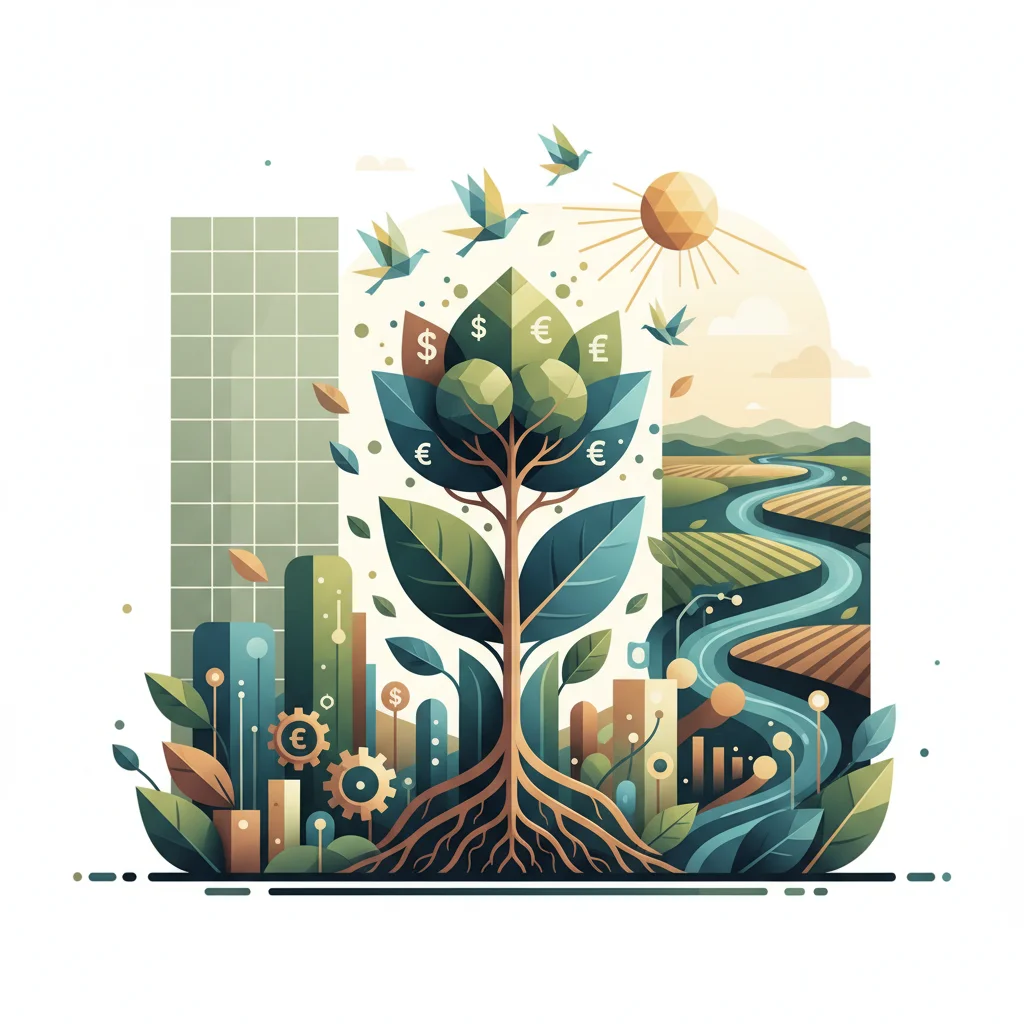
Rewilding the Portfolio: Why Natural Capital is the Next Frontier in Finance
It starts, as many profound economic shifts do, not in a bustling trading pit or a sterile boardroom, but in a simple garden. In a letter to the Financial Times, environmental commentator Rob Yorke posed a deceptively simple observation: even the most ardent “rewilding gardeners still need to eat breakfast.” This concise statement cuts through the romanticism of ecological restoration to reveal a fundamental tension—a tension that investors, business leaders, and financial professionals can no longer afford to ignore. The debate over a patch of land in Wales is a microcosm of a multi-trillion-dollar question facing the global economy: how do we value, manage, and invest in our most essential asset, Natural Capital?
For decades, the worlds of ecology and economics have operated in separate orbits. Nature was an externality—a source of free resources to be extracted or a picturesque backdrop for human activity. But this paradigm is collapsing under the weight of its own unsustainability. Climate change, biodiversity loss, and resource depletion are no longer abstract environmental concerns; they are material financial risks impacting every corner of the stock market, from agriculture and insurance to real estate and consumer goods. In this new reality, understanding the interplay between a rewilded forest and a productive farm is as crucial as understanding a company’s balance sheet. It’s about recognizing that the services nature provides—clean air, fresh water, fertile soil, and a stable climate—are the bedrock of our entire economic system.
The Evolving Landscape: Beyond the “Farming vs. Nature” Fallacy
The traditional view pits intensive agriculture against pristine wilderness in a zero-sum game. Yorke’s letter hints at a more nuanced conversation, one that moves beyond this false dichotomy. The future of land use, and by extension, a significant portion of our global economy, lies in a spectrum of solutions that integrate ecological health with economic productivity.
At one end, we have Rewilding, the large-scale restoration of ecosystems to a state where natural processes can function without human intervention. This isn’t just about planting trees; it’s about reintroducing keystone species and allowing complex ecological webs to re-establish themselves. The economic case for rewilding rests on the long-term value of “ecosystem services.” A rewilded landscape can provide immense, albeit historically un-priced, benefits: natural flood defense, carbon sequestration, water purification, and biodiversity that supports tourism and resilience.
At the other end, we have the evolving world of agriculture. The conversation is shifting from purely extractive, high-yield farming to models like Regenerative Agriculture. This approach focuses on improving soil health, enhancing biodiversity, and sequestering carbon in the ground, all while producing food. It transforms farms from being net carbon emitters to potential carbon sinks, creating a new potential revenue stream for farmers and a new asset class for investors.
The challenge for the world of finance is to build models that can accurately price the outputs of both systems—not just the bushels of wheat, but the tons of sequestered carbon, the cubic meters of purified water, and the unquantifiable value of a resilient ecosystem. This is where the modern financial toolkit, from sophisticated data analytics to innovative financial technology, becomes indispensable.
Pricing the Priceless: The New Economics of Natural Capital
For investors, the critical question is: how do we translate these ecological concepts into financial metrics? The answer lies in the burgeoning field of Natural Capital Accounting. This discipline seeks to assign a monetary value to the ecosystem services that have long been taken for granted. According to a landmark study, the global value of ecosystem services is estimated to be in the tens of trillions of dollars annually, far exceeding global GDP (source). Ignoring an asset of this magnitude is no longer a viable strategy.
This economic reframing is creating entirely new markets and investment opportunities:
- Carbon Markets: Companies and countries are increasingly required or incentivized to offset their emissions, creating a robust trading market for carbon credits generated by projects like reforestation and regenerative agriculture.
- Biodiversity Credits: A newer, but rapidly growing concept, where credits represent a measurable unit of biodiversity gain. Developers might purchase these credits to offset the environmental impact of a new project, creating a direct financial incentive for conservation.
- Water Quality Trading: In some regions, industrial polluters can purchase credits from farmers who implement practices that reduce nutrient runoff into waterways, creating a market-based solution to pollution.
To better understand the financial trade-offs, consider a simplified comparison of land-use models from an investor’s perspective. The table below illustrates how different approaches can yield diverse, stackable forms of value.
| Metric | Intensive Monoculture Farming | Regenerative Agriculture | Strategic Rewilding |
|---|---|---|---|
| Direct Commodity Yield | High ($1,500 – $2,500) | Moderate-High ($1,200 – $2,200) | Low/Negligible |
| Input Costs (Fertilizer, Pesticides) | High ($500 – $800) | Low-Moderate ($150 – $400) | Very Low ($0 – $50) |
| Carbon Sequestration Value* | Negative (Net Emitter) | Positive ($50 – $150) | High ($100 – $300) |
| Ecosystem Services Value** | Low | Moderate (Improved water retention, pollination) | Very High (Flood control, water purification) |
| Long-Term Asset Resilience | Decreasing (Soil degradation) | Increasing (Improved soil health) | High (Ecological stability) |
*Based on an estimated carbon price of $50/ton. **Ecosystem services values are highly localized and represent potential for payments or risk mitigation value. These figures are illustrative.
The Investor’s Playbook: From Soil to Stock Market
This transformation is not confined to rural landholdings; it is rippling through the entire financial ecosystem, from private equity to the public stock market. ESG (Environmental, Social, and Governance) investing has already moved from a niche concern to a dominant force, with global sustainable assets under management projected to exceed $50 trillion by 2025 (source). Natural Capital is the next logical evolution of the ‘E’ in ESG.
For finance professionals and business leaders, there are several key avenues for engagement:
- Agri-Tech & Food-Tech Investing: The need to produce more food with less environmental impact is fueling a boom in financial technology aimed at agriculture. This includes precision farming (using drones and IoT to optimize inputs), biotech for resilient crops, and platforms that connect farmers practicing regenerative methods with premium buyers. This is a core area where fintech innovation drives both economic and ecological returns.
- Natural Asset Companies (NACs): A new type of corporation is being developed and proposed for listing on exchanges like the New York Stock Exchange. These companies are designed to hold the rights to ecosystem services produced by natural landscapes, like a national park or a large-scale conservation area. This could allow investors to directly trade shares in the value of nature itself.
- Green Bonds and Thematic Funds: The banking sector is responding with a proliferation of financial products. Green bonds raise capital specifically for environmental projects, while a growing number of ETFs and mutual funds focus on themes like water technology, sustainable forestry, and the circular economy.
- Risk Management & Due Diligence: Companies that rely on natural resources—from beverage makers dependent on clean watersheds to clothing brands dependent on cotton—are facing new risks. Investors are increasingly scrutinizing supply chains for exposure to deforestation, water scarcity, and soil degradation, making natural capital a core component of modern risk analysis.
Brexit's Next Chapter: How a Political Showdown Could Redefine UK Finance and Investment
The Future is Blended: Policy, Technology, and a New Economic Mindset
Realizing the full potential of a natural capital-based economy requires more than just innovative investors; it needs a supportive framework of policy and technology. Governments are recalibrating agricultural subsidies to reward farmers for environmental stewardship rather than just pure output. Central banking institutions are beginning to incorporate climate and biodiversity risk into their financial stability models, acknowledging that ecological collapse is a systemic economic threat.
Simultaneously, financial technology is providing the essential infrastructure. Blockchain offers a promising solution for creating transparent, fraud-proof registries for carbon and biodiversity credits. AI and satellite imagery platforms are making it possible to monitor, report, and verify (MRV) environmental outcomes at scale, providing the data integrity that institutional investing demands.
Ultimately, the message from the rewilding gardener’s breakfast table is one of integration, not opposition. The future of a prosperous and stable economy is not a choice between a rewilded paradise and an industrial farm; it is a sophisticated blend of both. It is an economy where agricultural land is also a carbon sink, where forests are valued for their ability to prevent floods, and where a healthy ecosystem is understood to be the most critical infrastructure of all. For the investor and the business leader, the question is no longer *if* they should pay attention to nature, but *how* they will incorporate its immense value into their financial strategy. The breakfast, after all, depends on it.
The Venezuelan Oil Gambit: Why Trump's 0 Billion Pitch Clashed with Corporate Reality

Related Posts
The £1,500 Refund That Took 15 Months: A Case Study in Corporate Inefficiency and the Fintech Imperative

The ROI of a Free Breakfast: Deconstructing the Financial Power of Corporate Social Responsibility