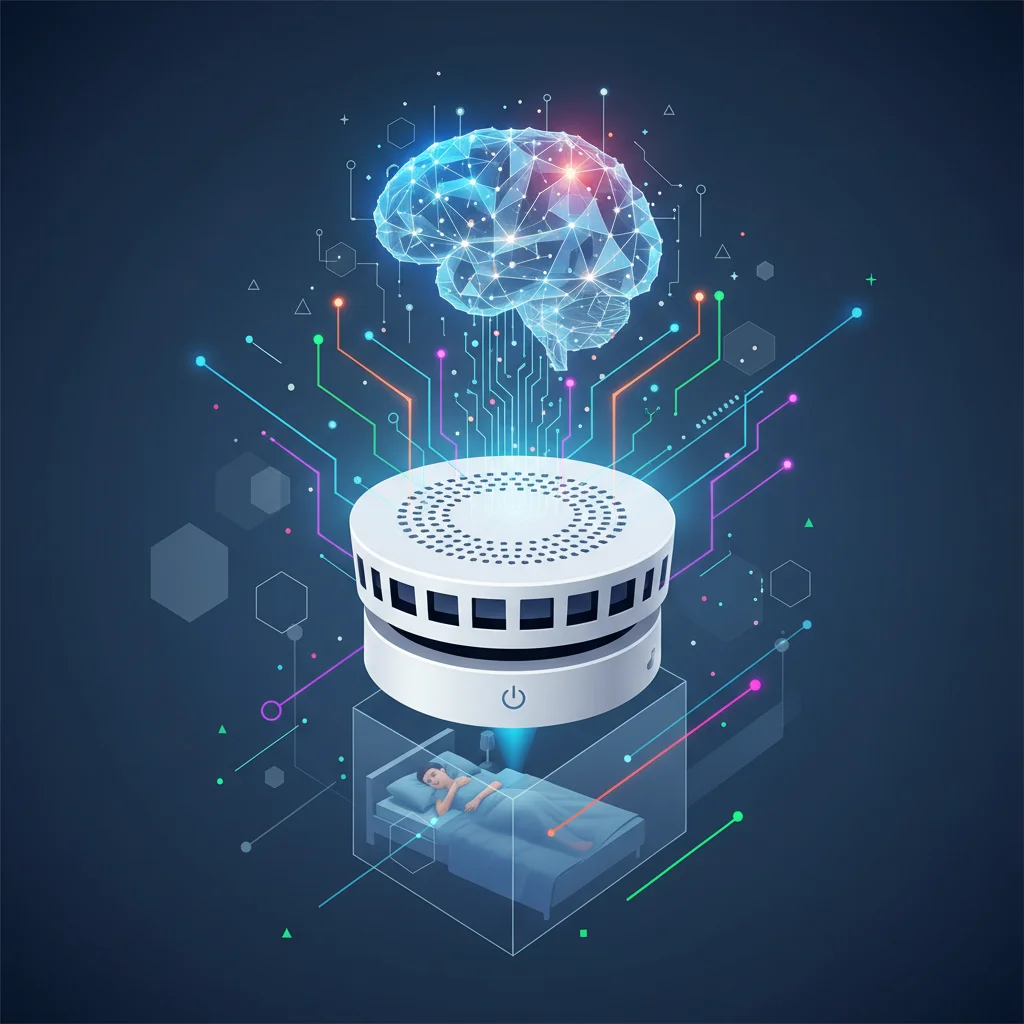
Your Smoke Detector is Getting a Brain: The AI Revolution in Fire Safety
We’ve all been there. It’s 3 AM, and a piercing, relentless chirp shatters your sleep. You stumble out of bed, grab a chair, and fumble with the plastic disc on the ceiling, desperately trying to silence the low-battery warning on your smoke detector. Or perhaps it’s the classic dinner-party scenario: a bit of steam from the kitchen or a slightly over-seared steak triggers a full-blown, ear-splitting alarm, sending guests into a mild panic.
For decades, the smoke detector has been a humble, essential, yet often frustratingly simple piece of technology. It’s a binary device—it either senses smoke particles or it doesn’t. While these devices are undeniably lifesavers, their simplicity is also their greatest weakness, leading to nuisance alarms that cause people to disable them, defeating their purpose entirely. In fact, you are nearly four times more likely to die in a house fire if you don’t have a working smoke alarm.
But what if that simple sensor could get a brain? What if it could think, learn, and understand the difference between burnt toast and a genuine, life-threatening blaze? This isn’t science fiction. A quiet revolution is underway, powered by artificial intelligence and machine learning, and it’s poised to transform the humble smoke detector into an intelligent guardian of our homes and workplaces.
From Simple Sensors to Intelligent Systems: A Quick History
To appreciate the leap forward that AI represents, it’s helpful to understand where we’ve come from. Most smoke detectors in use today rely on one of two technologies:
- Ionization Alarms: These are best at detecting fast-flaming fires. They use a tiny amount of radioactive material to create a small electric current. When smoke particles enter the chamber, they disrupt this current, triggering the alarm.
- Photoelectric Alarms: These excel at detecting smoldering, smoky fires. They use a beam of light. When smoke enters the chamber, it scatters the light onto a sensor, setting off the alarm.
While effective, both are prone to false positives from non-hazardous sources like cooking fumes, steam from a shower, or even dust. This “cry wolf” syndrome is a significant problem. The solution, until now, has been dual-sensor alarms that combine both technologies. It’s an improvement, but it’s still a blunt instrument. The next wave of innovation isn’t about better hardware; it’s about smarter software.
The AI Upgrade: Teaching a Machine to Recognize Fire
The new frontier in fire detection involves moving beyond simply sensing particles to actively interpreting a wide range of data points. Startups and tech firms are developing systems that use sophisticated machine learning models to analyze a rich tapestry of environmental data in real-time. Think of it as giving the detector eyes, a nose, and a brain.
One pioneering company, Pre-detec, is using artificial intelligence trained on a vast library of data to distinguish between real threats and false alarms (source). Instead of just looking for smoke, their systems can analyze the size and behavior of airborne particles, temperature fluctuations, humidity, and even carbon monoxide levels simultaneously. The AI model learns the unique “signature” of a dangerous fire versus the signature of boiling water or cooking smoke.
This multi-sensor approach, often called sensor fusion, is where AI truly shines. A traditional detector sees one data point: “smoke present.” An AI-powered system sees a dozen and asks intelligent questions:
- Are the particles large and dark, typical of a smoldering fire?
- Is the temperature rising rapidly?
- Is the level of carbon monoxide increasing?
- Does this pattern match the 10,000 other real fire events in my training data?
This leap in analytical capability is a game-changer. Below is a comparison of how these systems stack up.
| Feature | Traditional Smoke Detectors | AI-Powered Fire Detection Systems |
|---|---|---|
| Detection Method | Binary (Smoke/No Smoke) via Ionization or Photoelectric sensors. | Pattern Recognition via Multi-Sensor Fusion (Heat, CO, Humidity, Vision, etc.). |
| Accuracy | Prone to false alarms from steam, cooking fumes, dust. | Dramatically reduced false alarms by distinguishing real threats. |
| Response | Loud, localized alarm. | Tiered alerts, remote notifications to phone, can contact emergency services. |
| Intelligence | Static; does not learn or adapt. | Dynamic; models can be updated via the cloud to improve over time. |
| Integration | Typically standalone or hardwired to other alarms. | Integrates with smart home ecosystems for advanced automation. |
Some advanced systems are even incorporating computer vision. By integrating a camera (often a thermal or infrared one to respect privacy), the AI can be trained to visually recognize the flicker rate of flames or the specific way smoke plumes, providing another powerful layer of confirmation. This is the kind of granular analysis that was impossible just a few years ago.
The Taxman Cometh… With an API: Why a UK Tax Change Is a Gold Rush for AI and SaaS Startups
The Tech Stack: Cloud, SaaS, and Edge AI
This new intelligence doesn’t exist in a vacuum. It relies on a modern tech stack that will be familiar to any software developer or tech entrepreneur.
Edge AI vs. Cloud Computing: The initial, split-second decision-making needs to happen locally on the device. This is “Edge AI.” You can’t afford the latency of sending sensor data to the cloud and waiting for a response to sound an alarm. However, the device can periodically upload anonymized data to a central cloud platform. There, more powerful machine learning models can analyze trends from thousands of devices, refine the detection algorithms, and then push updated software back to the entire fleet. It’s a continuous learning loop that makes every device in the network smarter over time.
The Rise of Safety-as-a-Service (SaaS): For businesses, property managers, and even homeowners, this opens the door to a SaaS model for fire safety. Instead of just buying a piece of hardware, you could subscribe to a service that includes 24/7 monitoring, health checks on all your devices, detailed analytics, and automatic dispatching of emergency services. This model provides recurring revenue for startups in the space and a higher level of service for customers.
Programming and Data Science: The secret sauce is, of course, the data. Building these systems requires a massive, ongoing effort in data collection and programming. Engineers need to create simulations and conduct controlled burns of thousands of different materials—from wood and plastic to electrical wiring and cooking oil—to capture the unique data signatures and use them to train the AI models. It’s a complex intersection of hardware engineering, data science, and cloud architecture.
Grok AI, Deepfakes, and a Dangerous Delay: Why UK Law Can't Keep Up with Tech
The Unseen Hurdles: Cybersecurity and Trust
With great connectivity comes great responsibility. As these life-saving devices become connected to the internet, they also become potential targets for malicious actors. The cybersecurity implications are significant and cannot be an afterthought.
Imagine a hacker triggering thousands of alarms in a city simultaneously, causing mass panic and overwhelming first responders. Or, even more sinisterly, a targeted attack that disables the alarms in a building before an act of arson. Securing these devices—from the hardware level up through the cloud infrastructure—is paramount. This includes:
- End-to-End Encryption: All data transmitted from the device must be encrypted.
- Secure Boot & Firmware Updates: Ensuring that only authenticated software can run on the device.
- Network Security: Protecting the cloud servers from intrusion.
- Privacy by Design: Especially for devices with cameras, ensuring user data is anonymized and protected is crucial for building trust.
Beyond security, there’s the question of algorithmic trust. What happens if the AI gets it wrong? While the goal is to reduce false alarms, the system must be fail-safe, with a bias towards caution. The industry will need to establish rigorous testing and certification standards to ensure these AI systems are not just smart, but also incredibly reliable (source).
Grok AI and the Dark Web: When "Uncensored" AI Crosses a Dangerous Line
The Future is Smarter and Safer
The evolution of the smoke detector from a simple beeping box to an intelligent, connected safety hub is a perfect microcosm of the broader digital transformation happening all around us. It’s a story of how software, AI, and cloud computing are infusing everyday objects with unprecedented intelligence and capability.
For the general public, this means a future with fewer annoying false alarms and, more importantly, faster, more accurate detection that will save lives. For developers, entrepreneurs, and startups, it represents a massive market ripe for innovation, where cutting-edge technology can be applied to solve a fundamental human problem.
The next time you look up at that plastic disc on your ceiling, know that it’s on the verge of a serious upgrade. The simple chirp is giving way to a complex symphony of data analysis, pattern recognition, and intelligent automation. The brain is arriving, and it’s here to keep us safe.