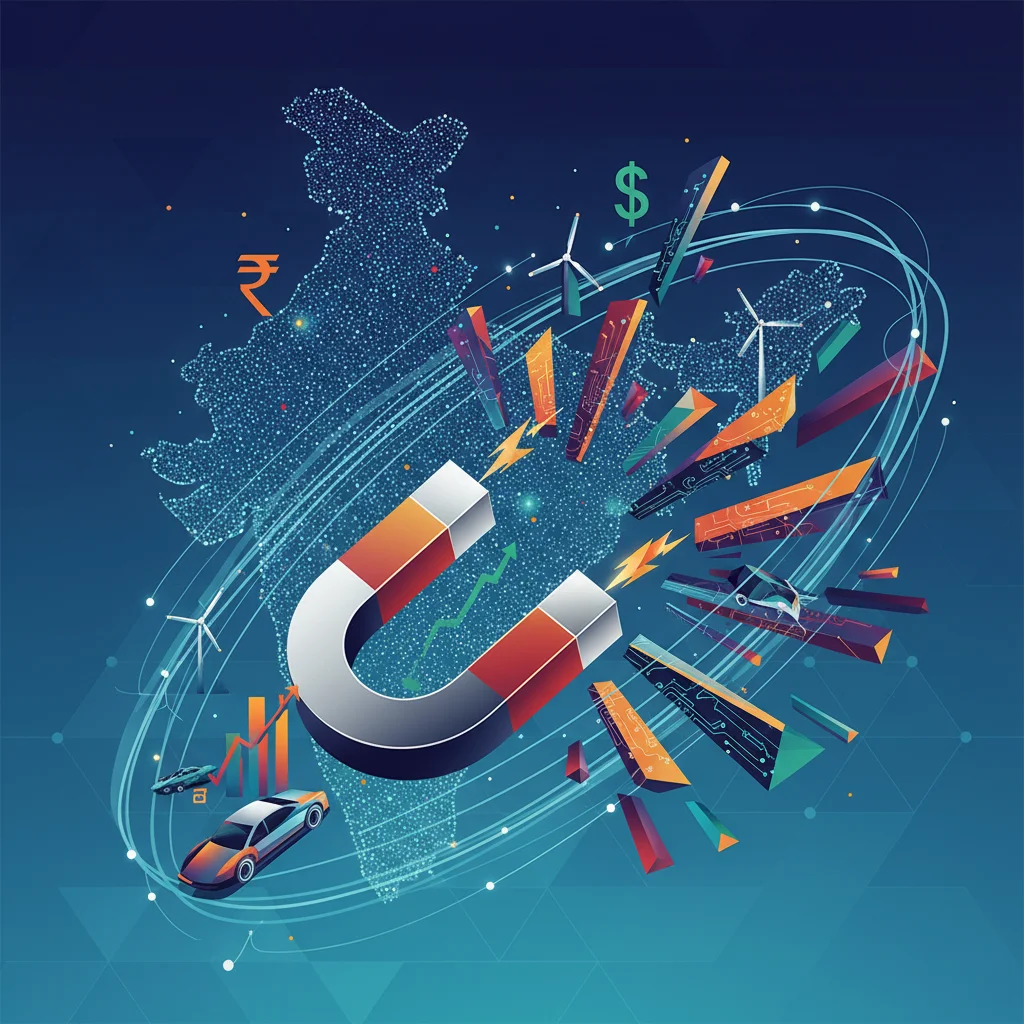
India’s $800M Bet on Rare Earths: A New Magnet for Global Investors?
In a world powered by invisible forces, few are more critical than the super-strong magnets at the heart of our most advanced technology. From the electric vehicle (EV) that glides silently down the street to the wind turbine spinning against the horizon, and even the smartphone in your pocket, these components are indispensable. For decades, the global supply chain for these critical materials has run squarely through one country: China. Now, India is making a bold, strategic move to change that, launching an $800 million plan to build its own rare earth magnet industry. This isn’t just an industrial policy; it’s a calculated gambit with profound implications for the global economy, geopolitical alignments, and the world of investing.
The Unseen Engine: Why Rare Earth Magnets Matter
First, let’s demystify the term “rare earth.” Rare Earth Elements (REEs) are a group of 17 metallic elements that, despite their name, aren’t necessarily rare in the earth’s crust. The real challenge—and where the strategic value lies—is in the complex, costly, and environmentally challenging process of extracting them from ores and refining them into high-purity materials. The most powerful of these are neodymium-iron-boron (NdFeB) magnets, or “neo” magnets. Their magnetic strength is unparalleled for their size, making them essential for high-efficiency electric motors and generators.
Consider the scale of their importance in the modern economy:
- Green Energy: Each large-scale wind turbine can use over a ton of rare earth magnets. Every electric vehicle requires several kilograms for its motor.
- Consumer Electronics: They are crucial for miniaturizing technology, found in everything from hard drives and speakers to medical devices.
- Defense & Aerospace: Their high performance is vital for missile guidance systems, drones, and jet fighter engines.
Without a stable supply of these magnets, the transition to a green economy stalls, technological innovation slows, and national security is compromised. This dependency has become one of the most significant, yet least discussed, vulnerabilities in the global supply chain.
The Domino Effect: Why the UK's Pub Rates Relief Is Igniting a Wider Call for Tax Reform
China’s Magnetic Monopoly: A Decades-Long Strategy
Understanding India’s move requires understanding the current landscape. China’s dominance in the rare earths sector is not an accident; it’s the result of a long-term industrial strategy. While other nations, including the US, scaled back production due to environmental concerns and lower costs abroad, China invested heavily, mastering the entire value chain from mining and processing to magnet manufacturing.
The numbers paint a stark picture. China currently accounts for an estimated 70% of global rare earth mining and a staggering 90% of the processing and refining into finished magnets (source). This vertical integration gives Beijing immense leverage, which it has not been afraid to use. In 2010, China temporarily halted exports to Japan during a diplomatic dispute, sending shockwaves through global markets and serving as a wake-up call for policymakers worldwide.
Below is a simplified breakdown of the global rare earth supply chain dominance:
| Stage of Production | China’s Estimated Global Market Share | Implication |
|---|---|---|
| Mining of REE Ores | ~70% | Control over raw material extraction. |
| Separation & Refining | ~90% | The most critical bottleneck; controls the conversion of ore into usable elements. |
| Alloy & Magnet Production | ~92% | Near-total monopoly on the final, high-value product. |
India’s Strategic Play: The $800 Million “Make in India” Push
Against this backdrop, India’s plan comes into focus. The nation possesses the world’s fifth-largest reserves of rare earths (source), yet it has historically lacked the technological capacity to process them into high-value magnets, forcing it to export raw materials and import the finished products—often from China. The new initiative, part of the broader “Make in India” campaign, aims to build this missing link in the value chain.
The government is offering production-linked incentives to private companies to establish refining and magnet manufacturing facilities. The goal is twofold:
- Achieve Strategic Autonomy: Secure a domestic supply of critical components for its burgeoning EV market, renewable energy sector, and defense industry.
- Become a Global Supplier: Position itself as a reliable alternative to China for Western and Asian nations looking to de-risk their supply chains—a concept often referred to as “friend-shoring.”
Success would be a monumental win for the Indian economy, creating high-skilled jobs, fostering a domestic tech ecosystem, and significantly improving its trade balance in a high-value sector.
Beyond the Hangover: The Multi-Billion Dollar Economics of Dry January
An Investor’s Perspective: Navigating the New Economic Frontier
For those in finance and investing, India’s rare earth gambit presents a complex but potentially lucrative long-term play. This initiative is set to create a new sub-sector on the Indian stock market, but it comes with a unique set of risks and rewards.
The Bull Case (Opportunities):
- First-Mover Advantage: Companies that successfully establish a beachhead in this sector could see exponential growth, backed by strong government support.
- Geopolitical Tailwinds: As Western governments actively seek to diversify from China, Indian producers could secure long-term supply contracts with major international firms in the automotive and energy sectors.
- Massive Domestic Demand: India’s own push for 30% EV adoption by 2030 and its ambitious renewable energy targets create a huge, captive market.
- ESG Angle: If India can develop environmentally superior processing methods, it could attract a premium from ESG-focused investment funds, a significant trend in modern financial technology.
The Bear Case (Risks):
- Execution Risk: This is a technologically intensive field. Delays, cost overruns, and failures in scaling up production are significant threats.
- Chinese Competition: China can leverage its scale and established infrastructure to lower prices, potentially making it difficult for new Indian entrants to compete on cost. This could create immense volatility for those involved in commodities trading.
- Technological Gap: Acquiring the necessary patents and know-how for efficient and clean processing may require expensive international partnerships or lengthy R&D cycles.
- Capital Intensity: Building this industry requires immense capital, and the path to profitability is long. The role of the Indian banking sector and its willingness to provide long-term financing will be crucial.
The Global Ripple Effect: Reshaping Trade and Technology
The implications of India’s success would extend far beyond its borders. A viable Indian rare earth magnet industry would fundamentally alter the global geopolitical landscape. It would provide a crucial counterweight to China’s dominance, reducing the risk of supply chain weaponization and creating a more resilient global market for critical technologies.
This move is a textbook example of the new era of economics, where industrial policy and national security are inextricably linked. For the United States, Europe, Japan, and South Korea, an Indian supply chain partner is an extremely attractive proposition. It aligns with the global “China Plus One” strategy that many multinational corporations are adopting.
The financing of such a massive industrial undertaking will also test and showcase modern financial instruments. We can expect to see green bonds, strategic investment funds, and innovative fintech solutions emerge to channel capital into this nascent industry. The success of this venture could serve as a blueprint for other emerging economies looking to build strategic industrial capacity.
Merck's Billion Gambit: Decoding the High-Stakes Pursuit of a Cancer-Fighting Pioneer
Conclusion: A High-Stakes Bet on the Future
India’s $800 million quest to master the rare earth magnet supply chain is far more than an industrial project; it’s a declaration of technological ambition and a bid for a more central role in the 21st-century global economy. The path is fraught with technical, financial, and environmental challenges. Failure would be a costly setback, but success would unlock immense strategic and economic value.
For investors, business leaders, and policymakers, this is a development to watch closely. It represents a potential tectonic shift in a critical, high-stakes industry. Whether India can turn its raw resource potential into a finished, high-tech manufacturing powerhouse remains to be seen, but its ambition to become a new magnet for the world is clear.

Related Posts
The Nobel Gambit: What María Corina Machado’s White House Visit Means for Venezuela’s Economy and Global Investors

Sudan’s Economic Implosion: Why the World’s Worst Crisis is a Red Flag for Global Investors