The Nikkei’s 33-Year High and Kishida’s Election Gambit: What Investors Need to Know
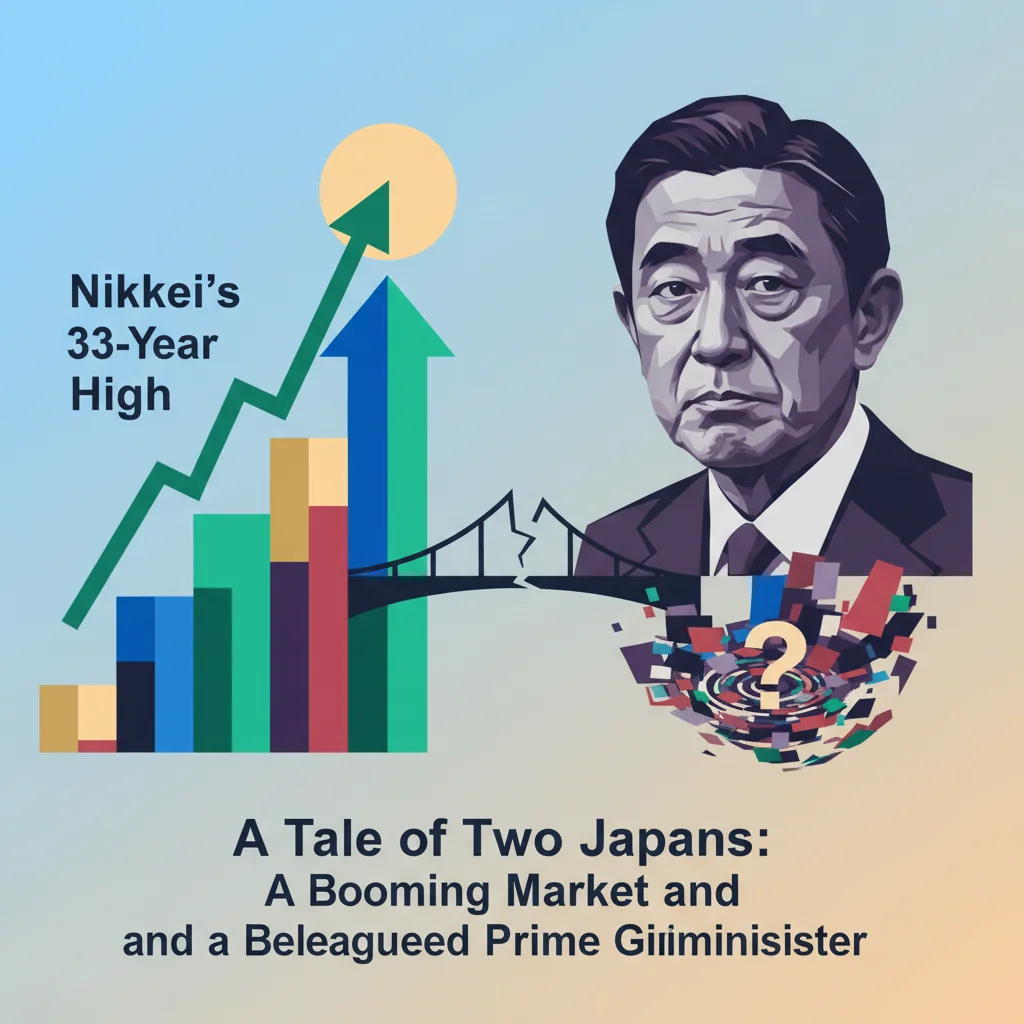
A Tale of Two Japans: A Booming Market and a Beleaguered Prime Minister
In the world of global finance, Japan is currently the talk of the town. The Nikkei 225, its benchmark stock index, has surged to heights not seen in over three decades, captivating investors and signaling a potential economic reawakening. Foreign capital is flooding back, legendary investor Warren Buffett is doubling down, and a wave of corporate reform is promising to unlock shareholder value. This is a story of economic optimism, a revival of an investment powerhouse.
Yet, there is a second, contrasting narrative unfolding in the corridors of power in Tokyo. Prime Minister Fumio Kishida, the leader presiding over this economic boom, is grappling with stubbornly low approval ratings. Despite recent diplomatic triumphs, including hosting a successful G7 summit in Hiroshima, public support remains tepid. It is within this paradox—a roaring stock market and a politically vulnerable leader—that the prospect of a high-stakes “snap election” has emerged. Why would a leader with shaky public standing risk it all? And more importantly, what does this political maneuvering mean for Japan’s economic trajectory and for investors worldwide?
This analysis will delve into the intricate political calculus behind a potential snap election, deconstruct the powerful forces driving the Japanese market rally, and explore the profound implications for the future of Japan’s economy, its role in global finance, and the opportunities for savvy investors.
The Political Calculus: Why Gamble Now?
In parliamentary systems like Japan’s, a prime minister has the power to dissolve the lower house of parliament and call an election before the end of their term. This “snap election” is a powerful political tool—a strategic gamble designed to maximize a ruling party’s advantage. For Prime Minister Kishida, the timing, while seemingly risky, is a calculated move to navigate a narrow window of opportunity.
His approval ratings have been languishing in the low 30s, a precarious position for any leader. However, a series of recent events have provided a temporary updraft. The G7 summit in his home constituency of Hiroshima was widely seen as a diplomatic success, bolstering his image on the world stage (source). Simultaneously, the Nikkei’s spectacular performance creates a “feel-good” factor that the ruling Liberal Democratic Party (LDP) hopes will translate into votes.
The urgency comes from what lies ahead. The government faces difficult and potentially unpopular decisions, including debates over tax hikes to fund increased defense spending and childcare initiatives. Furthermore, rising electricity prices are set to hit consumers’ pockets, which could further erode public support. By calling an election now, Kishida aims to secure a fresh mandate from the electorate *before* these contentious issues dominate the headlines, effectively “clearing the decks” to govern more decisively for the next few years.
The Coming Copper Crisis: Why a Metal Shortage Poses a Systemic Risk to the Global Economy
Deconstructing the “Kishida Rally”: A Structural Shift, Not Just a Sugar Rush
While the political winds are swirling, the real engine of Japan’s current moment is the fundamental transformation happening in its corporate sector. To label the market’s surge merely a “Kishida rally” would be to overlook the deep, structural changes that are making Japan an attractive destination for global capital. These changes suggest a sustainable trend, not a fleeting political bubble.
Several powerful catalysts are converging to drive this historic market performance. Below, we break down the key drivers:
| Key Driver | Description | Impact on Investing & Finance |
|---|---|---|
| Corporate Governance Reform | The Tokyo Stock Exchange (TSE) is aggressively pushing companies, particularly those trading below their book value (P/B ratio < 1), to improve capital efficiency and shareholder returns. | This is the most significant long-term factor. It forces management to focus on profitability, share buybacks, and dividend payouts, directly benefiting investors and improving the overall health of the stock market. |
| The “Warren Buffett Effect” | Legendary investor Warren Buffett’s Berkshire Hathaway has increased its stake in Japan’s five largest trading houses, signaling a major vote of confidence in the country’s economy. | Buffett’s endorsement acts as a powerful global signal, attracting a wave of foreign institutional investors who had previously overlooked Japan. It legitimizes the “Japan is back” narrative. |
| A Weaker Yen | The Bank of Japan’s continued ultra-loose monetary policy has kept the yen weak relative to other major currencies, especially the US dollar. | A weak yen is a major boon for Japan’s export-heavy economy, boosting the overseas profits of giants like Toyota and Sony when repatriated. This directly improves corporate earnings, a key metric for trading and investment. |
| Return of Foreign Capital | After years of being underweight on Japanese equities, foreign investors are now returning in force, injecting billions into the market as they seek value outside of the US and China. | This influx of capital provides the liquidity and momentum that fuels a sustained market rally, creating a positive feedback loop of rising prices and renewed investor interest. |
These factors combined represent a paradigm shift. For decades, Japanese companies were known for hoarding cash and prioritizing stability over shareholder returns. The pressure from the TSE is forcing a long-overdue cultural change in corporate Japan, unlocking immense latent value for those participating in the market.
The Election Gamble: Scenarios and Market Implications
A snap election is a double-edged sword. A victory could solidify Kishida’s leadership and provide a clear mandate for his “New Capitalism” agenda, which blends wealth redistribution with pro-growth policies. However, a poor showing could backfire spectacularly, weakening his position within the LDP and creating a period of political uncertainty—something markets abhor.
Investors and business leaders should be prepared for several potential outcomes, each with distinct consequences for Japan’s economy and financial markets.
Here is a breakdown of the most likely scenarios and their potential impact:
| Election Scenario | Political Outcome | Potential Market Impact |
|---|---|---|
| 1. Decisive LDP Victory | The LDP and its coalition partners maintain a strong majority. Kishida’s position is secured, and his leadership is validated. | Highly positive. This signals policy continuity and political stability, likely extending the market rally. Confidence in the “New Capitalism” agenda and corporate reforms would be reinforced. |
| 2. LDP Wins but Loses Seats | The ruling coalition holds onto power but with a reduced majority. This would be seen as a lukewarm victory, weakening Kishida’s mandate. | Neutral to slightly negative. The market may experience short-term volatility. While stability is largely maintained, questions about Kishida’s leadership could create uncertainty and slow policy momentum. |
| 3. LDP Loses Majority (Unlikely) | A major upset where the fragmented opposition parties manage to unseat the LDP-led coalition. | Highly negative. This would trigger significant political instability and policy uncertainty, likely leading to a sharp market sell-off as investors flee risk. The future of key economic and corporate reforms would be in doubt. |
The consensus view is that the LDP will likely win, but the margin of that victory is critical (source). For investors, the key takeaway is that political risk, which had been on the back burner, is now a factor to monitor closely in the Japanese market.
The Renminbi Riddle: Is China's Currency the World's Most Powerful Economic Lever?
Beyond the Ballot Box: Japan’s Broader Financial and Tech Horizon
Regardless of the election’s outcome, the renewed global focus on Japan is illuminating broader trends in its financial technology (fintech) and banking sectors. A stable, forward-looking government could act as a powerful accelerator for modernization. Prime Minister Kishida has already made investing in technology and startups a pillar of his “New Capitalism” agenda.
A renewed political mandate could fast-track initiatives aimed at:
- Digital Transformation: Encouraging traditional corporations and government services to adopt modern financial technology, improving efficiency and creating opportunities for fintech startups.
- Banking Modernization: Pushing Japan’s megabanks to innovate and compete more effectively on a global scale, potentially opening the door for more agile, tech-driven financial services.
- Regulated Digital Assets: Creating a clear regulatory framework for digital assets and blockchain technology, positioning Japan as a potential leader in the responsible development of Web3 finance.
This focus on technology and innovation is a crucial part of Japan’s long-term economic strategy. For international firms and investors in the tech and fintech space, Japan represents a massive, developed market on the cusp of a significant technological leap. The political stability that a decisive election victory would bring could be the final ingredient needed to unlock this potential.
Geopolitical Chess: Why a Squeeze on Venezuela's Oil Has China—and Global Investors—on Edge
Conclusion: A Critical Juncture for Japan
The potential snap election in Japan is far more than a domestic political affair; it is a pivotal event with significant implications for the global economic landscape. Prime Minister Kishida is attempting to thread a difficult needle—leveraging a transient market high and diplomatic goodwill to secure a long-term political mandate. For investors, the situation demands a nuanced perspective. The immediate focus may be on the political horse race, but the enduring story lies in the fundamental corporate reforms that are reshaping the bedrock of Japanese investing.
The Nikkei’s rally is built on a solid foundation of improved shareholder returns and renewed foreign confidence. A stable political outcome would serve as a powerful tailwind, accelerating these positive trends. Conversely, a political misstep could introduce a period of uncertainty. Ultimately, whether Kishida’s gamble pays off or not, the world has been reminded of Japan’s immense economic power and potential. The coming months will be critical in determining whether this is a fleeting moment of optimism or the dawn of a new, sustained era of Japanese economic leadership.

Related Posts
The UK’s Economic Paradox: Why Consumer Confidence Reveals a Nation Divided

The High-Stakes Showdown: Why Political Interference with the Federal Reserve Threatens Your Portfolio and the Global Economy