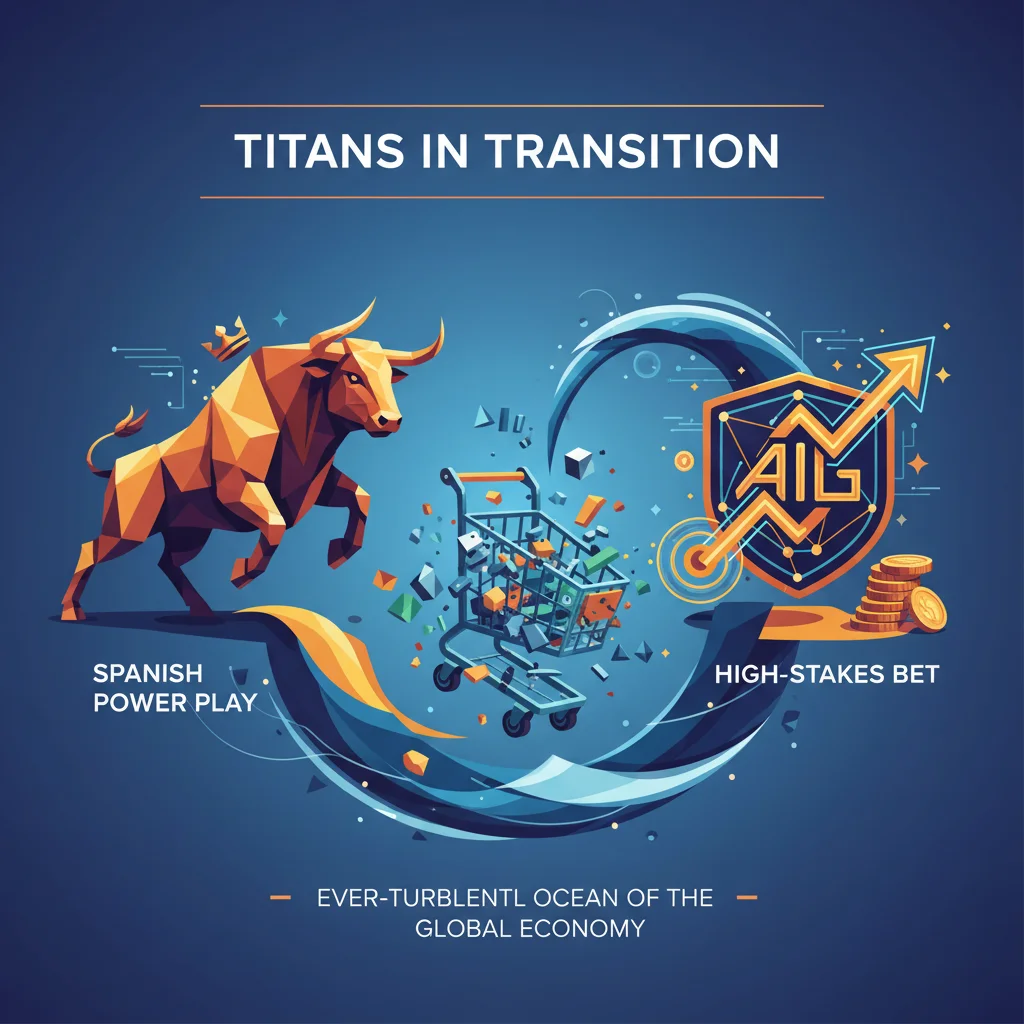
Titans in Transition: A Spanish Power Play, a Retail Reckoning, and AIG’s High-Stakes Bet
In the ever-turbulent ocean of the global economy, massive waves are constantly forming, reshaping the landscape for investors, executives, and consumers alike. This week, three distinct but interconnected stories paint a vivid picture of this dynamic reality: a bold power play in Spain’s corporate arena, the dramatic collapse of a retail icon, and the calculated return to risk by a financial giant still shadowed by its past. Each event, a chapter in the larger saga of modern finance, offers critical lessons on strategy, survival, and the relentless march of creative destruction.
From the boardrooms of Madrid to the bankruptcy courts of New York, these developments are more than just headlines; they are signals. They tell us where capital is flowing, which business models are failing, and how the titans of the financial world are positioning themselves for the future. For anyone involved in investing, banking, or leading a business, understanding these undercurrents is not just important—it’s essential for navigation.
The Spanish Gambit: How a New Powerbroker is Reshaping European M&A
All eyes in European finance are turning to Spain, where a new corporate powerbroker is orchestrating a multi-billion-dollar deal set to redefine the country’s industrial landscape. This isn’t just another transaction; it’s a masterclass in strategic maneuvering that highlights a broader shift in the continent’s mergers and acquisitions (M&A) climate. While the original Financial Times report outlines the deal’s mechanics, the true story lies in its implications for the European economy and investment strategy.
At the center of this move is a powerful investment vehicle that has spent years quietly accumulating influence. Now, it’s making a decisive play, targeting a legacy player in a critical sector—likely energy or telecommunications—with the aim of consolidation and modernization. This strategy is indicative of a new, more aggressive European M&A philosophy, one that is less about friendly mergers and more about strategic, value-extractive acquisitions driven by private capital.
The table below breaks down the key components of this landmark transaction, illustrating the complexity and ambition behind the headlines.
| Deal Component | Strategic Implication |
|---|---|
| Acquiring Entity | A consortium of private equity and sovereign wealth funds, showcasing the global nature of modern capital. |
| Target Company | An established Spanish industrial firm with significant assets but lagging technological integration. |
| Announced Valuation | Over €15 billion, making it one of the largest European deals of the year (source). |
| Stated Goal | To streamline operations, invest heavily in financial technology and green energy, and create a pan-European competitor. |
| Potential Hurdle | Navigating EU and Spanish regulatory approval, a key test for post-Brexit M&A frameworks. |
This deal matters because it signals that significant pools of capital see deep value in legacy European industries, provided they can be overhauled with modern management and technology. For investors, this opens up new avenues for thinking about the European stock market—not as a collection of stagnant giants, but as a hunting ground for transformative opportunities. The success or failure of this Spanish gambit will serve as a bellwether for the future of European corporate finance.
Beyond the Briefing Room: Decoding the High-Stakes Economic Chess Game in Venezuela
The Fall of an Icon: Saks Global’s Bankruptcy and the Brutal Reality of Modern Retail
On the other side of the Atlantic, a different kind of corporate drama is unfolding, one that serves as a cautionary tale for an entire industry. The news that Saks Global is facing bankruptcy is a seismic shock, but not an entirely surprising one. The luxury retailer, once a bastion of high-street aspiration, has become the latest casualty of a perfect storm: crushing debt, seismic shifts in consumer behavior, and the relentless dominance of e-commerce.
The company’s downfall wasn’t a single event but a slow-motion decline. It began years ago with a leveraged buyout that saddled the company with billions in debt, stifling its ability to invest in the very financial technology and logistics needed to compete with nimble online rivals. As consumer preferences shifted from ownership to experiences and from brand loyalty to social media-driven trends, Saks’ sprawling, expensive department stores began to look less like palaces of commerce and more like relics of a bygone era.
The numbers tell a stark story of a business model under siege. The filing revealed liabilities exceeding assets by a significant margin, a direct consequence of declining foot traffic and razor-thin margins. According to the report, same-store sales had been declining for eight consecutive quarters (source), a death knell in the world of retail.
This event is a crucial data point for anyone analyzing the consumer economy. It demonstrates that brand heritage alone is no longer a shield against market forces. Survival in modern retail requires a seamless integration of physical and digital experiences, a mastery of data analytics to predict trends, and a balance sheet strong enough to weather economic downturns. Saks Global’s failure is a lesson written in red ink for every business leader to study.
Dragon's Gambit: Why China's Billion Bet on Venezuela is a High-Stakes Test for Global Investors
AIG’s Risky Business: Why the Insurance Giant is Edging Back to the Abyss
Perhaps the most intriguing story of the week comes from the world of high-stakes banking and insurance. American International Group (AIG), a name synonymous with the 2008 financial crisis, is reportedly “edging back towards risk.” For anyone who remembers the taxpayer-funded bailouts and the near-collapse of the global financial system, those words are enough to send a shiver down the spine.
However, this isn’t 2008, and AIG’s current strategy is far more nuanced than the reckless abandon of the past. The company isn’t diving back into the murky world of credit default swaps on subprime mortgages. Instead, it is carefully expanding its portfolio into more complex, higher-margin areas of insurance and reinsurance. This includes underwriting risks in sectors like cybersecurity, climate change, and even the burgeoning field of blockchain-related asset protection.
Why this shift? The traditional insurance market of covering homes and cars is highly competitive and offers low returns. To satisfy shareholders and grow in a challenging economic environment, AIG is leveraging its vast analytical capabilities to price risks that other insurers won’t touch. This is where modern financial technology becomes critical. AIG is using sophisticated AI models and massive datasets to underwrite these new policies, a capability that simply didn’t exist in the same form fifteen years ago.
The table below contrasts AIG’s past risks with its current, more calculated approach.
| Risk Factor | 2008-Era AIG | Modern AIG Strategy |
|---|---|---|
| Primary Risk Type | Opaque, highly correlated financial derivatives (CDS). | Complex but diversifiable real-world risks (e.g., cyber, climate). |
| Risk Assessment | Based on outdated models that underestimated systemic risk. | Driven by AI, machine learning, and advanced fintech platforms. |
| Regulatory Oversight | Minimal and fragmented. | Strict, with high capital reserve requirements under post-crisis banking rules. |
| Market Signal | A sign of systemic over-leverage and financial hubris. | A signal of confidence in new risk-pricing technologies and a search for yield. |
This move is a litmus test for the entire financial industry. It asks a fundamental question: have we truly learned the lessons of 2008? AIG’s leadership would argue that with superior technology, stronger regulation, and a more diversified portfolio, this is a calculated, intelligent expansion. Skeptics, however, worry that a renewed appetite for risk, no matter how well-modeled, could reintroduce instability into the financial system. The outcome will have profound implications for the future of banking, trading, and the global economy.
Conclusion: Navigating the Tides of Change
The stories of a Spanish dealmaker, a fallen retailer, and a resurgent insurer are not isolated events. They are interconnected narratives about the powerful forces of capital, technology, and strategy that are shaping our world. They show us a global economy in a state of profound transition, where fortunes are made by those who can orchestrate change and lost by those who fail to adapt to it.
For investors and business leaders, the message is clear. The landscape is unforgiving, but it is also ripe with opportunity. Understanding the deep structures of finance, from the intricacies of a European M&A deal to the risk algorithms of a global insurer, is no longer optional. It is the only way to build resilient businesses and successful investment portfolios in the 21st century.