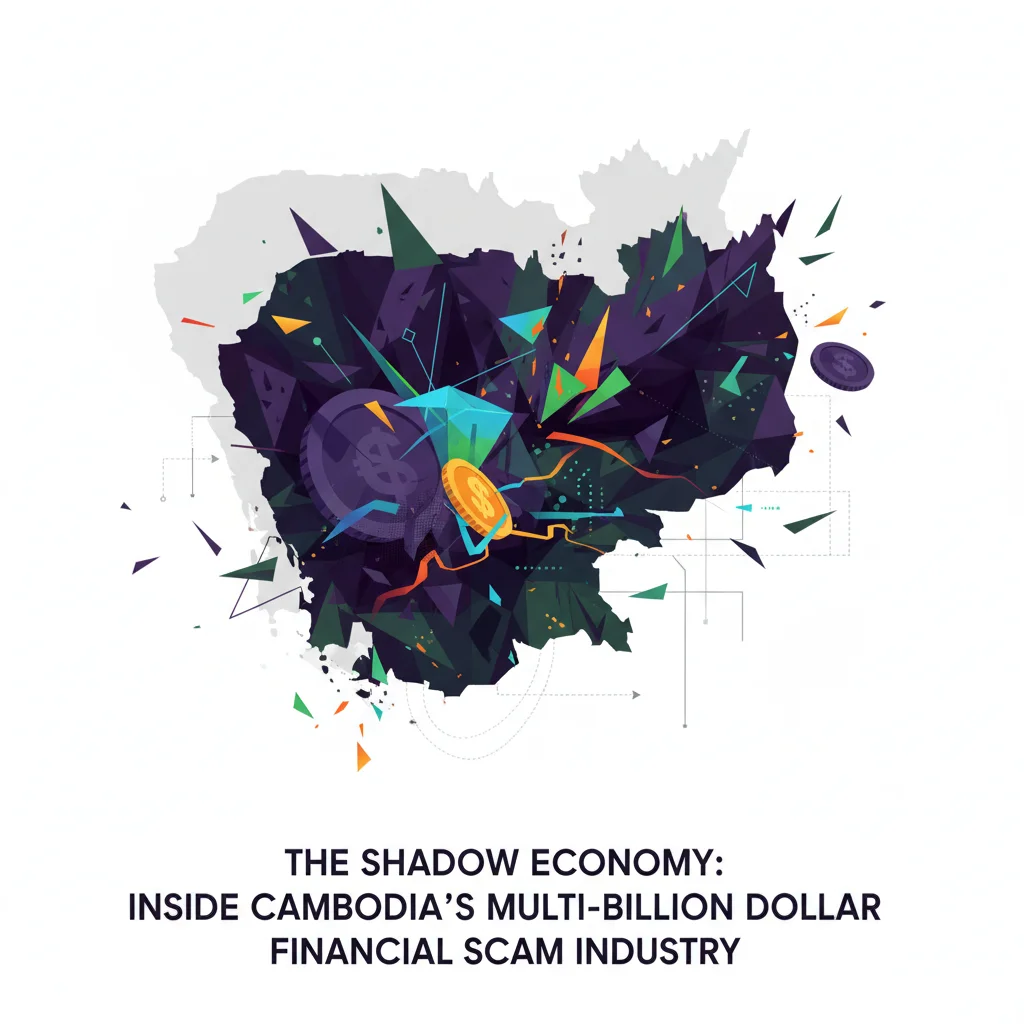
The Shadow Economy: Inside Cambodia’s Multi-Billion Dollar Financial Scam Industry
In the world of global finance, we often talk about disruptive innovation, the promise of fintech, and the democratization of investing. But running parallel to this bright, optimistic narrative is a darker, shadow economy—one that leverages the very same technologies to orchestrate fraud on an industrial scale. At the heart of this global criminal enterprise lies Cambodia, a nation that has become the unwilling epicenter of a sprawling network of online scams that defraud internet users of billions of dollars annually.
These are not the clumsy “Nigerian prince” emails of the past. This is a highly sophisticated, technologically advanced, and brutally efficient industry that combines psychological manipulation, fraudulent financial technology, and modern-day slavery. For investors, finance professionals, and business leaders, understanding the mechanics of this shadow economy is no longer just a matter of curiosity; it’s a critical component of risk management in an increasingly digital world.
The Anatomy of a 21st-Century Heist: “Pig Butchering”
The dominant model perfected in these Cambodian scam compounds is known as “pig butchering” (sha zhu pan in Chinese). The name is grimly descriptive: victims are identified (“pigs”), “fattened up” over weeks or months with feigned romantic or friendly relationships, and then “butchered” by convincing them to invest their life savings into fraudulent trading platforms.
These platforms are masterpieces of deception. They are meticulously designed to mimic legitimate stock market or cryptocurrency trading apps, complete with real-time charts, sophisticated user interfaces, and what appear to be small, initial profits to build confidence. The scammer, acting as a trusted friend or lover, guides the victim through the process, leveraging the complexities of modern finance and trading to their advantage. They exploit the victim’s lack of deep knowledge about financial technology, making them feel empowered while leading them into a trap.
The UN estimates that these criminal syndicates generate revenues in the billions of dollars, a scale that rivals the economy of some small nations. According to one Taiwanese police official, a single case saw a victim lose an astounding US$2 million, highlighting the devastating financial impact on individuals.
India's Trillion Dream: A Rising Tide or a Widening Gulf?
Why Cambodia? A Perfect Storm of Corruption and Opportunity
How did Cambodia become the global hub for these operations? The answer lies in a confluence of economic, political, and social factors that created the perfect environment for organized crime to flourish.
Much of this activity is centered in coastal cities like Sihanoukville, which underwent a massive, largely unregulated construction boom fueled by Chinese investment under the Belt and Road Initiative. When China cracked down on online gambling in 2019 and the COVID-19 pandemic hit, these gleaming new casinos and compounds stood empty. They quickly became the ideal infrastructure for criminal gangs, many with links to mainland China, to set up secure, large-scale scam operations.
Weak governance and endemic corruption provide a shield for these networks. Despite international pressure and sanctions from countries like the US, these operations continue with impunity. A senior western official noted that the Cambodian government “has not shown the political will to address this problem,” a sentiment echoed by many international observers (source). This creates a low-risk, high-reward environment for criminals, transforming parts of the country into de facto special criminal zones.
The Human Trafficking Engine Fueling the Scams
Perhaps the most disturbing aspect of this industry is its reliance on forced labor. The “employees” carrying out these scams are often victims themselves, lured to Cambodia (and neighboring countries like Myanmar and Laos) with promises of high-paying tech or customer service jobs. Upon arrival, their passports are confiscated, and they are forced to work 16-hour days under the threat of violence, torture, or being sold to another gang.
The UN High Commissioner for Human Rights has reported that hundreds of thousands of people across Southeast Asia are trapped in this horrific system . These are often educated, multilingual young people from across Asia and beyond, who are coerced into defrauding people in their native languages. This creates a cruel, self-perpetuating cycle where victims are forced to create more victims.
This human element adds a layer of complexity for law enforcement and financial institutions. The person on the other end of the chat may be both a perpetrator and a captive, blurring the lines of criminality and victimization.
Dragon's Gambit: Why China's Billion Bet on Venezuela is a High-Stakes Test for Global Investors
Following the Money: The Role of Blockchain and Crypto
A multi-billion dollar criminal enterprise requires a sophisticated financial plumbing system to launder its proceeds. This is where blockchain and cryptocurrency play a pivotal, and problematic, role. While traditional banking systems have robust Anti-Money Laundering (AML) and Know Your Customer (KYC) regulations, the world of decentralized finance offers a path of less resistance.
Scammers typically direct victims to convert their fiat currency into cryptocurrencies like Tether (USDT) or Bitcoin (BTC) and transfer them to wallets controlled by the criminal network. From there, the funds are rapidly moved through a complex web of wallets and mixing services, intentionally obfuscating their origin before being cashed out. This makes tracking and recovery nearly impossible for law enforcement and a nightmare for the traditional banking sector, which often serves as the initial on-ramp and final off-ramp for these funds.
The table below outlines the typical financial flow in a “pig butchering” scam, highlighting the role of different financial technologies.
| Phase | Description | Key Financial Technology Used |
|---|---|---|
| 1. Initial Investment | Victim is convinced to make a small, “test” investment. | Traditional Banking (Wire Transfer), Payment Apps. |
| 2. Conversion to Crypto | Victim is instructed to convert larger sums into cryptocurrency for “better returns.” | Regulated Crypto Exchanges (e.g., Coinbase, Binance). |
| 3. Transfer to Fraudulent Platform | Victim sends crypto from their personal wallet to a wallet controlled by the scammers. | Blockchain (Public Ledgers), Non-custodial Wallets. |
| 4. Laundering & Obfuscation | Scammers move the funds through multiple wallets and mixing services to hide the trail. | Decentralized Exchanges (DEXs), Crypto Mixers, Chain-hopping. |
| 5. Cash-Out | Criminals convert the “clean” crypto back into fiat currency through OTC brokers or exchanges in jurisdictions with lax oversight. | Peer-to-Peer (P2P) Trading, Overseas Banking. |
Implications for the Global Financial Ecosystem
The rise of Cambodia’s scam industry is more than a collection of individual tragedies; it’s a systemic threat to trust in the digital economy. For the finance and investing world, the implications are profound:
- Erosion of Trust: Every successful scam undermines confidence in legitimate online investment platforms and financial technology. This “trust tax” can slow adoption and make genuine customers more hesitant.
- Compliance and Regulatory Risk: Banks and regulated crypto exchanges are under immense pressure to identify and block transactions linked to these networks. Failure to do so can result in massive fines and reputational damage. The sophistication of these scams challenges even the most advanced AML systems.
- The Future of Investing: As AI-powered deepfakes and more personalized scamming scripts become prevalent, the line between legitimate financial advice and sophisticated fraud will become even blurrier. The industry must innovate defensively to protect consumers.
The AI Productivity Paradox: Why Wall Street's Hype May Not Lift Main Street's Fortunes
Ultimately, tackling this global problem requires a multi-pronged approach. It demands not only international law enforcement cooperation and diplomatic pressure on countries like Cambodia but also a concerted effort from the financial technology sector itself. Better security, more robust user verification, and proactive education are essential. For investors and business leaders, the key takeaway is a renewed emphasis on diligence. The old adage, “If it sounds too good to be true, it probably is,” has never been more relevant. In today’s complex financial landscape, a healthy dose of skepticism is the most valuable asset you can have.