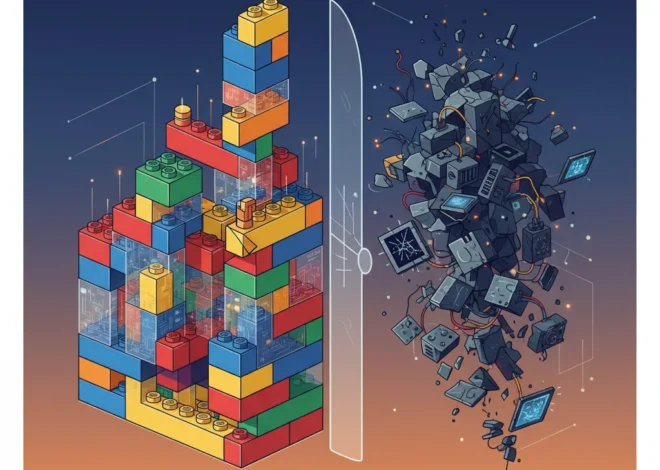
The Hard Reset: Why Your Robot Revolution Is Failing and How to Fix It
We’ve all seen the videos. Sleek robotic arms moving with hypnotic precision, autonomous carts gliding silently through futuristic warehouses, and the promise of a “lights-out” factory humming along with perfect efficiency. It’s a compelling vision, one that fuels the dreams of entrepreneurs, developers, and Fortune 500 executives alike. The message is clear: automation is the future, and the future is now.
But for anyone who has actually tried to bring this vision to life, the reality is often less like a slick marketing video and more like a complex, expensive, and frustrating science project. The truth is, the robot itself is just the tip of the iceberg. The real challenge—the part that sinks budgets and timelines—is everything else: the planning, the integration, the software, and the immense human effort required to make machines work in a world built for people.
Implementing automation isn’t a simple purchase; it’s a deep, strategic transformation. And according to a recent analysis, the path is paved with significant investments of planning, time, and money. Whether you’re a developer writing the code, a startup founder pitching the vision, or a manager tasked with execution, understanding the hidden complexities is the first step toward success.
The Automation Iceberg: What Really Lies Beneath the Surface
When a company decides to automate a process, the focus is almost always on the hardware. “Which robot should we buy?” is the first question asked. But it’s the wrong one. The right question is, “What entire system do we need to build around this robot?”
The physical machine is the visible 10%. The other 90% is a sprawling, interconnected system of invisible components:
- Systems Integration: Your new robot doesn’t just plug into the wall. It needs to communicate with your existing Enterprise Resource Planning (ERP) software, your Warehouse Management System (WMS), and a dozen other legacy systems. This requires complex API development, custom programming, and endless testing.
- Infrastructure Overhaul: Does your facility have the right power grid? Is your Wi-Fi network robust and secure enough to handle a fleet of connected devices? Do you need to physically re-engineer your assembly line or warehouse floor? These are costly, time-consuming prerequisites.
- Cloud and Data Pipelines: Modern automation is powered by data. This means building robust data pipelines to feed information to your robots and, more importantly, to the artificial intelligence and machine learning models that optimize their behavior. This often involves significant investment in cloud infrastructure and specialized SaaS platforms.
- Maintenance and Downtime: Robots break. Software has bugs. When your automated system goes down, it doesn’t just stop one person’s work; it can halt an entire production line. The cost of downtime and the need for a highly skilled, on-call maintenance team are frequently underestimated.
To put this in perspective, let’s break down the perceived costs versus the hidden reality of a typical automation project. The initial hardware purchase is often just the entry fee.
| Cost Component | Common Assumption (The “Sticker Price”) | The Hidden Reality (The Total Cost of Ownership) |
|---|---|---|
| Hardware | The main expense. The robot itself. | Often only 25-30% of the total project cost. |
| Software | Included with the robot or a one-time license fee. | Requires extensive customization, integration fees, ongoing SaaS subscriptions, and specialized programming. |
| Installation | A few days of setup by the vendor. | Weeks or months of facility prep, infrastructure upgrades, and systems integration before the robot is even turned on. |
| Training | A quick workshop for a few operators. | A complete cultural shift. Requires retraining operators, upskilling maintenance teams, and hiring new talent in areas like data science and robotics engineering. |
| Security | Covered by our existing IT security. | Requires specialized Operational Technology (OT) cybersecurity to protect physical assets from new, complex attack vectors. |
AI's Trillion-Dollar Gamble: Are We Building a Revolution or the Next Tech Bubble?
The People Problem: Automation is a Human Challenge
Perhaps the most overlooked aspect of automation is the human element. You can’t simply replace a human worker with a robot and expect the same results. You are fundamentally changing the nature of the work itself, which creates a new set of challenges.
The skills gap is one of the most significant hurdles. The person who used to manually assemble a product is not the same person who can troubleshoot a Python script, recalibrate a sensor, or analyze a machine learning model’s performance. The demand for “hybrid” talent—individuals who understand both the physical world of mechanics and the digital world of code—is skyrocketing. These roles, like Robotics Engineers and Automation Technicians, are difficult to fill and command high salaries.
Furthermore, successful automation requires a cultural shift. It demands collaboration between previously siloed departments: IT, operations, and engineering must now work in lockstep. It also requires a commitment to continuous learning and adaptation. The “set it and forget it” mentality is a recipe for disaster in a field where innovation is constant.
The same is happening with robotics. Companies think they’re just buying a machine, but they’re actually adopting a new operational paradigm. The rise of smarter, AI-powered robots that can adapt to new tasks without reprogramming is a game-changer, but it also adds another layer of complexity. Now you don’t just need a robotics engineer; you need a data scientist who can manage the training data and an AI ethics specialist to ensure your autonomous systems are making safe and fair decisions. The hardware problem is getting easier to solve, but the systems and people problems are getting exponentially harder. The real winners won’t be those who buy the most robots, but those who build the smartest, most resilient human-machine systems.
The Startup’s Dilemma: Building for the Physical World
For the entrepreneurs and startups in the audience, the automation space presents a unique and daunting set of challenges. Unlike a pure SaaS company that can scale with minimal marginal cost, a robotics startup lives in the messy, expensive world of atoms.
The sales cycle is notoriously long and complex. You’re not just selling a software subscription; you’re selling a multi-million dollar capital expenditure that requires buy-in from a dozen stakeholders. The R&D is also incredibly capital-intensive, requiring expertise in mechanical engineering, electrical engineering, and advanced software development. This is a far cry from two developers building an app in a garage.
However, this is also where the greatest opportunity for innovation lies. Startups are pioneering new business models like Robotics-as-a-Service (RaaS), where customers pay a subscription fee for the robot’s output (e.g., per pick in a warehouse) rather than buying the hardware outright. This lowers the barrier to entry for customers and creates a more predictable, recurring revenue stream for the startup, mirroring the successful SaaS model. These RaaS platforms rely heavily on robust cloud backends and sophisticated remote monitoring and management software, making them as much a software company as a hardware one.
AI's Reckoning: When Innovation and Regulation Collide Over X's Grok
Your Roadmap to a Smarter Automation Strategy
So, how do you navigate this complex landscape and avoid the common pitfalls? It’s not about abandoning automation, but about approaching it with a clear-eyed, strategic mindset. The promise of increased productivity and innovation is real, but it must be earned.
- Start Small, Think Big: Don’t try to automate your entire factory overnight. Identify a single, high-impact, well-defined problem and launch a pilot project. Use this project to learn—not just about the technology, but about your own organization’s readiness for change. Success hinges on meticulous planning.
- Focus on the System, Not the Robot: From day one, map out the entire ecosystem. How will data flow? Which systems need to be integrated? What does the end-to-end workflow look like? Your project’s success depends more on the APIs and data pipelines than the robot’s payload capacity.
- Invest in Your People: Your employees are not an obstacle to be automated away; they are your greatest asset in this transition. Create clear pathways for upskilling and retraining. Invest in training programs that build the hybrid skills you’ll need for the future.
- Build Security In, Not On: Automated systems, especially those connected to the cloud, are a prime target for cyberattacks. A hacked robot isn’t just a data breach; it’s a physical safety hazard. Your cybersecurity strategy must be a core part of your implementation plan from the very beginning, not an afterthought.
The Browser Wars 2.0: Are AI Startups Coming for Google's Throne?
The journey to effective automation is a marathon, not a sprint. It’s a complex fusion of hardware, software, and human ingenuity. The companies that succeed will be the ones that recognize that they aren’t just installing robots; they are building the operating system for the factory of the future. By embracing the complexity, investing in their people, and adopting a systems-level approach, they can move beyond the hype and turn the promise of the robot revolution into a commercial reality.