Collision Course: Why the Looming Trump vs. Powell Showdown Could Reshape the Global Economy
The Unprecedented Challenge to America’s Economic Bedrock
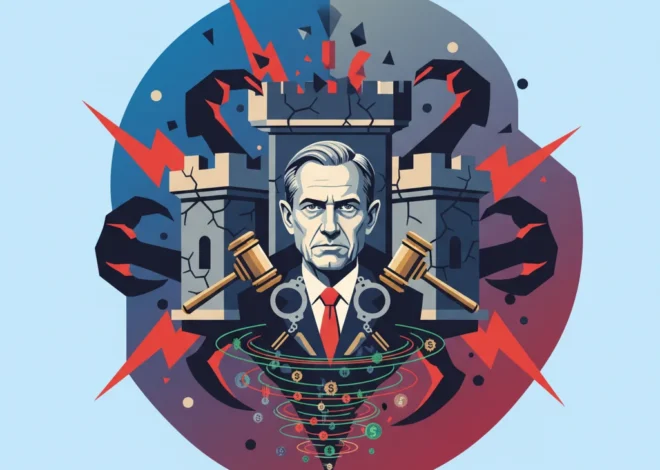
In the high-stakes world of global finance, stability is the most valuable currency. For decades, that stability has been anchored by the unwavering independence of the U.S. Federal Reserve. But we may be on the cusp of an unprecedented stress test. A recent analysis from the BBC’s Faisal Islam highlights a scenario that could trigger a “seismic moment” for the American economy: a potential Donald Trump presidency leveraging the Department of Justice (DoJ) to investigate Federal Reserve Chair Jerome Powell. This isn’t just another political headline; it’s a direct challenge to the institutional framework that underpins the U.S. dollar, the global stock market, and the entire modern financial system.
For investors, business leaders, and anyone involved in the economy, understanding the gravity of this potential conflict is paramount. This goes beyond partisan politics. It touches upon the core principles of monetary policy, institutional credibility, and the trust that powers global capitalism. What happens when the irresistible force of political ambition meets the immovable object of central banking tradition? The answer could have profound consequences for your portfolio, your business, and the future of finance.
The Sacred Cow of Economics: Why Fed Independence Matters
Before diving into the current conflict, it’s crucial to understand why the Federal Reserve’s independence is considered almost sacred in economic circles. Established in 1913, the Fed was designed to be insulated from short-term political pressures. The rationale is simple yet powerful: politicians, by their nature, are focused on election cycles. They often favor policies that create short-term economic booms—like cutting interest rates to fuel growth just before an election—even if those policies lead to runaway inflation and long-term instability later.
A truly independent central bank, by contrast, can make the tough, often unpopular decisions necessary for long-term economic health. Its mandate is to pursue stable prices and maximum employment, guided by economic data, not political polls. This credibility is the Fed’s greatest asset. When markets believe the Fed will act impartially to control inflation, it helps “anchor” inflation expectations, making the bank’s job easier and the economy more predictable.
History provides a stark warning of what happens when this independence is compromised. During the 1970s, President Richard Nixon exerted considerable pressure on then-Fed Chair Arthur Burns to keep monetary policy loose to aid his 1972 re-election. The result, as detailed by numerous economic historians, was a contributing factor to the “Great Inflation” that ravaged the U.S. economy for nearly a decade (source). It took the painful, recession-inducing rate hikes under Fed Chair Paul Volcker in the early 1980s to finally break the back of inflation and restore the central bank’s credibility.
A Pattern of Pressure: Trump’s History with the Federal Reserve
The current situation did not emerge from a vacuum. During his presidency, Donald Trump shattered the long-standing tradition of presidential deference to the Fed’s autonomy. He publicly and repeatedly attacked Chair Powell—a man he himself appointed—for raising interest rates, calling the Fed “crazy,” “loco,” and the “only problem our economy has.” He openly mused about his authority to fire or demote the Fed Chair, a legally dubious proposition that nonetheless sent shockwaves through the financial community (source).
This verbal barrage was already a significant departure from the norm. However, the idea of using the DoJ to launch a formal investigation represents a dramatic escalation. It transforms political rhetoric into the weaponization of a state apparatus against the institution responsible for the nation’s financial stability. This move would be perceived by global markets not just as an attack on an individual, but as an assault on the rule of law and the independence of America’s core economic institutions.
Mapping the Tremors: Potential Scenarios and Market Impact
For investors and financial professionals, the key question is how to translate this political drama into actionable market intelligence. The uncertainty itself is a major factor, but we can outline several potential scenarios and their likely impact on the economy and key asset classes.
Below is a table outlining these potential paths and their consequences for the stock market, banking, and the broader world of finance and trading.
| Scenario | Description | Potential Market & Economic Impact |
|---|---|---|
| 1. Status Quo: Verbal Threats | The rhetoric continues, but no formal action is taken against Powell or the Fed. The threat of interference lingers. | Stock Market: Increased day-to-day volatility. Markets become highly sensitive to political news. Economy: Businesses may delay investment due to uncertainty. Finance: A “wait-and-see” approach prevails, but underlying anxiety remains. |
| 2. Escalation: Formal Investigation | The DoJ is directed to open an investigation into the Fed Chair, regardless of the premise. Powell is forced to respond. | Stock Market: Sharp, immediate sell-off. A flight to safety (e.g., gold, Swiss franc). VIX (volatility index) spikes. Economy: Risk of a “sudden stop” as credit markets freeze. Potential for a sharp recession. Banking & Fintech: Severe tightening of credit conditions. Confidence crisis could impact the entire banking sector. |
| 3. Powell Resigns Under Pressure | Facing an untenable situation, the Fed Chair resigns, and a more politically compliant replacement is sought. | Stock Market: Massive crisis of confidence. A sustained bear market is likely. Economy: Inflation expectations become unanchored, leading to higher long-term inflation. The dollar weakens significantly. Trading: Extreme volatility across all asset classes, including a potential rush to decentralized assets like blockchain-based currencies. |
| 4. Institutional Pushback & De-escalation | The Fed, Congress, and the business community successfully push back, forcing a retreat from the threats. | Stock Market: A significant relief rally. Economy: Confidence is partially restored, but a scar remains. Financial Technology: The crisis may accelerate discussions about the role of technology in ensuring institutional transparency and independence. |
The Brexit Reset: How Labour's Proposed EU Pivot Could Reshape UK Finance and Investment
The Global Contagion: Why the World is Watching
This is not merely an American domestic issue. The Federal Reserve is, for all intents and purposes, the world’s central bank. Its monetary policy decisions create ripples that become waves by the time they reach foreign shores. When the Fed raises interest rates, it strengthens the dollar, making it more expensive for other countries to pay their dollar-denominated debts and import essential goods.
A crisis of confidence in the Fed is therefore a crisis of confidence in the entire global financial system. International investors hold trillions of dollars in U.S. Treasury bonds because they are considered the safest asset on Earth, backed by the full faith, credit, and institutional stability of the United States. An attack on the Fed’s independence directly threatens that “safe haven” status. According to analysis from institutions like the Peterson Institute for International Economics, central bank independence is a key determinant of a country’s long-term economic success. If global investors begin to demand a higher yield to hold U.S. debt to compensate for this new political risk, it would raise borrowing costs for the entire U.S. economy.
This could trigger a global re-evaluation of risk, with capital potentially fleeing U.S. markets. The stability that has defined the post-WWII economic order would be fundamentally shaken, with unpredictable consequences for international trade, banking, and geopolitics.
Draining the Coffers: Why a Government's Reliance on Reserves is a Red Flag for the Global Economy
Conclusion: An Extraordinary Moment for Finance and the Future
The potential confrontation between a future Trump administration and the Federal Reserve is far more than a personality clash. It is a battle over the ideas and institutions that have governed the American and global economy for generations. The principles of central bank independence, data-driven monetary policy, and insulation from political whim are now facing their most direct challenge in modern history.
For those in finance, from the seasoned Wall Street trader to the retail investor managing their retirement fund, this is a developing story that cannot be ignored. The outcome will influence everything from inflation and interest rates to stock market valuations and the strength of the dollar. As Faisal Islam noted, Jerome Powell’s response could indeed be a seismic, defining moment. The tremors that follow could permanently alter the financial landscape we all operate in.