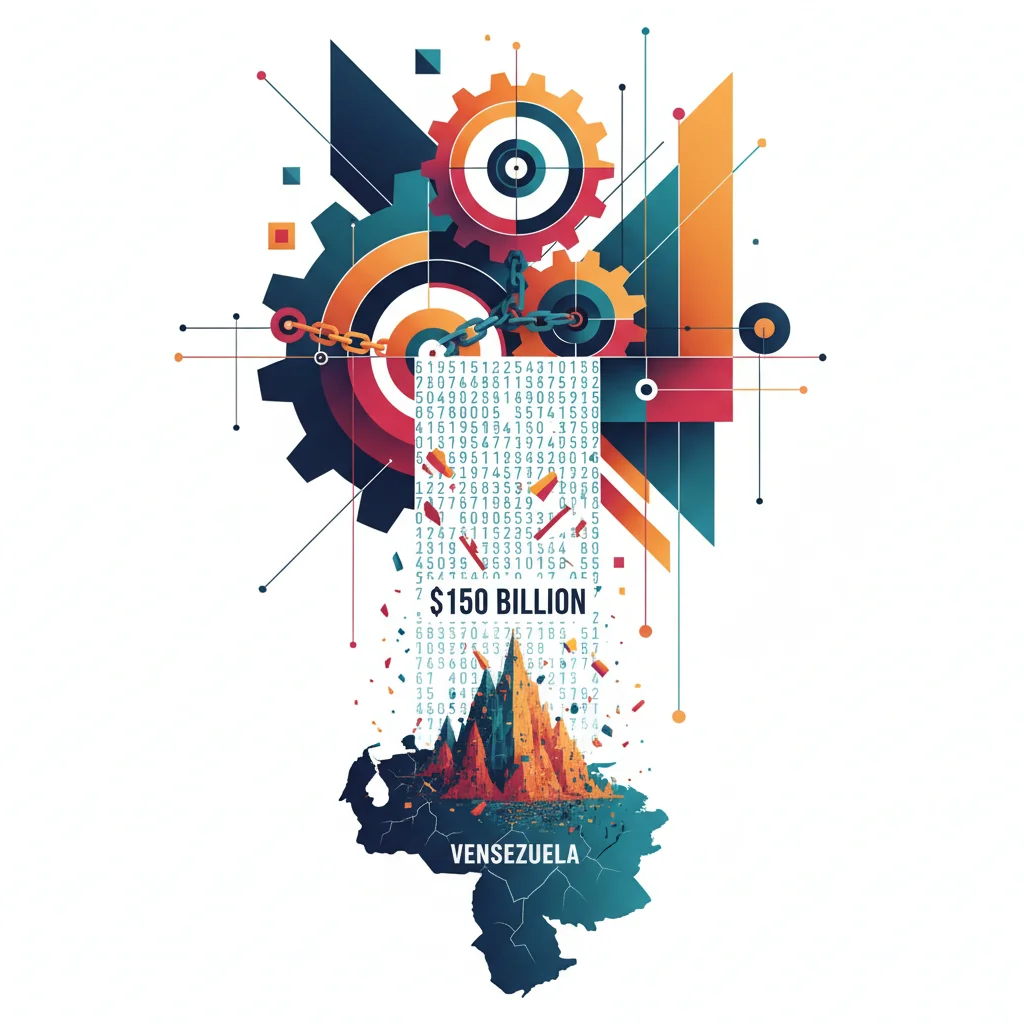
Venezuela’s $150 Billion Default: Deconstructing the Most Complex Debt Restructuring in History
In the world of international finance, some events are so massive they threaten to redefine the rules of the game. The potential restructuring of Venezuela’s colossal public debt is one of them. For years, the nation has been locked in a state of economic paralysis and sovereign default, rendering its vast debt—estimated to be north of $150 billion—a toxic and untradable asset for most of the world. However, the prospect of political change on the horizon has transformed this financial black hole into a subject of intense speculation among investors, economists, and policymakers.
What would it take to unravel this tangled web of obligations? The task is monumental, promising to be the largest and most complex sovereign debt workout ever witnessed. It’s a high-stakes drama involving Wall Street hedge funds, Russian and Chinese state-owned banks, multinational corporations, and the future of 28 million Venezuelans. This is more than just a story about finance; it’s about geopolitics, economics, and the future of a nation sitting on the world’s largest proven oil reserves.
The Anatomy of a Financial Catastrophe
To understand the solution, we must first grasp the sheer scale of the problem. Venezuela’s debt is not a single, simple loan. It is a chaotic mosaic of different liabilities, issued by different entities, under different legal frameworks, and held by a dizzying array of creditors. The country’s economic collapse, fueled by mismanagement, corruption, and a subsequent plunge in oil prices, led to a default on most of its external debt in 2017.
The primary issuers are the Republic of Venezuela itself and its state-owned oil company, Petróleos de Venezuela, S.A. (PDVSA). The situation is complicated by numerous other claims, including arbitration awards from nationalized assets and unpaid bills to commercial suppliers. Here is a simplified breakdown of the key creditor groups and debt types:
| Creditor Type | Nature of Debt | Estimated Value (USD) | Key Complications |
|---|---|---|---|
| International Bondholders | Sovereign & PDVSA Bonds | ~$60 Billion | Governed by New York law; diverse group of holders from hedge funds to pension funds. |
| China | Oil-for-Loan Agreements | ~$20 Billion+ | Geopolitical interests; lack of transparency on terms and outstanding balances. |
| Russia | Bilateral Loans & Rosneft Stakes | ~$10 Billion+ | Strategic interests, including stakes in Venezuelan oil assets as collateral. |
| Commercial Creditors | Unpaid Invoices, Promissory Notes | Billions (disputed) | Includes oil service firms like Halliburton; claims are often hard to track and verify. |
| Arbitration Claimants | Awards from Nationalizations | ~$20 Billion+ | Companies like ConocoPhillips hold legally binding awards, giving them power to seize assets abroad. |
This tangled mess means a simple negotiation is impossible. Each group has different legal rights and strategic priorities. A bondholder in New York has little in common with a Chinese state bank, whose loan is secured by future oil shipments. This sets the stage for a contentious, multi-front battle for repayment.
The Great Myth of the Maverick CEO: Are Capitalists Innovators or Just Accumulators?
The Legal Labyrinth: Sanctions, Legitimacy, and Vulture Funds
Before any meaningful negotiations can begin, a significant hurdle must be cleared: U.S. sanctions. Imposed to pressure the Maduro regime, these sanctions currently prohibit U.S. entities from trading or negotiating most Venezuelan debt. A future, internationally recognized government would need these sanctions lifted to engage with the majority of its creditors and access international financial markets.
Once sanctions are gone, the legal battles will begin in earnest. A key question will be the legitimacy of the debt incurred under Nicolás Maduro. Some legal scholars and opposition figures have floated the idea of declaring some of this debt “odious,” arguing it was incurred illegitimately and did not benefit the Venezuelan people. While a compelling moral argument, it is a legal longshot that would spook the entire sovereign debt market. A more likely outcome is that all claims will be recognized, but subjected to a deep “haircut”—a reduction in their principal value.
The legal framework of the bonds themselves will be critical. Most were issued under New York law. Older bonds lack “Collective Action Clauses” (CACs), which allow a supermajority of bondholders to approve a restructuring deal that is binding on all holders. The absence of CACs on some bonds opens the door for so-called “vulture funds” to buy up a small portion of the debt and litigate aggressively for full payment, potentially disrupting the entire process (source). The battle over the `pari passu` (“equal footing”) clause, which dictates that all creditors of a certain type should be treated equally, will be a central feature of the litigation.
King Henry II's Sour Grapes: A 12th-Century Lesson in Modern Finance and Supply Chain Risk
A Potential Roadmap to Recovery
So, how does Venezuela move forward? The path is steep and fraught with peril, but a general roadmap, based on historical sovereign defaults, can be sketched out. It is a multi-year process that will test the limits of international financial diplomacy.
1. Political Transition and Sanctions Relief: A new, internationally recognized government is the non-negotiable first step. This would trigger the lifting of U.S. sanctions, opening the door for formal engagement with the global financial community.
2. IMF Engagement: Venezuela would almost certainly need a massive bailout package from the International Monetary Fund (IMF). The IMF would not just provide financing; it would work with the new government to design a credible economic reform program. This plan is essential for restoring confidence and demonstrating to creditors that the country has a viable path back to solvency.
3. A Comprehensive Debt Audit: The government would need to hire legal and financial advisors to conduct a full audit of all outstanding claims. This process, which could take over a year, involves identifying every creditor and verifying the legal standing and amount of their claim. According to the Financial Times, the sheer number of creditors and debt instruments makes this an unprecedented challenge source.
4. Negotiations with Creditor Committees: Creditors would form committees to negotiate with the government. There will likely be separate committees for bondholders, commercial claimants, and bilateral lenders. The government’s goal will be to offer a package of new, longer-term securities with a lower principal value—the “haircut”—in exchange for the old, defaulted debt.
5. Unlocking Oil Wealth: Ultimately, Venezuela’s ability to pay rests on its ability to rebuild its shattered oil industry. Restructuring the debt of PDVSA will be crucial for attracting the foreign investment and technology needed to ramp up production. The new debt instruments offered to creditors will likely be linked to the future performance of Venezuela’s oil exports, giving investors a stake in the country’s recovery.
Implications for Global Investing and Finance
Why should a trader in Tokyo or a banker in London care about Venezuela’s debt? Because the outcome of this restructuring will set powerful precedents for the world of international finance and investing.
First, it will test the global financial system’s ability to handle a sovereign default of this magnitude and complexity, especially one involving major non-Western creditors like China and Russia. The outcome will influence how future sovereign debt crises are handled.
Second, for the adventurous investor, Venezuelan debt represents the ultimate distressed asset. Currently trading for pennies on the dollar, these bonds offer potentially astronomical returns if a successful restructuring occurs. It is the highest-risk, highest-reward play in the sovereign debt market today, a pure bet on political change and economic recovery. This saga highlights the volatile but potentially lucrative nature of emerging market trading and investing.
Finally, it serves as a stark reminder of the deep connection between political stability, economic policy, and the functioning of financial markets. The collapse of Venezuela’s economy shows how quickly a nation’s wealth can be squandered, and how long and arduous the road back to prosperity can be.
Solving the Market: Why Successful Investing is Like Conquering the FT Crossword
The journey to resolve Venezuela’s debt crisis will be a marathon, not a sprint. It will be marked by legal drama, political intrigue, and intense negotiations. But for the first time in years, a faint light has appeared at the end of a very long tunnel. A successful resolution would not only put Venezuela on the path to recovery but could also unlock one of the most significant investment opportunities of the 21st century. The world of finance is watching, and waiting.

Related Posts
The Treasury’s Grand Slam: Deconstructing the US’s “Homerun Deal” on the Argentine Peso
Beyond the Headlines: Decoding Iran’s Economic Uprising and Its Global Ripple Effect