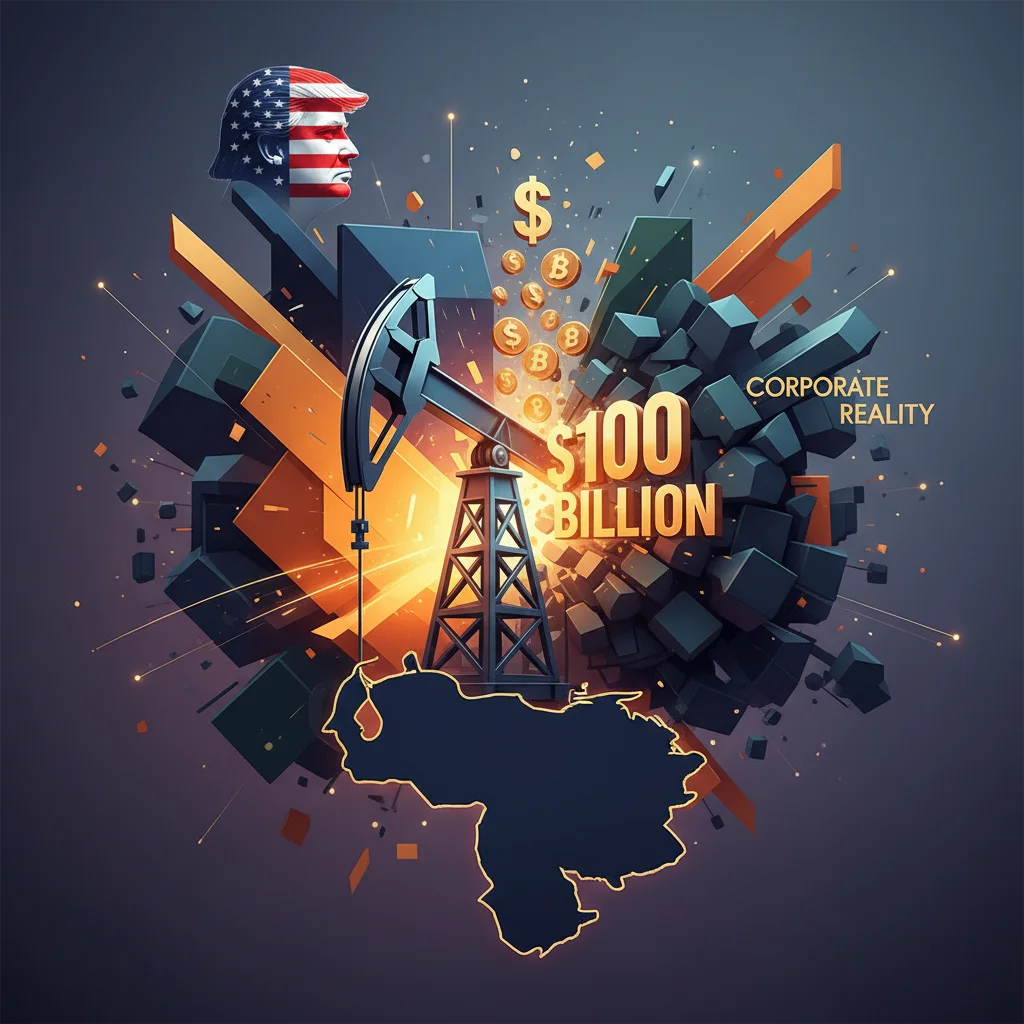
The Venezuelan Oil Gambit: Why Trump’s $100 Billion Pitch Clashed with Corporate Reality
In the high-stakes world where global politics and corporate finance intersect, few scenarios are as charged as a former U.S. President pitching a multi-billion dollar investment to oil titans for one of the world’s most volatile nations. This was the scene when Donald Trump reportedly sought a staggering $100 billion investment to revitalize Venezuela’s dilapidated oil industry. The proposition is, on its surface, tantalizing: unlock the planet’s largest proven oil reserves and reshape the global energy market. Yet, the response from the boardroom was a cold dose of reality. As one top executive from ExxonMobil bluntly put it, Venezuela is simply “uninvestable.”
This clash between a grand political vision and the hard-nosed pragmatism of the energy sector reveals a deep chasm of mistrust, risk, and historical grievance. It’s a story that goes far beyond a single meeting, touching on the core principles of international investing, the brutal lessons of political risk, and the complex future of the global economy. Why would a prize so vast be considered untouchable? The answer lies not in the ground beneath Venezuela, but in the country’s troubled history and the long memory of capital.
The Grand Vision: A $100 Billion Bet on Black Gold
The scale of the proposition is difficult to overstate. Venezuela sits atop an estimated 300 billion barrels of proven oil reserves, more than any other nation, including Saudi Arabia. At its peak in the late 1990s, the country was an energy powerhouse, producing over 3 million barrels per day. Today, after decades of mismanagement, corruption, and crippling U.S. sanctions, production has cratered to a fraction of that, hovering around 800,000 barrels per day (source).
From a purely logistical and economic standpoint, reviving this industry could have monumental consequences:
- Stabilizing Global Markets: Bringing millions of barrels of Venezuelan crude back online could significantly increase global supply, potentially lowering gasoline prices for consumers and easing inflationary pressures on the world economy.
- Shifting Geopolitical Power: A U.S.-backed revival of Venezuelan oil could reduce the market influence of OPEC+ nations, particularly Russia and Saudi Arabia, altering the strategic calculus of global energy politics.
- A Boon for the Stock Market: The engineering, logistics, and energy companies involved in such a colossal rebuilding effort would likely see their valuations soar, creating a ripple effect across the market.
The pitch is rooted in a transactional view of foreign policy—leveraging American political might to secure a deal that serves both strategic and economic interests. However, this vision collides with a wall of skepticism built over decades of bitter experience.
Beyond the Balance Sheet: The Economic Case for a Hot Meal
The Wall of Worry: “They Seized Our Assets Twice”
For the oil executives in the room, Trump’s proposal wasn’t an abstract economic theory; it was a direct invitation to ignore one of the cardinal rules of investing: protect your capital. The CEO of ExxonMobil’s stark assessment that Venezuela is “uninvestable” was echoed by another executive’s haunting reminder: “Venezuela had seized their assets twice,” as reported by the BBC.
This isn’t hyperbole. It’s a reference to the nationalization campaigns under the late President Hugo Chávez. In the mid-2000s, Venezuela’s government systematically expropriated foreign-owned assets, including multi-billion dollar projects run by giants like ExxonMobil and ConocoPhillips. These companies were forced to abandon massive investments, leading to protracted legal battles that dragged on for over a decade. ConocoPhillips, for instance, fought for years to recover nearly $10 billion in compensation for its seized assets (source). Such events leave indelible scars on corporate memory.
The risks today extend far beyond the ghost of nationalization. Below is a breakdown of the key deterrents that make any serious investor pause.
| Risk Factor | Description |
|---|---|
| Political & Legal Instability | Venezuela lacks a stable rule of law. Contracts can be arbitrarily voided, the judiciary is not independent, and the political situation remains highly volatile. There is no credible guarantee that a new regime wouldn’t reverse any agreement made by the current one. |
| Crumbling Infrastructure | The country’s oil infrastructure—from pipelines and refineries to ports and power grids—is in a state of advanced decay due to years of neglect and lack of maintenance. A $100 billion investment might only scratch the surface of the necessary repairs and modernization. |
| U.S. Sanctions | While the U.S. has occasionally issued temporary waivers, a complex web of sanctions remains in place. Navigating this legal minefield is a massive compliance headache, and sanctions can be re-imposed at any time, stranding new investments. |
| Debt & Creditor Claims | Venezuela and its state oil company, PDVSA, are buried under a mountain of debt and face numerous claims from international creditors. Any new revenue generated from oil production would immediately become the target of a complex and contentious legal battle for repayment. |
These factors combine to create a risk profile that is off the charts for any publicly traded company accountable to its shareholders. The primary duty of a CEO is fiduciary, and sinking billions into such a precarious environment would be seen as a reckless dereliction of that duty.
The K-Beauty Effect: How a Skincare Trend Became a Global Economic Powerhouse
Could emerging financial technology offer a solution? One could imagine a futuristic scenario where blockchain technology is used to create immutable contracts and transparent royalty-payment systems, ensuring foreign investors get their share directly. However, such a fintech solution is only as strong as the underlying legal and physical security. If a government can physically seize an oil rig, a smart contract on a blockchain becomes a mere digital ghost. The Venezuelan problem isn’t a technological one; it’s a fundamental crisis of governance and trust that no amount of innovative banking or tech can solve on its own.
The Broader Implications for the Global Economy
This standoff is more than just a failed pitch; it’s a bellwether for the future of global energy economics and international finance. The hesitation of Big Oil underscores a crucial trend: the world is becoming more fragmented and risky. The era of globalization, where capital flowed freely across borders with the assumption of a stable, rules-based order, is fading.
For the global economy, the continued sidelining of Venezuela’s reserves means that energy markets will remain tighter and more susceptible to shocks from other regions, like the Middle East or Russia. This has direct consequences for inflation, monetary policy, and the cost of doing business worldwide. The dream of cheap, abundant energy remains capped as long as the world’s largest reserves are locked behind a wall of political and financial risk.
For the world of finance and trading, it reinforces the immense premium placed on political stability. Investment is flowing towards nations with predictable legal systems, even if their resources are less plentiful. This is a flight to safety that reshapes capital flows and determines which nations develop and which are left behind. The complex financial instruments and international banking networks required to fund a project of this magnitude simply cannot function without a bedrock of legal certainty.
Beyond the Pasta Bowl: Decoding the Economic Ripple Effects of a US Tariff Reversal
A Long Road to “Investable”
In conclusion, the chasm between the potential of Venezuela’s oil wealth and its current reality is vast. Donald Trump’s audacious $100 billion proposal highlights what is possible from a geological perspective, but the cold response from industry leaders underscores what is impossible from a financial one.
Capital is not just a collection of dollars; it is a repository of experience and memory. The lessons learned from past seizures in Venezuela have not been forgotten. Before any supermajor oil company will risk billions of shareholder dollars, they will need to see far more than a political green light. They will require a fundamental transformation within Venezuela itself: the restoration of the rule of law, the establishment of an independent judiciary, ironclad international investment protections, and a long, proven track record of stability.
Until then, the world’s greatest oil reserves will remain a stranded asset—a symbol of immense potential squandered and a cautionary tale for investors everywhere. The road to making Venezuela “investable” again will be a marathon of institutional reform, not a sprint powered by a single political deal.

Related Posts

Beyond the Balance Sheet: The Geopolitical Chess Match for Global Currency Supremacy

Venezuela’s Oil Crossroads: A $100 Billion Gamble or the Next Great Investment?