The Helicopter and the Coder: What a 1970s War Machine Teaches Us About Building Resilient Tech
In an era defined by ones and zeros, where cyber-attacks and autonomous drones dominate headlines, the deafening thwump-thwump of helicopter blades can feel like a relic from a bygone action movie. Yet, recent high-stakes operations, from a US counter-narcotics mission targeting Nicolás Maduro to the seizure of a Russian tanker, weren’t executed by silent, unmanned predators. They were carried out by helicopters—a powerful reminder that in a world obsessed with ephemeral software, the robust, adaptable platform still reigns supreme.
For those of us in the tech world—developers, entrepreneurs, and startup founders—this might seem counterintuitive. We are disciples of agile development, cloud-native architecture, and the disruptive power of pure software. We believe code can solve anything. But the enduring relevance of the war chopper offers a critical, grounding lesson: the most revolutionary innovation often isn’t about replacing the old, but augmenting it with intelligence. It’s a lesson in building platforms that last, a masterclass in the balance between hardware and software, and a guide for creating truly resilient systems.
The All-in-One Platform vs. The Specialized Microservice
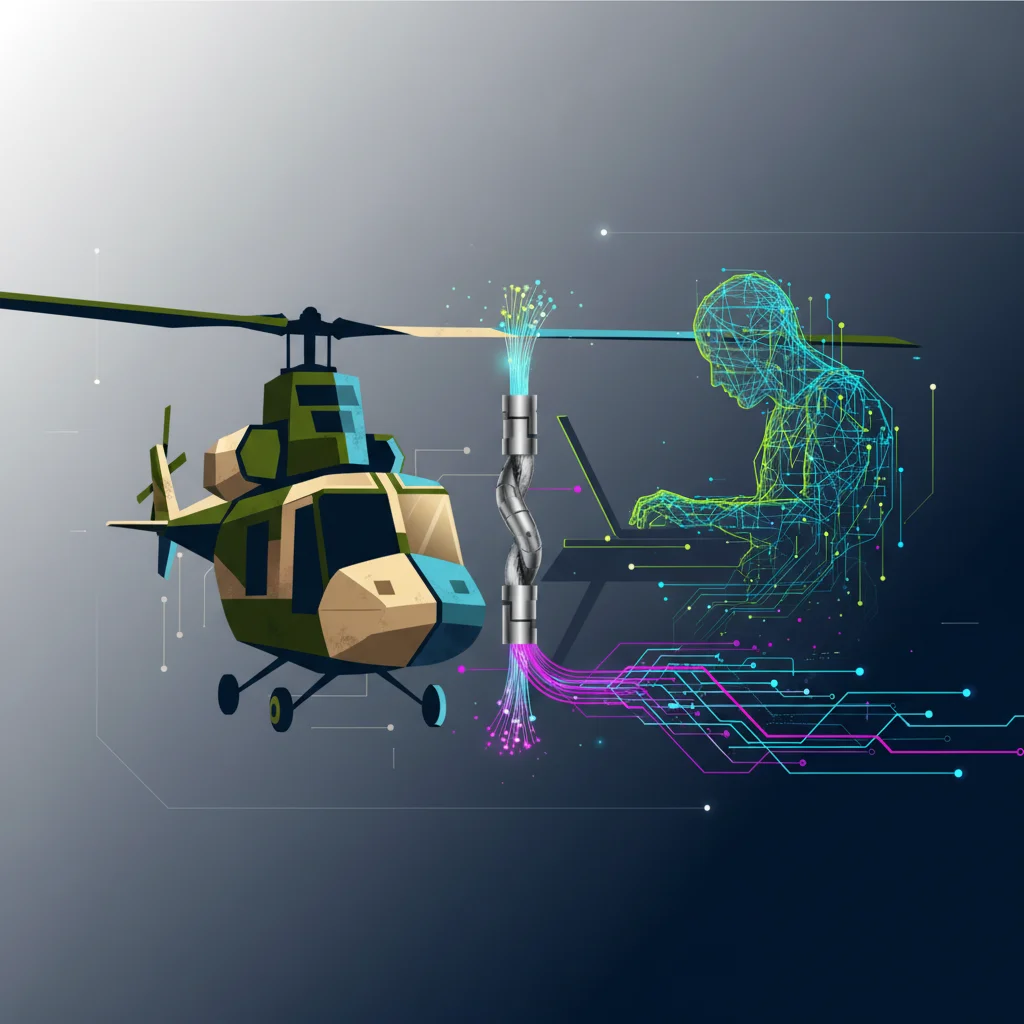
Think of a modern attack helicopter. It’s not just a vehicle; it’s a flying, integrated system. It’s a sensor platform, a communications hub, a weapons delivery system, and a troop transport all in one rugged, adaptable package. In tech parlance, it’s the ultimate monolithic application, but one designed for extreme modularity and mission-critical reliability.
Now, consider the drone. It’s a brilliant piece of specialized technology—a microservice, if you will. It excels at specific tasks like surveillance (a “read” operation) or a targeted strike (a “write” operation). But it lacks the helicopter’s sheer versatility. You can’t rappel a team of special forces from a Reaper drone or use it to evacuate wounded personnel under fire. The helicopter’s “feature set” is broader and more resilient to unexpected edge cases—the “unknown unknowns” of a chaotic environment.
This mirrors a fundamental debate within the world of software and startups. Do you build a comprehensive, all-in-one SaaS platform that handles a dozen customer needs? Or do you build a lean, best-in-class tool that does one thing perfectly? The trend has leaned towards unbundling, but the helicopter’s persistence suggests that for complex, high-value problems, a robust, integrated platform provides a strategic advantage that a collection of disparate tools cannot match.
Beyond the Hype: A Deep Dive into the Year's Biggest Tech Revolutions
Augmentation, Not Replacement: The Secret to Legacy Longevity
The Black Hawks and Apaches flying today are not the same machines that rolled off the assembly line in the 1980s. While their airframes are decades old, their avionics, sensors, and weapons systems are state-of-the-art. They are bristling with next-generation technology, from advanced thermal imagers to secure datalinks that integrate them into a wider network of assets. Militaries have poured billions into upgrading these platforms, integrating layers of modern tech onto a proven, reliable core.
This is perhaps the most powerful lesson for any tech professional dealing with a “legacy system.” The impulse is often to “rip and replace.” But as the helicopter proves, the more effective strategy is often “augment and integrate.” Your company’s core application may not be built on the latest programming framework, but it’s battle-tested and it works. Instead of rebuilding from scratch, can you wrap it in modern APIs? Can you feed its data into a machine learning model to generate new insights? Can you enhance its capabilities with new automation workflows?
The US Army’s Future Vertical Lift program, for example, aims to eventually replace platforms like the Black Hawk. But even this multi-decade, multi-billion dollar effort acknowledges the immense challenge. As one analyst noted, these new aircraft are “eye-wateringly expensive,” with a projected cost of $40 million per aircraft. This cost-benefit analysis is something every CTO and entrepreneur understands intimately. Sometimes, upgrading the reliable workhorse is infinitely smarter than betting the farm on an unproven, expensive replacement.
To better visualize this dynamic, let’s compare the attributes of these two approaches, framed in a way a product manager would appreciate:
| Attribute | The Legacy Platform (Helicopter) | The Disruptive Tech (Drone) |
|---|---|---|
| Versatility | High (Multi-mission capable: attack, transport, recon, medevac) | Low (Highly specialized for surveillance or strike) |
| Payload / Capacity | Significant (Can carry troops, cargo, heavy munitions) | Limited (Small payloads, lightweight sensors) |
| Psychological Impact | High (Visible, audible presence projects power) | Low (Stealthy, often invisible until it’s too late) |
| Resilience | High (Can sustain damage, adaptable to changing conditions) | Low (Often single-use or easily downed) |
| Upfront Cost | High (Expensive to build and procure) | Relatively Low (Cheaper to produce in mass) |
| Integration Potential | Proven (Decades of upgrading with new software & sensors) | Emerging (Designed for network integration from the start) |
The Human-in-the-Loop Imperative
One of the most critical “features” of a helicopter is the one sitting in the cockpit: the pilot. Or more accurately, the crew. These are highly trained humans capable of making dynamic, ethical, and intuitive decisions in milliseconds. An autonomous system can follow its programming flawlessly, but it can’t yet replicate the nuanced judgment of a pilot who can distinguish a civilian from a combatant or abort a mission based on a gut feeling that something is wrong.
This is the crux of the debate raging in the field of artificial intelligence. As we build more powerful and autonomous systems, we must consciously design for human oversight. The goal of automation shouldn’t be to replace the human, but to augment them—to offload tedious cognitive tasks so the human can focus on high-level strategy and critical decision-making. Just as a helicopter’s advanced avionics help a pilot manage immense complexity, our AI tools should serve as co-pilots, not autopilots. This is especially critical in fields like cybersecurity, where automated defenses must be paired with human analysts who can identify novel threats that a machine learning model, trained on past data, might miss. As one report highlights, despite advances in drones, the demand for helicopters remains strong, with a projected market of over 7,500 new military helicopters to be delivered in the next decade.
Yann LeCun's AI Heresy: Why a Godfather of AI is Betting Against the ChatGPT Hype
Actionable Lessons for Tech Innovators
The return of the war chopper isn’t just a military briefing; it’s a strategic memo for the tech industry. The takeaways are clear, actionable, and vital for anyone building a product or a company meant to last.
- Build a Robust Core: Don’t get distracted by shiny objects. Focus on building a stable, reliable, and versatile core platform. This is your airframe. It needs to be strong enough to support years of future innovation.
- Design for Augmentation: Architect your systems for evolution, not revolution. Use modular design, clean APIs, and clear documentation. Make it easy to bolt on new technologies like AI features or third-party integrations later.
- Embrace the Human Co-Pilot: As you implement automation and machine learning, always consider the user. Design systems that empower, inform, and augment human decision-making, rather than seeking to fully replace it.
- Calculate the True Cost of “New”: Before you decide to scrap a legacy system, perform a ruthless cost-benefit analysis. Consider the development cost, migration risks, retraining, and the loss of battle-tested reliability. Sometimes, the most innovative path is evolutionary.
Silence as a Service: How AI and Startups Are Winning the War on Noise
The thrum of a helicopter’s rotors is a sound of enduring power. It’s a testament to a design philosophy that values resilience, adaptability, and the powerful synthesis of human and machine. For those of us building the future with code, it’s a vital reminder that the best technology doesn’t always have to be the newest; it has to be the most effective. It’s time to stop chasing ghosts in the machine and start building machines that last.