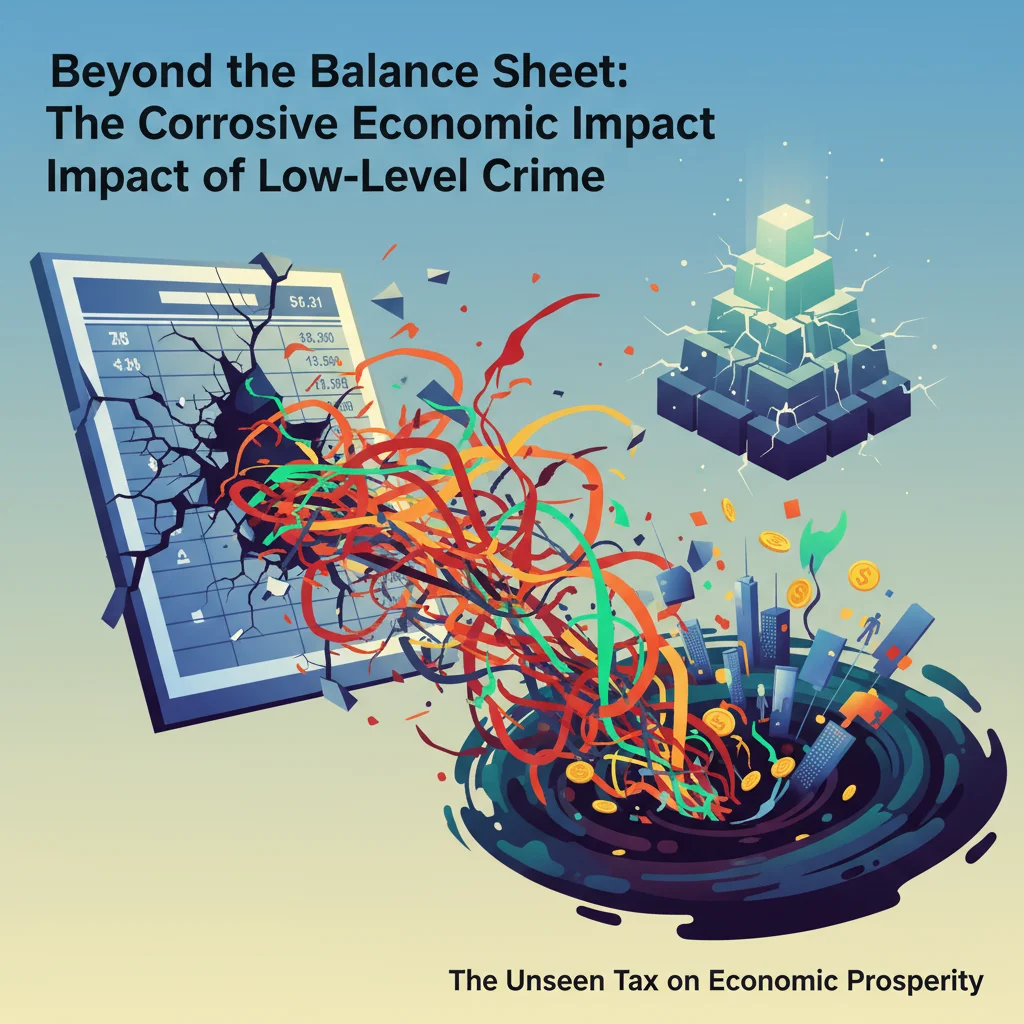
Beyond the Balance Sheet: The Corrosive Economic Impact of Low-Level Crime
The Unseen Tax on Economic Prosperity
In the grand theater of global finance and economics, our attention is often captured by macroeconomic indicators: interest rate decisions from central banks, geopolitical shifts impacting the stock market, and the disruptive power of new financial technology. We meticulously analyze quarterly earnings and debate the nuances of fiscal policy. Yet, a more insidious and granular force is often overlooked, a “hidden tax” that silently erodes economic vitality from the ground up. This force is the persistent, corrosive impact of what is often dismissed as “lower-level” crime.
A recent letter to the Financial Times by Mark Johnson of East Yorkshire poignantly highlighted this very issue. It argues against dismissing the “drip, drip, drip” of shoplifting, vandalism, and anti-social behavior as minor nuisances. Instead, it frames them as significant contributors to a sense of community decay and lawlessness. While the letter’s focus is social, its economic implications are profound and demand closer examination by investors, business leaders, and anyone involved in the financial world. The stability of our economy is not just built on sound banking and innovative fintech; it rests on a foundation of social order and security. When that foundation cracks, the entire economic superstructure is at risk.
This article will expand on that crucial premise, exploring the multifaceted ways in which low-level crime impacts everything from local business viability and property values to broader investor confidence and the performance of specific market sectors. We will delve into the quantifiable costs, the ripple effects on the national economy, and the role that technology and strategic investing can play in mitigating these risks.
The Broken Windows Theory: An Economic Reinterpretation
The “Broken Windows” theory, first introduced by social scientists James Q. Wilson and George L. Kelling in 1982, posited that visible signs of crime, anti-social behavior, and civil disorder create an urban environment that encourages further, more serious crime. A single broken window left unrepaired signals that no one cares, inviting more vandalism and decay. For decades, this has been a cornerstone of criminological debate. However, it is equally powerful when viewed through the lens of economics.
From a financial perspective, a “broken window” is not just a piece of shattered glass; it is a negative economic signal. It communicates risk, neglect, and a breakdown of the social contract that underpins commercial activity. For a business leader, this translates into:
- Increased Operational Costs: Businesses in affected areas are forced to divert capital from growth-oriented activities—like hiring, marketing, or R&D—towards defensive measures. This includes investing in sophisticated security systems, hiring guards, and paying escalating insurance premiums.
- Reduced Revenue: An environment perceived as unsafe deters customers. Foot traffic declines, leading to lower sales. This is particularly damaging for retail, hospitality, and service-based businesses that rely on a vibrant, welcoming street presence.
- Deteriorating Asset Values: For investors, particularly in real estate, the impact is direct. Commercial and residential property values stagnate or decline in areas plagued by persistent low-level crime, as demand wanes and perceived risk increases.
This creates a vicious cycle. As businesses suffer, they may reduce hours, lay off staff, or shut down entirely. This leads to more vacant storefronts—more “broken windows”—which further degrades the commercial environment, discourages new investing, and accelerates economic decline. The local economy is hollowed out, not by a single catastrophic event, but by a thousand small cuts.
The Financial Polymath: Why Solving for 'X' in Today's Economy is Like a Crossword Puzzle
Quantifying the Financial Drain of ‘Minor’ Offenses
While the conceptual impact is clear, the direct financial costs are staggering. The term “shrinkage”—a retail industry euphemism for losses due to theft, fraud, and damage—is a significant line item on any retailer’s profit and loss statement. But the total economic damage extends far beyond the value of stolen goods.
To put this in perspective, consider the direct and indirect costs associated with retail crime. The following table illustrates the cascading financial consequences that businesses and, by extension, the economy must bear.
| Cost Category | Description & Economic Impact |
|---|---|
| Direct Merchandise Loss | The immediate cost of stolen goods. In the UK, the British Retail Consortium reported that customer theft cost retailers £1.8 billion in 2022/23, a figure that directly impacts profitability and stock market valuations for publicly traded retailers. |
| Loss Prevention & Security | Capital expenditure on security staff, CCTV, security tags, and other anti-theft technologies. This represents a diversion of capital that could otherwise be used for expansion, innovation, or hiring. Retailers spent £1.2 billion on crime prevention in the same period. |
| Increased Insurance Premiums | Businesses in high-crime areas face higher premiums, a direct hit to their operational budget. This affects not just large corporations but critically squeezes the margins of small and medium-sized enterprises (SMEs). |
| Business Closures & Job Losses | When costs become untenable, businesses close. This not only erases jobs but also reduces the local tax base, impacting public services and creating a downward spiral for the community’s economy. |
| Supply Chain Disruption | Theft is not limited to storefronts. Cargo and warehouse theft disrupt supply chains, leading to stock shortages, increased logistics costs, and ultimately higher prices for consumers, contributing to inflationary pressures. |
The Macro Ripple Effect: From High Street to Stock Market
The consequences of unchecked low-level crime are not confined to local economies. They ripple outwards, affecting the national economy, banking sector, and even stock market performance in subtle but significant ways.
For investors, this manifests as sector-specific risk. The retail sector is the most obvious casualty. Publicly traded retail giants have begun to explicitly cite organized retail crime as a material headwind in their earnings calls, impacting their forecasts and stock prices. For example, major US retailers like Target have attributed significant profit warnings to the rise in theft, a trend mirrored globally. This directly affects institutional and individual portfolios with exposure to these companies.
Beyond retail, the impact spreads:
- Real Estate Investment Trusts (REITs): Commercial REITs with portfolios concentrated in struggling urban or suburban shopping centers face the dual threat of tenant defaults and declining property valuations.
- Banking and Lending: The banking sector becomes more cautious. Underwriting standards for small business loans may tighten in areas deemed high-risk, stifling entrepreneurship and local economic growth. The perceived risk of default increases, making capital less accessible and more expensive.
- Insurance Industry: Higher claim volumes and perceived risk lead to increased premiums across the board or even the withdrawal of coverage from certain areas, placing an immense burden on businesses.
This cumulative effect can dampen overall economic sentiment. An environment perceived as unstable and unsafe is a deterrent to foreign direct investment (FDI). International corporations and funds look for stability, predictability, and the rule of law when making capital allocation decisions. A country that cannot manage crime on its own streets sends a powerful negative signal to the global investing community.
The Ghost in the Machine: Are Modern Trading Apps Just 1920s Bucket Shops in Disguise?
Financial Technology and Innovative Responses
While the problem is complex, it is not without potential solutions, many of which are emerging from the world of financial technology and data analytics. The fight against low-level crime is becoming a new frontier for innovation, shifting from purely physical security to a more integrated, data-driven approach.
The fintech sector is responding with tools that can help businesses mitigate these new-age risks. Advanced payment systems are reducing the amount of physical cash held on premises, making businesses less attractive targets. Insurtech companies are using granular data, including localized crime statistics, to offer more dynamic and fairly-priced insurance products. On the trading and investing side, alternative data providers are now scraping information on crime rates and social sentiment to provide hedge funds and asset managers with a more holistic view of a company’s operational risks.
Furthermore, while the term is often overused, blockchain technology offers potential in securing supply chains. By creating an immutable ledger for high-value goods, companies can track products from factory to shelf, making it harder for stolen items to be resold on grey markets. This application of distributed ledger technology moves beyond cryptocurrency trading and into tangible, real-world risk management.
The Unlikely Beauty of a Power Plant: An Investor's Guide to Aesthetic Alpha
Conclusion: A Call for a Re-evaluation of Risk
The letter from a concerned citizen in East Yorkshire serves as a microcosm of a global economic challenge. The dismissal of low-level crime as a secondary issue is a grave mistake in economic and financial analysis. It is not merely a social problem but a fundamental economic one with a measurable, negative impact on business, investing, and national prosperity.
For business leaders, it requires a re-evaluation of operational risk to include community stability. For investors, it means looking beyond the balance sheet to understand the environmental factors that can erode value. And for policymakers, it is a reminder that a thriving economy requires a bedrock of safety and order. The health of the stock market is inextricably linked to the health of our main streets. By ignoring the “broken windows,” we are not just allowing for social decay; we are systematically dismantling the very foundation of our economic future.

Related Posts
Beyond the Racks: A Financial Autopsy of Saks’s Impending Bankruptcy
The Great Retail Divide: Why Food Feasted and Fashion Famished in the UK’s Christmas Showdown