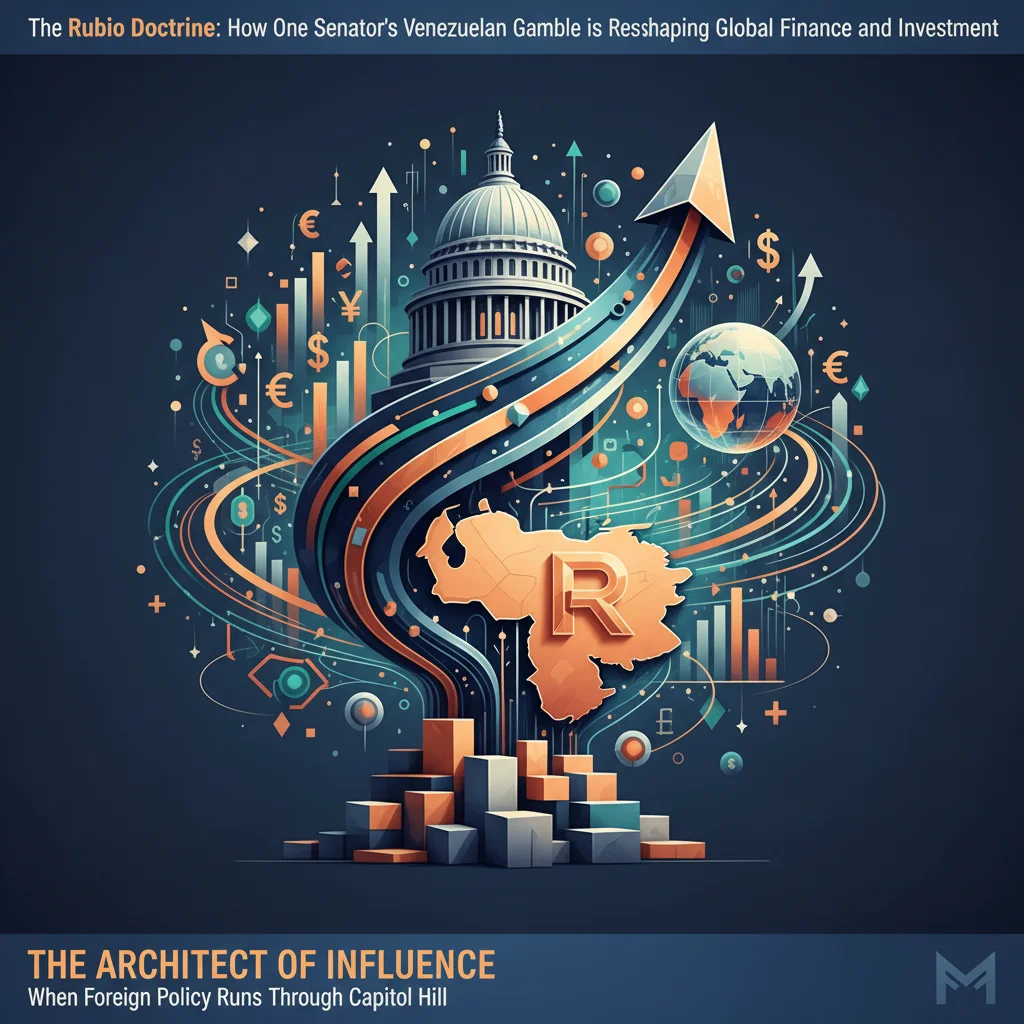
The Rubio Doctrine: How One Senator’s Venezuelan Gamble is Reshaping Global Finance and Investment
The Architect of Influence: When Foreign Policy Runs Through Capitol Hill
In the intricate dance of global diplomacy, it’s typically the State Department that leads. Yet, in the complex and high-stakes saga of Venezuela, the conductor’s baton was often wielded not from Foggy Bottom, but from the office of a single US Senator: Marco Rubio. For a crucial period, the Florida senator effectively became the architect of American policy in Latin America, a de facto Secretary of State for the Western Hemisphere. This concentration of influence presents a fascinating case study for investors, business leaders, and anyone involved in global finance, demonstrating how the conviction of one political figure can ripple through international markets, shape sanction regimes, and define the risk profile of an entire continent.
Rubio’s deep-seated opposition to leftist regimes in Latin America, born from his Cuban-American heritage, found a receptive ear in the Trump administration. He leveraged this position to champion a hardline “maximum pressure” campaign against Nicolás Maduro’s government in Venezuela. This wasn’t merely a political stance; it was a strategy with profound consequences for the global economy, particularly in the energy sector. As the Financial Times noted, Rubio’s influence was so significant that he had the power to shape sanctions and guide the White House’s response to one of the worst humanitarian crises in modern history (source). For those in the world of investing, understanding these undercurrents of political power is no longer optional—it’s essential for navigating the volatile landscape of emerging markets.
An Economic Implosion: Deconstructing Venezuela’s Financial Collapse
To grasp the scale of the US gamble, one must first understand the sheer totality of Venezuela’s collapse. Once the wealthiest nation in South America, possessing the world’s largest proven oil reserves, Venezuela devolved into a state of economic ruin. Years of mismanagement, corruption, and the nationalization of key industries under Hugo Chávez and later Maduro crippled the nation’s productive capacity. The state-owned oil company, PDVSA, once a global powerhouse, became a hollowed-out shell, its production plummeting to levels not seen in decades.
This collapse triggered a domino effect across every sector of the economy. Hyperinflation reached astronomical figures, rendering the national currency, the bolívar, practically worthless. The banking system seized up, and the formal financial infrastructure crumbled, pushing citizens towards a barter economy or the volatile world of cryptocurrencies for survival. The impact on the global stock market was felt by any multinational corporation with exposure to the region, leading to massive write-downs and asset seizures. The following table provides a stark snapshot of this economic disintegration.
Here is a look at some key indicators illustrating the depth of the crisis, based on data points from the period leading up to and during the peak of the “maximum pressure” campaign.
| Economic Indicator | Pre-Crisis (Approx. 2013) | Peak Crisis (Approx. 2018-2019) |
|---|---|---|
| Annual Inflation Rate | ~56% | Over 1,000,000% (source) |
| Crude Oil Production (barrels per day) | ~2.5 million | Under 800,000 |
| GDP Contraction (Cumulative since 2013) | N/A | Over 65% |
| Population Displacement | Minimal | Over 4 million people fled the country |
This data isn’t just a collection of statistics; it represents a catastrophic failure of economic policy, exacerbated by a targeted and aggressive sanctions regime. For financial professionals, it’s a textbook example of sovereign risk, where political decisions lead directly to the destruction of capital and the evaporation of market confidence.
The High-Stakes Gamble: Sanctions, Oil, and Geopolitical Chess
The core of the Rubio-backed strategy was a series of escalating sanctions targeting the pillars of the Maduro regime: its leaders, its financial operations, and most critically, its oil industry. The goal was to choke off the government’s revenue streams, hoping to either force a democratic transition or trigger an internal collapse. This was a high-risk, high-reward proposition with massive implications for global trading and energy markets. By sidelining a major oil producer, even a diminished one, the policy introduced a new layer of volatility into global oil prices.
This geopolitical chess match also involved other global powers. Russia and China, both significant creditors to Venezuela, stepped in to prop up the Maduro government, providing loans, technology, and diplomatic cover. Their involvement was not just ideological; it was a calculated move to protect their investing outlays and expand their influence in America’s traditional backyard. This turned Venezuela into a flashpoint in a new kind of Cold War, where economic statecraft and control over critical resources are the primary weapons. As the Financial Times article points out, the challenge for US policymakers was immense: how to isolate a regime without completely collapsing a nation and creating a failed state (source).
The Fungal Frontier: Why Mushrooms Are the Hottest New Asset in the Circular Economy
The Investor’s Viewpoint: Risk, Default, and the Vulture’s Dance
For the world of high finance, the Venezuelan crisis is more than a headline; it’s a complex and treacherous investment landscape. Venezuela and its state oil company, PDVSA, have defaulted on billions of dollars in government bonds. This has created a playground for a specific type of investor: distressed debt funds, often called “vulture funds.” These firms buy defaulted bonds for pennies on the dollar, betting that a future, friendlier government will eventually honor the debt, leading to astronomical returns. This is the riskiest form of sovereign debt investing, entirely dependent on political outcomes.
The legal battles are already staggering. The fate of Citgo, PDVSA’s US-based subsidiary, is being fought over in courts by a myriad of creditors, from bondholders to companies whose assets were expropriated by the Venezuelan government. The central question for any long-term investor is: what happens the day after Maduro? Rebuilding Venezuela will require one of the largest economic reconstruction efforts in modern history. It will demand:
- Massive Capital Inflows: Billions from the IMF, World Bank, and private investors to restart the oil industry and rebuild infrastructure.
- A Modernized Banking System: A complete overhaul of the financial sector, likely leveraging fintech solutions to promote transparency and financial inclusion.
- A Stable Macroeconomic Framework: A new government will need to implement sound economics, tame inflation, and create a predictable regulatory environment to attract foreign capital.
The potential returns are enormous, but the risks remain equally vast. The success of this reconstruction hinges entirely on a stable political transition—the very outcome the “maximum pressure” policy was designed to achieve, but has yet to secure.
Conclusion: The Enduring Link Between Politics and Portfolios
The story of Marco Rubio’s Venezuelan gamble is a powerful reminder that geopolitical forces are a fundamental driver of market behavior. It illustrates how the ideological convictions of key policymakers can set in motion events that destabilize nations, roil commodity markets, and create both catastrophic losses and once-in-a-generation opportunities for investors. The line between a senator’s foreign policy agenda and the performance of a global investment portfolio is shorter and more direct than many realize.
As the situation in Venezuela continues to evolve, business leaders and financial professionals must watch not only the economic indicators but also the political machinations in Washington, Moscow, and Beijing. The future of Venezuela’s economy, its role in the energy market, and its potential as a destination for investing will be decided in the halls of power. For those who can correctly read the political tea leaves, the stakes—and the potential rewards—have never been higher.