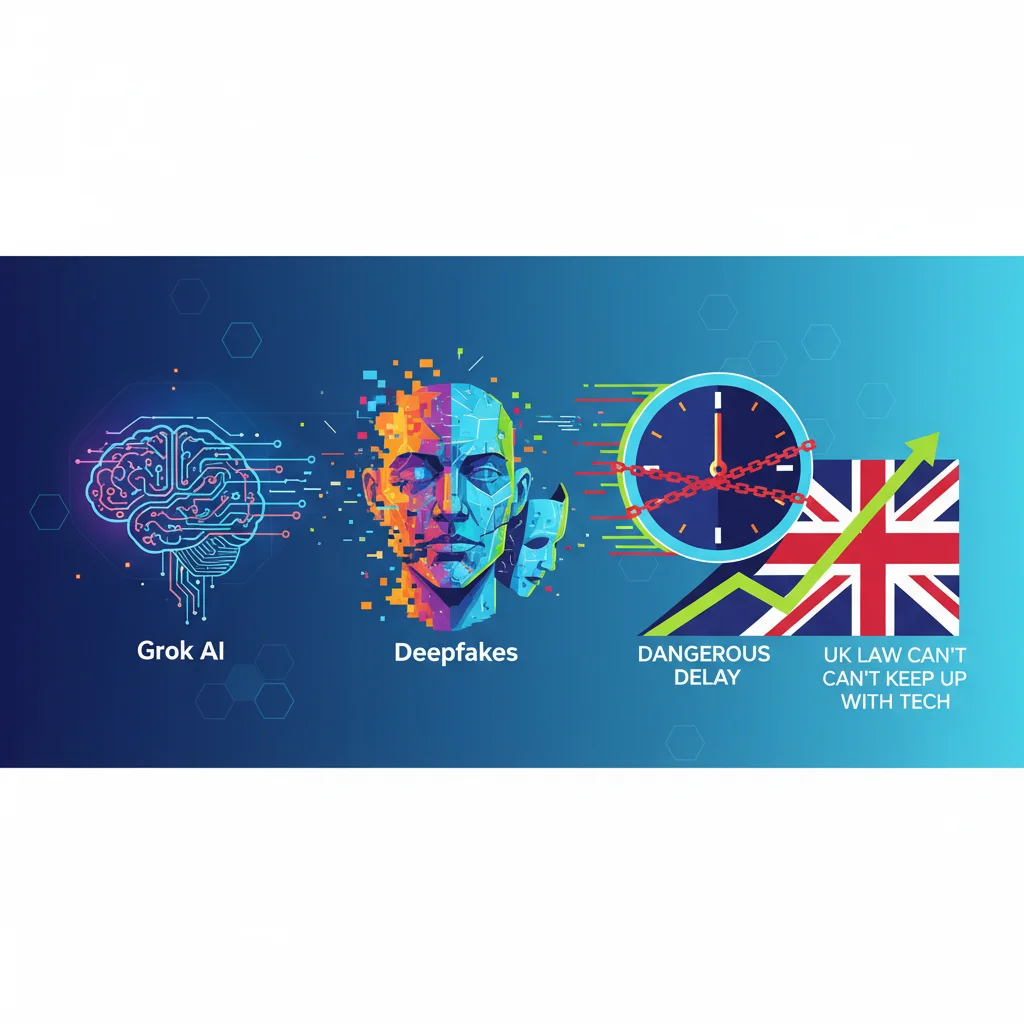
Grok AI, Deepfakes, and a Dangerous Delay: Why UK Law Can’t Keep Up with Tech
We live in an era of breathtaking technological acceleration. Every week, it seems, a new breakthrough in artificial intelligence redefines what’s possible. From automating complex workflows to generating stunning art from a simple prompt, AI is reshaping our world. But this relentless pace of innovation has a dark side, and it’s rapidly outpacing our ability to govern it. Nowhere is this more apparent than in the UK’s struggle to legislate against AI-generated deepfakes, a delay that advocacy groups warn is leaving vulnerable people dangerously exposed.
For over a year, campaigners have been urging the government to close a legal loophole that fails to explicitly criminalize the creation of sexually explicit deepfakes made without consent. Now, with the emergence of powerful, less-restricted AI models like Elon Musk’s Grok, the calls for action have reached a fever pitch. The government is being accused of “dragging its heels,” and the central question becomes: can our laws ever hope to keep pace with the code?
The Gathering Storm: Understanding the Deepfake Threat
Before we dive into the legislative gridlock, let’s clarify what we’re talking about. “Deepfake” is a portmanteau of “deep learning” and “fake.” It refers to synthetic media, typically images or videos, created using sophisticated machine learning techniques. These AI models are trained on vast datasets of real images and videos to learn how to realistically swap a person’s face onto another’s body or manipulate their actions and words.
While the technology has benign applications in film and entertainment, its potential for misuse is staggering. The most prominent and insidious use is the creation of non-consensual pornography, disproportionately targeting women. This form of digital violence can cause profound psychological trauma, reputational damage, and emotional distress. According to the End Violence Against Women Coalition, the situation has been critical for some time, with the initial law being suggested a full year ago.
But the threat extends far beyond this specific, horrific application. Consider the implications for:
- Misinformation: Imagine a realistic video of a world leader declaring war, or a CEO admitting to fraud, released just before a critical election or market open.
- Cybersecurity & Fraud: Deepfake audio can be used to impersonate executives and authorize fraudulent wire transfers (a technique known as vishing). Video can be used to bypass biometric security checks.
- Personal Harassment: Beyond pornography, deepfakes can be used to create videos of individuals saying or doing things they never did, fueling targeted bullying and blackmail campaigns.
The core problem is that as the underlying software becomes more sophisticated and accessible, often through cloud-based SaaS platforms, the barrier to entry for creating convincing fakes plummets. What once required specialized programming knowledge and significant computing power is fast becoming available to anyone with a smartphone.
The AI Tax: Why Your Next Gadget Could Cost 20% More
A Year of Waiting: The UK’s Legislative Limbo
Recognizing the growing danger, the UK’s Law Commission made recommendations back in 2022 to create new offenses to tackle the abuse. The government subsequently promised to introduce a new law making it illegal to create a sexually explicit deepfake without consent, even if the creator never shares it. This is a crucial distinction. Current laws often focus on the *sharing* or *distribution* of harmful material, but the proposed legislation would target the act of *creation* itself, acknowledging that the very existence of such a file is a profound violation.
Yet, here we are. The End Violence Against Women Coalition has highlighted that it has been a year since this law was first suggested, and it has yet to materialize. The government insists it is “working at pace” and that the measures will be introduced “as soon as parliamentary time allows,” but for victims and advocates, these assurances ring hollow. Every day of delay is another day that creators of this malicious content can operate in a legal grey area.
This timeline starkly illustrates the gap between technological advancement and the legislative process.
| Date / Period | Key Tech Advancement | Key Legislative / Advocacy Action (UK) |
|---|---|---|
| Late 2017 | Deepfake code and examples first appear on Reddit, making the technique widely known. | Existing laws (e.g., harassment, copyright) are the only recourse, often ill-suited for deepfakes. |
| 2018 – 2021 | Generative AI models (like GANs) improve exponentially. Open-source tools become more powerful and easier to use. | Growing calls from advocacy groups for specific legislation to address the unique threat. |
| July 2022 | Release of powerful text-to-image models like DALL-E 2 and Stable Diffusion to the public. | The Law Commission of England and Wales recommends new criminal offenses for intimate image abuse. |
| November 2023 | Elon Musk’s xAI releases Grok, an AI chatbot designed with fewer restrictions and a “rebellious streak.” | The government’s promise to introduce deepfake legislation remains unfulfilled. |
| Present | AI models continue to advance, with video generation and voice cloning becoming more realistic. | Advocates accuse the government of “dragging its heels” as the one-year mark since the proposal passes. |
Enter Grok AI: Pouring Fuel on the Fire
The recent launch of Grok AI by xAI has added a new, urgent dimension to this debate. Grok is marketed as a more audacious, less-filtered alternative to other AI chatbots. It’s designed to answer “spicy questions” that other systems might reject. While its primary function isn’t image generation, its philosophy is what worries cybersecurity experts and ethicists.
An AI model built with fewer guardrails could, in theory, be more easily manipulated or jailbroken to provide instructions, code snippets, or methods for creating harmful content, including deepfakes. It represents a broader trend in the AI community: a philosophical split between those who advocate for tightly controlled, safety-first models and those who champion a more open, “free-speech” approach to AI development. For legislators, this is a nightmare. How do you regulate a technology when its own creators can’t agree on the ethical boundaries?
The emergence of Grok is a perfect example of why the government’s delay is so perilous. The technological landscape isn’t waiting for Parliament to find a convenient time slot. It’s evolving, mutating, and creating new challenges on a monthly basis.
4 AI Shockwaves Set to Reshape Your Career by 2026
The Developer’s Dilemma and the Startup’s Responsibility
This issue isn’t just for lawmakers to solve. It lands squarely at the feet of the tech community—the developers, entrepreneurs, and startups building the future. The same automation and machine learning tools that can optimize a supply chain can also be used to ruin a life. This dual-use nature of technology places a heavy ethical burden on its creators.
For tech professionals, this means:
- Building with Intention: Ethical considerations can’t be an afterthought. From the initial programming phase, teams must ask: “How could this tool be misused?” and build safeguards accordingly.
- Robust Terms of Service: SaaS and cloud platforms that provide AI tools must have crystal-clear, rigorously enforced policies against the creation of abusive content.
- Investing in Detection: The same AI that creates fakes can be used to detect them. The cybersecurity field of AI-generated content detection needs more investment and talent to create a technological immune system against this plague.
For startups in the generative AI space, navigating this landscape is a tightrope walk. The pressure to innovate and ship products quickly is immense, but releasing a powerful tool without adequate safeguards is a recipe for disaster, both ethically and for the brand’s reputation. Responsible innovation is the only sustainable path forward.
From Paralysis to Possibility: How AI is Rebuilding the Bridge Between Mind and Body
Conclusion: From Inaction to Action
The UK government’s delay in criminalizing the creation of deepfake pornography is more than a legislative backlog; it’s a failure to keep pace with a clear and present danger. While the challenges of regulating fast-moving artificial intelligence are real and complex, they cannot be an excuse for paralysis. The harm caused by this technology is not theoretical—it’s happening now.
A multi-pronged approach is needed. The government must urgently pass the specific, targeted legislation it promised. But beyond that, we need a broader conversation involving tech companies, researchers, and the public about the ethical guardrails we want to place on AI development. The solution will involve a combination of robust laws, responsible corporate governance, advanced detection technologies, and greater public awareness.
The code is getting smarter every day. It’s time our laws, and our collective sense of responsibility, did too.