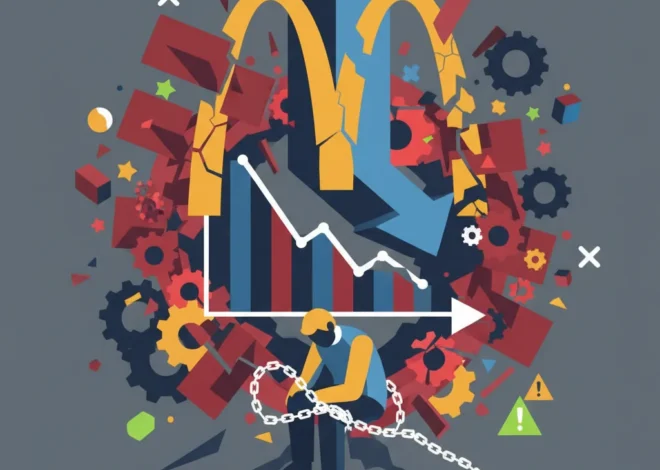
Beyond the Burger: Why McDonald’s Harassment Allegations Are a Red Flag for Investors
The golden arches, a globally recognized symbol of consistency and fast-food convenience, are once again under a harsh spotlight. Recent allegations from unions accuse McDonald’s of “repeated harassment” against its staff, a significant portion of whom are teenagers. This news, stemming from a BBC report, is not just a public relations crisis; it’s a critical data point for anyone involved in finance, investing, and corporate leadership. It serves as a stark reminder that a company’s culture is inextricably linked to its financial health and long-term stock market performance.
For decades, many in the financial world viewed corporate culture as a “soft” metric—important for morale but disconnected from the hard numbers of revenue and profit. That perspective is now dangerously outdated. In today’s economy, where Environmental, Social, and Governance (ESG) factors are paramount, issues like workplace harassment are material risks that can erode shareholder value, invite regulatory scrutiny, and permanently damage a brand’s reputation. This incident goes beyond a single company; it’s a case study in the tangible financial consequences of neglecting the “S” in ESG.
The Core of the Allegations: A Pattern of Neglect?
The accusations, brought forward by the Bakers, Food and Allied Workers Union (BFAWU), paint a troubling picture. They follow a comprehensive BBC investigation from 2023 that uncovered over 100 allegations of a toxic work environment, including claims of sexual assault, harassment, racism, and homophobia. The union now claims that despite public commitments to change, the fast-food giant has failed to adequately protect its young workforce, with ongoing reports of harassment and a culture of fear that discourages reporting.
McDonald’s has stated it is “determined to root out” harassment and has implemented new policies. However, the persistence of these claims highlights a fundamental challenge, particularly for a business with a sprawling franchise model. For investors and business leaders, the key question is not just whether the allegations are true, but whether the corporate governance structure is capable of enforcing standards and protecting its most valuable asset: its people. When a company’s workforce, especially one composed heavily of young and vulnerable employees, feels unsafe, the operational and financial repercussions are inevitable.
Clash of the Titans: Why the Saudi-UAE Rivalry is Redefining Middle East Finance and Investing
Translating Culture into Currency: The Financial Fallout of ESG Failures
How does a workplace culture issue translate into a balance sheet problem? The pathways are numerous and interconnected, creating a cascade of financial risks that sophisticated investors and financial professionals must monitor.
1. Direct Financial Costs
The most immediate impact comes from direct costs. This includes legal fees for defending against lawsuits, potential multi-million dollar settlements, and regulatory fines. In the UK, the Equality and Human Rights Commission (EHRC) has previously entered into a legal agreement with McDonald’s to address these issues, and continued failures could lead to more severe penalties. These are direct drains on capital that could otherwise be used for growth, innovation, or shareholder returns.
2. Brand and Reputation Damage
In the digital age, reputation is a currency. The McDonald’s brand is built on a family-friendly image. Allegations of exploiting or failing to protect teenage workers directly attack the core of this brand identity. This can lead to consumer boycotts, decreased foot traffic, and a measurable decline in sales. Rebuilding that trust is a long and expensive process, impacting the company’s standing in a highly competitive market.
3. Human Capital Depreciation
A toxic culture leads to higher employee turnover, which is incredibly costly. According to a Gallup report, the cost of replacing an individual employee can range from one-half to two times the employee’s annual salary. For a company the size of McDonald’s, which employs hundreds of thousands globally, even a small increase in turnover percentage translates to hundreds of millions of dollars in recruitment, hiring, and training costs. Furthermore, it erodes institutional knowledge and service consistency, directly affecting the customer experience.
To better visualize the potential financial ramifications, consider the following breakdown of risks associated with corporate governance and cultural failures:
| Risk Category | Specific Examples | Potential Financial Impact |
|---|---|---|
| Legal & Regulatory | Employee lawsuits, regulatory investigations (e.g., EHRC), government fines. | Multi-million dollar settlements, ongoing legal fees, increased compliance costs. |
| Market & Brand | Negative press, consumer boycotts, erosion of brand trust, stock price volatility. | Decreased sales revenue, loss of market share, long-term decline in stock market valuation. |
| Operational | High employee turnover, difficulty in recruitment, decreased productivity, inconsistent service. | Increased hiring and training expenses, reduced operational efficiency, lower customer satisfaction. |
| Capital & Investing | Divestment by ESG-focused funds, lower ESG score, difficulty securing favorable terms from banking partners. | Reduced access to capital, higher cost of borrowing, pressure from institutional investors. |
The Investor Perspective: Why the ‘S’ in ESG is No Longer Optional
For years, the ‘E’ (Environmental) in ESG dominated headlines. Now, the ‘S’ (Social) is taking center stage. Institutional investors, asset managers, and even retail traders are recognizing that social factors like labor practices, employee relations, and workplace safety are powerful indicators of a company’s long-term viability. A company that fails to manage its social risks is often a company with deeper, systemic governance problems.
This shift is reshaping the world of finance. Major banking institutions and investment firms now integrate sophisticated ESG scoring into their analysis. A poor score in the ‘Social’ category can trigger red flags, leading to divestment or shareholder activism. The economics are simple: a well-managed, engaged, and safe workforce is a more productive and innovative workforce, leading to better financial outcomes. Conversely, a culture of fear and harassment is a leading indicator of future operational and financial decay.
The Role of Technology in Fostering Transparency
The evolution of financial technology is playing a crucial role in this new paradigm. The rise of fintech platforms has democratized access to information, allowing everyday investors to view detailed ESG ratings for companies in their portfolios. This transparency puts unprecedented pressure on corporations to improve their practices. What was once hidden in internal HR reports is now a data point influencing trading decisions.
Looking ahead, emerging technologies could offer even more robust solutions. While not yet mainstream, some futurists speculate that blockchain technology could one day be used to create immutable, transparent records for supply chains and labor practices, making it harder for governance failures to go unnoticed. For now, the primary technological driver remains the rapid dissemination of information and the fintech tools that help investors process it, turning news alerts about harassment into actionable financial intelligence.
Conclusion: A Wake-Up Call for Business Leaders and Investors
The allegations against McDonald’s are more than just a troubling news story; they are a critical lesson for the modern economy. They underscore the fact that corporate culture is not a soft skill but a hard asset—or a debilitating liability. For business leaders, this is a call to action to invest in robust governance, create truly safe and respectful workplaces, and understand that these efforts are fundamental to sustainable growth.
For those in the finance and investing world, it’s a reminder to look beyond the quarterly earnings reports. The health of a company’s culture, its relationship with its employees, and its commitment to ethical governance are leading indicators of its future performance on the stock market. In the final analysis, how a company treats its people is one of the most reliable predictors of how it will treat its shareholders. Neglecting this fundamental principle is not just a moral failure; it’s a catastrophic financial miscalculation.
The Fungal Frontier: Why Mushrooms Are the Hottest New Asset in the Circular Economy

Related Posts
The Price of Prestige: Are London’s High Standards Strangling its Stock Market?

The 3% Illusion: Why a Minor Correction in Sinochem’s Pirelli Stake Reveals Major Truths About Global Finance