Beyond 0 and 1: Inside the Sub-Zero Heart of Google’s Quantum Computer
Step Inside a Chamber Colder Than Deep Space
Imagine a place so cold it makes the vacuum of deep space feel balmy. A silent, shielded chamber where the fundamental laws of physics are harnessed to perform calculations that would take today’s fastest supercomputers millennia. This isn’t science fiction. This is the reality inside Google’s quantum computing lab in Santa Barbara, California, the home of “Willow,” one of the most powerful computers ever conceived.
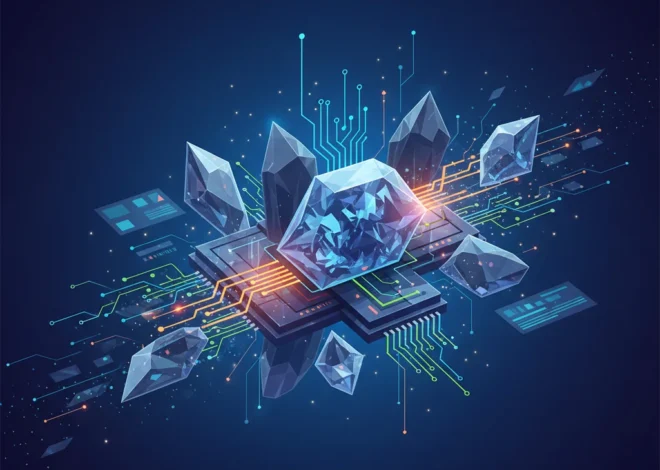
Recently, the BBC’s Faisal Islam was granted rare access to this sub-zero lair. What he saw wasn’t a rack of servers, but a stunning, intricate “chandelier” of gold-plated tubes and wires, descending into a super-cooled cylinder. This isn’t just a machine; it’s a portal to a new era of computation. But what exactly is happening inside this frozen heart, and why does it represent a seismic shift for everything from artificial intelligence to cybersecurity?
In this deep dive, we’ll unpack the revolutionary science behind Google’s Willow, explore the world-changing problems it aims to solve, and analyze the profound implications for developers, entrepreneurs, and the future of technology itself.
From Bits to Qubits: A New Computing Paradigm
To understand why Willow is so revolutionary, we first need to appreciate the limitations of the computers we use every day. For over 70 years, classical computing has been built on a simple, binary foundation: the bit. A bit can be either a 0 or a 1, like a light switch that is either off or on. All the incredible software, apps, and digital experiences we have are built on trillions of these switches flipping at lightning speed.
Quantum computers tear up this rulebook. They use “qubits.”
Thanks to a mind-bending principle of quantum mechanics called superposition, a qubit can be a 0, a 1, or—crucially—both at the same time. Think of it like this: a classical bit is a coin lying flat on a table, either heads (1) or tails (0). A qubit is that same coin while it’s spinning in the air, a blend of both possibilities until the moment you measure it.
Add another quantum phenomenon, entanglement (what Einstein famously called “spooky action at a distance”), and things get even more powerful. When two qubits are entangled, their fates are linked, no matter how far apart they are. Measuring one instantly influences the other. This interconnectedness allows quantum computers to explore a vast number of possibilities simultaneously. A machine with 300 entangled qubits could, in theory, represent more states than there are atoms in the known universe.
This immense computational space is why Google was able to claim “quantum supremacy” back in 2019. Their machine performed a specific calculation in just 200 seconds that, they estimated, would have taken the world’s most powerful classical supercomputer 10,000 years to complete. The game has fundamentally changed.
The Gold Phone That Wasn't: Why Building a Smartphone is a Startup's Ultimate Boss Battle
Why the Deep Freeze? The Fragility of a Quantum Dream
So, if qubits are so powerful, why don’t we have quantum laptops? The answer lies in their extreme fragility. The quantum states of superposition and entanglement are incredibly delicate. The slightest vibration, temperature fluctuation, or stray magnetic field—what physicists call “noise”—can cause the qubit to “decohere,” collapsing its quantum state back into a boring, classical 0 or 1. This erases the magic and destroys the calculation.
To protect these fragile qubits, Google has to create one of the most isolated environments on Earth. The Willow “chandelier” is a sophisticated refrigeration unit, a cryostat, that cools the quantum chip down to temperatures of around 10 millikelvin—a fraction of a degree above absolute zero. That’s more than 100 times colder than the deepest, darkest corners of outer space (source). This extreme cold slows down atomic vibrations, creating the pristine, silent environment where quantum mechanics can work its wonders.
The Problems Only a Quantum Computer Can Solve
A common misconception is that quantum computers will simply be faster versions of what we have now. That’s not quite right. They won’t replace your laptop for checking email or scrolling social media. Instead, they are specialized machines designed to tackle specific classes of problems that are currently intractable for even the most powerful supercomputers. These are problems of immense complexity and simulation, particularly those found in the natural world.
Here’s a comparison of how classical and quantum computers approach some of the world’s biggest challenges:
| Problem Domain | Classical Computing Approach | Quantum Computing Potential |
|---|---|---|
| Drug & Material Discovery | Slow, costly physical trials and simplified molecular simulations that often miss crucial details. | Precisely simulating molecular interactions to design new drugs, catalysts, and materials from the ground up. This could revolutionize medicine and manufacturing. |
| Battery Technology | Incremental improvements through trial-and-error chemistry. Simulating the complex electrochemistry is too difficult. | Designing new, highly efficient battery materials by accurately modeling energy storage and transfer at the atomic level, leading to a true EV revolution. |
| AI & Machine Learning | Training complex AI models requires massive datasets and enormous energy consumption. Optimization problems can be slow to solve. | Solving complex optimization problems exponentially faster, potentially supercharging machine learning algorithms for finance, logistics, and scientific research. |
| Cryptography | Relies on the difficulty of factoring very large numbers. Modern encryption is secure against all known classical attacks. | Using algorithms like Shor’s, a large-scale quantum computer could break most modern encryption, posing a massive cybersecurity threat. |
As you can see, the goal isn’t just speed; it’s about unlocking a new depth of understanding. By simulating nature with a machine that operates on nature’s own quantum rules, we can solve problems that have been out of reach for generations. This is the ultimate form of automation in scientific discovery.
From Paralysis to Possibility: How AI is Rebuilding the Bridge Between Mind and Body
The Quantum Apocalypse: A Ticking Clock for Cybersecurity
While the potential for good is immense, there’s a darker side to this power. One of the first and most well-defined applications for a fault-tolerant quantum computer is breaking the encryption that protects virtually all our digital information—from bank accounts and government secrets to private messages.
Modern public-key cryptography, the foundation of online security, relies on the fact that it’s easy to multiply two large prime numbers together but computationally impossible for a classical computer to work backward and find the original factors. A large-scale quantum computer running Shor’s algorithm could solve this factoring problem with ease, rendering much of our current security infrastructure obsolete overnight. This potential “quantum apocalypse” has spurred a global race among cryptographers and government agencies to develop and standardize “post-quantum cryptography” (PQC)—new encryption methods that are secure against attacks from both classical and quantum computers.
For any organization dealing with sensitive data, the quantum threat is no longer a distant academic concern. It’s a strategic imperative that requires planning today. The transition to PQC will be one of the most significant and complex upgrades in the history of IT and cybersecurity.
The Global Race for Quantum Supremacy
Google is a clear leader, but they are far from alone in this race. The pursuit of quantum computing is a global endeavor with massive investment from both public and private sectors.
- Tech Giants: IBM is a formidable competitor with its own roadmap and publicly accessible quantum systems on the cloud. Microsoft and Amazon are also investing heavily in their own unique approaches to building qubits.
- Nations: The United States and China are locked in a strategic competition for quantum leadership, pouring billions into research and development, viewing it as a critical technology for economic and national security.
- Startups: A vibrant ecosystem of startups is flourishing, tackling everything from specialized quantum software and programming languages to novel hardware designs and cooling technologies. Companies like Rigetti, IonQ, and PsiQuantum are making significant strides and pushing the boundaries of innovation.
This competition is accelerating progress at an incredible rate. Every breakthrough, whether in qubit stability, error correction, or algorithmic development, brings us one step closer to the quantum future.
The Great Reshuffle: AI Is Coming for 200,000 European Banking Jobs. Are You Ready?
Conclusion: From a Chandelier in a Freezer to a Revolution in a Cloud
The journey into the sub-zero heart of Google’s Willow computer is a journey to the very edge of human knowledge. It’s a place where the abstract theories of quantum mechanics are being forged into a tangible, world-changing technology. We are not on the cusp of a quantum-powered iPhone, but we are witnessing the birth of a tool that will redefine what is possible.
As Google’s Hartmut Neven projects, a decade may be all that separates us from a useful, error-corrected machine (source). When that day comes, this power will likely be delivered via the cloud, democratizing access and allowing developers, scientists, and entrepreneurs to tackle humanity’s greatest challenges. From designing life-saving drugs and creating a sustainable future to supercharging artificial intelligence, the revolution won’t be televised—it will be calculated, in a silent, frozen chamber, one qubit at a time.