Nvidia’s High-Stakes Gamble: How the H200 Chip is Redefining the US-China AI War
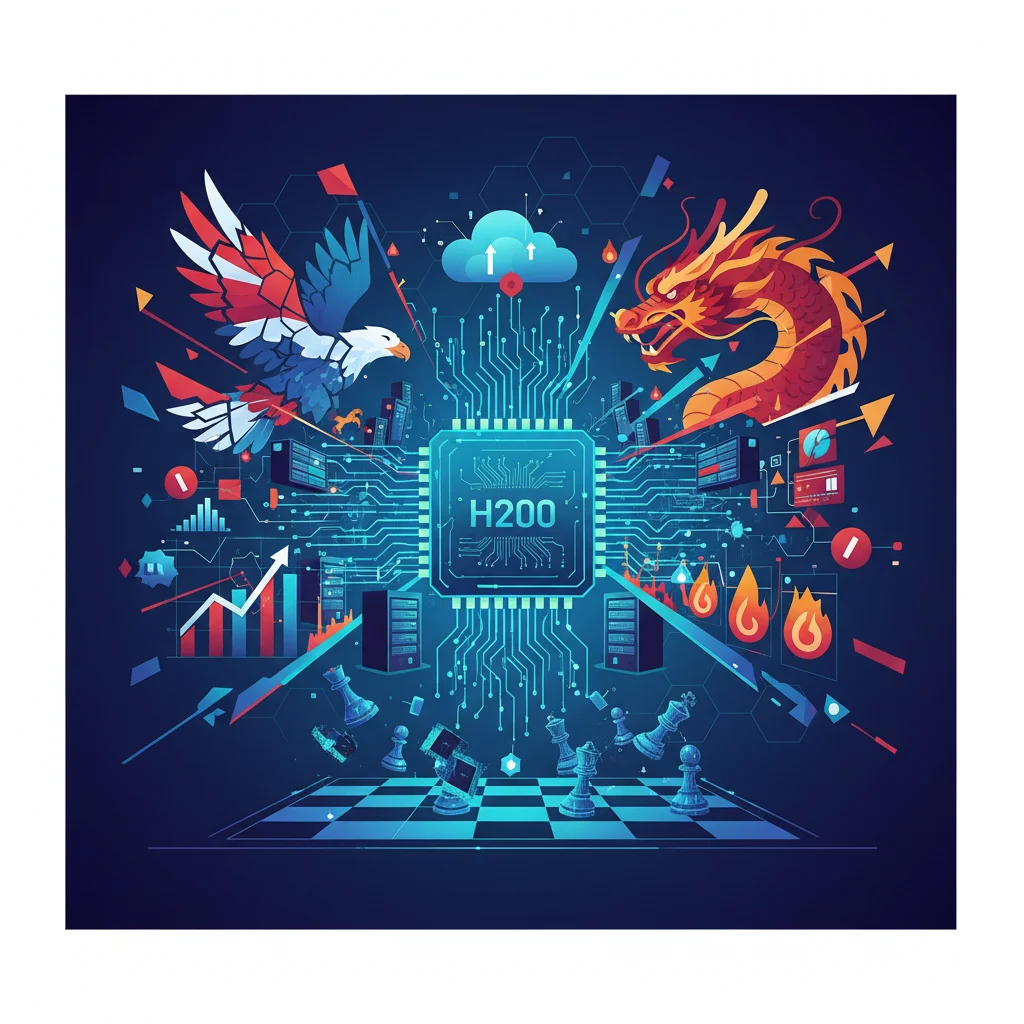
In the high-stakes chess match of global technology, every move is scrutinized, every decision weighed against a complex backdrop of commerce, national security, and relentless innovation. The latest move comes from the undisputed king of the AI hardware world, Nvidia. The company is stepping up production of its powerful H200 Tensor Core GPU for the Chinese market, a bold maneuver that navigates the intricate web of U.S. export controls. Nvidia CEO Jensen Huang has expressed confidence that the “last details” of a deal with the White House to resume these crucial AI chip exports will be finalized soon.
This isn’t just a simple product launch. It’s a strategic masterstroke with profound implications for the future of artificial intelligence, global supply chains, and the simmering technological rivalry between Washington and Beijing. For developers, entrepreneurs, and tech leaders, understanding the nuances of this development is critical. It’s a story about more than just silicon; it’s about the very architecture of our digital future.
The Geopolitical Gauntlet: A Primer on the AI Chip War
To fully grasp the significance of the H200’s journey to China, we need to rewind. For the past few years, the U.S. government has been tightening its grip on the export of high-performance computing technology to China. The rationale is rooted in national security: prevent advanced AI chips from being used to modernize China’s military or for other applications that could challenge U.S. interests, particularly in the realm of cybersecurity and surveillance.
This led to a series of escalating export controls, famously banning Nvidia’s top-tier A100 and H100 GPUs—the workhorses of the generative AI revolution—from being sold to Chinese companies. The impact was immediate and seismic. Chinese tech giants like Alibaba, Tencent, and Baidu, which rely on these chips to power their massive cloud infrastructures and train their large language models (LLMs), were suddenly facing a computational drought.
Nvidia, for its part, faced a painful dilemma. China represents a massive, lucrative market. Walking away was not an option, but defying the U.S. government was impossible. The result was a “compliance dance”—designing and releasing down-specced versions of their chips, like the A800 and H800, that met the performance caps set by the Department of Commerce. However, as the AI race intensified, so did the restrictions. In October 2023, the rules were tightened again, rendering even these modified chips illegal for export to China.
This set the stage for Nvidia’s latest, and perhaps most sophisticated, response: a new lineup of compliant chips, with the H200 variant at the forefront.
China's New AI 'Guardian': Protecting Kids or Stifling Innovation?
Walking the Tightrope: Nvidia’s H200 Strategy for China
The H200 is, in its unrestricted form, an absolute beast. As the successor to the H100, it was the first GPU to feature HBM3e memory, offering staggering bandwidth and capacity. This is precisely the kind of hardware needed for the next wave of machine learning models, which are growing exponentially in size and complexity.
Nvidia’s plan isn’t to ship the full-power H200 to China. Instead, they are producing a carefully calibrated version that threads the needle of U.S. regulations. While the exact specifications of this China-specific model are not fully public, the strategy is clear: maximize performance within the legal limits. According to the Financial Times report, Nvidia is ramping up production, signaling a strong belief that this new chip will get the green light from Washington (source).
This move is crucial for several reasons:
- Market Preservation: It allows Nvidia to maintain its dominant position in the Chinese AI market, fending off competition from domestic players like Huawei and its Ascend 910B chip.
- Ecosystem Lock-in: The AI world doesn’t just run on hardware; it runs on Nvidia’s CUDA software platform. By providing Chinese developers with powerful, CUDA-compatible hardware, Nvidia ensures they remain within its ecosystem, a massive competitive moat.
- Geopolitical De-escalation: By working closely with the White House, Nvidia is positioning itself not as an adversary of U.S. policy, but as a pragmatic partner finding workable solutions.
A Tale of Two Chips: H200 vs. Its Potential China-Compliant Sibling
To understand the trade-offs involved, let’s compare the full-power H200 with what a hypothetical China-compliant version might look like, based on the known export control parameters. The key is balancing different performance metrics to stay under the regulatory ceiling.
| Specification | Nvidia H200 (Full Power) | Hypothetical H200 (China-Compliant Version) |
|---|---|---|
| Memory | 141 GB HBM3e | Likely the same 141 GB HBM3e (Memory capacity is less restricted) |
| Memory Bandwidth | 4.8 TB/s | Likely the same 4.8 TB/s (A key advantage they’d want to keep) |
| Peak FP16/BF16 Tensor Core Performance | ~1,979 TFLOPS (teraflops) | Significantly reduced to fit under performance density caps |
| Interconnect Speed (NVLink) | 900 GB/s | Potentially throttled to limit large-scale clustering capabilities |
| Primary Restriction Factor | N/A | Total Processing Performance and Performance Density |
As the table illustrates, the China-specific version would likely retain the impressive memory advantages of the H200 but see its raw computational power (TFLOPS) curtailed. This allows Chinese companies to work with massive datasets and models but slows down the absolute speed of training and inference, achieving the U.S. government’s goal of moderating the pace of AI advancement.
However, there’s a long-term risk here. By supplying “good enough” chips, the U.S. might be creating a comfortable middle ground that reduces the urgency for Chinese firms to switch to domestic alternatives like Huawei’s Ascend. But it could also be giving them just enough runway to perfect their software and AI models while they work furiously to close the hardware gap. The big question is whether this strategy slows China down in the long run or simply trains a more resilient and eventually self-sufficient competitor. For startups in the West, this means the global competitive landscape remains fierce, as Chinese counterparts won’t be as starved for compute as previously thought.
The Ripple Effect: What This Means for the Entire Tech Ecosystem
Nvidia’s H200 maneuver is not happening in a vacuum. It sends ripples across the entire global tech landscape, affecting everyone from cloud providers to individual developers.
For Chinese Tech Giants & Cloud Providers
Companies like Alibaba Cloud, Tencent Cloud, and Baidu AI Cloud receive a critical lifeline. Access to these chips means they can continue to offer competitive SaaS and platform-as-a-service (PaaS) products for AI and machine learning. It allows them to keep pace, to some degree, with AWS, Google Cloud, and Azure. This prevents a complete bifurcation of the AI world and ensures their vast ecosystems of developers and customers have a viable path forward for innovation.
For Developers and Startups
For a developer working on a new AI application or a startup building a foundational model, access to cutting-edge hardware is everything. This development means that the global talent pool of programmers and AI researchers in China won’t be completely cut off from the Nvidia ecosystem. Their programming work on the CUDA platform remains relevant, and they can continue to contribute to the global open-source AI community. It’s a win for the collaborative nature of software development.
The Great AI Firewall: Why China's Move to Regulate AI for Kids Will Impact Everyone in Tech
For Automation and the Future of AI
The relentless march of automation, from autonomous systems to AI-powered business processes, is fueled by computational power. By ensuring a steady (albeit regulated) flow of advanced hardware, this move guarantees that the development of these transformative technologies continues on a global scale. The race to build more sophisticated AI for everything from drug discovery to financial modeling will continue unabated, both inside and outside of China.
The Road Ahead: A Fragile Détente
Jensen Huang’s confidence is a key indicator. His statement that the company is “confident that the last details are being finalised” suggests a deep and ongoing dialogue with U.S. regulators (source). Nvidia is likely providing extensive data to prove these new chips cannot be easily clustered to form a supercomputer that would violate the spirit of the export rules.
However, this situation remains fluid. The U.S. government could always tighten the rules again. Meanwhile, China is pouring billions into its domestic semiconductor industry, aiming for technological self-sufficiency. Huawei’s progress with its Ascend chips is a clear sign that they are not standing still. The Nvidia H200 for China is a brilliant solution for today, but it may just be one chapter in a much longer and more complex story.
For now, Nvidia has navigated the geopolitical minefield with remarkable agility. It has found a way to serve a critical market, adhere to complex regulations, and keep its shareholders happy—all while supplying the foundational technology for the single most important technological revolution of our time. This high-stakes gamble on the H200 is more than just a business decision; it’s a defining moment in the global race for AI supremacy.
Beyond OpenAI: Inside Satya Nadella’s Bold New Blueprint for Microsoft's AI Future

Related Posts
Nvidia’s High-Stakes Game: The Billion-Dollar Scramble for AI Dominance in Asia
Samsung’s AI-Powered Juggernaut: What Record Profits Signal for the Global Economy and Your Portfolio