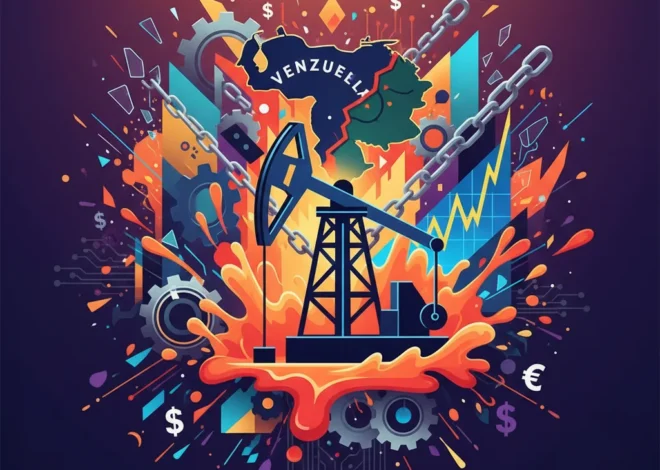
Venezuela’s Black Gold: The Ultimate High-Risk, High-Reward Investment?
The Trillion-Dollar Question: Is Venezuela’s Oil Sector Open for Business?
Imagine a country sitting on the world’s largest proven oil reserves—over 300 billion barrels, more than Saudi Arabia—yet its economy is in ruins and its production is a fraction of its former glory. This is the paradox of Venezuela. For years, crippling US sanctions, political turmoil, and systemic corruption have rendered its vast oil wealth almost untouchable for global investors. But the geopolitical winds are shifting, and a tentative door has creaked open.
In late 2023, the United States offered a six-month reprieve, temporarily lifting sanctions on Venezuela’s oil and gas sector. This move was part of a delicate diplomatic dance, contingent on President Nicolás Maduro’s regime holding fair and competitive elections. Suddenly, a market that was off-limits became the subject of intense speculation across the global finance and energy sectors. The question on every investor’s and business leader’s mind is stark: Is this a once-in-a-generation opportunity to get in on the ground floor of a massive economic revival, or is it a fool’s errand—a high-stakes gamble in one of the world’s most volatile political landscapes?
This isn’t a simple stock market play; it’s a complex chess match involving geopolitics, operational nightmares, and staggering potential returns. As the clock ticks on the sanctions waiver, we’ll dissect the players, the risks, and the monumental prize at stake in Venezuela’s oil endgame.
The Players at the Table: A Mix of Cautious Giants and Bold Newcomers
The temporary lifting of sanctions triggered an immediate flurry of activity. Companies long sidelined are now re-engaging, while new, more risk-tolerant players are testing the waters. The landscape is crowded with a diverse cast of characters, each with a different strategy for navigating this treacherous yet potentially lucrative environment.
Here’s a breakdown of the key actors vying for a piece of Venezuela’s oil wealth:
| Player | Country of Origin | Strategic Position & Recent Moves |
|---|---|---|
| Chevron | USA | The only US major with a significant, long-standing presence. Has been operating under a special license even during sanctions, allowing it to produce and export oil to recoup debt. Holds a critical first-mover advantage. |
| Repsol & Eni | Spain & Italy | European giants who have navigated sanctions through complex oil-for-debt swap agreements. They are now looking to ramp up operations and potentially convert debt into equity in lucrative joint ventures. |
| Maurel & Prom | France | A smaller, more agile player that recently signed a deal to boost production at an oilfield near Lake Maracaibo. Represents the new wave of risk-tolerant companies willing to enter where larger firms fear to tread. |
| Reliance Industries | India | A major pre-sanctions buyer of Venezuelan crude, perfectly suited to process its heavy, sour oil. Is reportedly in talks to revive these purchases, showcasing the global demand waiting in the wings. |
| China | China | A massive creditor to Venezuela, but has adopted a surprisingly cautious stance. Beijing is wary of further financial exposure and is likely waiting for more concrete signs of stability before committing new capital. |
Chevron’s position is particularly noteworthy. Having weathered the storm, the American giant is uniquely positioned to scale its operations quickly if the political climate stabilizes. However, even for them, the path is fraught with challenges, from decaying infrastructure to the ever-present threat of political reversal.
The 2026 Horizon: Ukraine, Russia, and the Economic Endgame for Investors
The Colossal Risks: A Minefield for the Unwary
While the allure of 300 billion barrels of oil is powerful, the risks associated with investing in Venezuela are equally immense. Any serious analysis requires a clear-eyed assessment of the obstacles that could turn a dream investment into a financial nightmare.
1. Extreme Political & Regulatory Instability
The entire investment thesis hinges on a fragile political deal. The Maduro government has a long history of reneging on promises and changing rules arbitrarily. The primary risk is “snap-back” – the immediate re-imposition of US sanctions if Venezuela fails to meet its democratic commitments. This could leave investors with stranded assets and worthless contracts overnight. The recent decision to bar the leading opposition candidate, María Corina Machado, from running in the election is a major red flag that has put the entire sanctions-relief deal in jeopardy (source).
2. Dilapidated Infrastructure & Operational Decay
Venezuela’s state-owned oil company, PDVSA, is a shadow of its former self. Decades of corruption, mismanagement, and lack of investment have left pipelines, refineries, and drilling equipment in a state of near-total collapse. Experts estimate that restoring production to its former peak of over 3 million barrels per day would require a staggering investment of “$15bn to $20bn a year for a decade.” This is not a simple matter of turning on the taps; it’s a full-scale reconstruction project requiring massive capital expenditure in an environment with no guarantee of returns.
3. A Tangled Web of Debt and Legal Claims
PDVSA and the Venezuelan government are buried under a mountain of debt and legal judgments from creditors and bondholders around the world. Any company generating revenue in the country faces the risk that its assets or payments could be seized by creditors seeking to enforce court rulings. Untangling these competing claims will be a legal quagmire for years to come, adding another layer of complexity to any investing or trading activity.
Beyond the Balance Sheet: The Battle for the Soul of Accounting
The Unignorable Upside: A Generational Opportunity?
Despite the daunting risks, the potential reward remains a powerful magnet. If the political situation stabilizes and the legal framework becomes reliable, the upside is almost unparalleled in the world of economics and energy.
The sheer scale of the reserves means that even a partial recovery could be transformative. Boosting production from its current level of around 800,000 barrels per day to 1.5 or 2 million barrels per day would significantly impact global energy markets, potentially moderating prices and providing a stable source of non-OPEC+ supply. For the companies that secure favorable terms, the long-term profitability could be enormous, reshaping their portfolios for decades.
Furthermore, the rebuilding of Venezuela’s energy sector would create a massive ripple effect across its economy. It would require a monumental effort in engineering, logistics, and infrastructure development, creating opportunities for a wide range of service companies. The influx of capital would necessitate a revitalized banking sector and could even spur innovation in financial technology. In a best-case scenario, could a transparent, blockchain-based system for tracking oil revenues be implemented to combat corruption and ensure funds are directed toward rebuilding the nation? It’s a distant dream, but one that highlights the transformative potential if the foundational issues of governance are resolved.
The Investor's Blueprint: What an Artist's 18th-Century Home Teaches Us About 21st-Century Finance
The Final Verdict: A Test of Nerve for Global Finance
Investing in Venezuela’s oil sector today is the definition of a contrarian, high-risk play. It is not for the faint of heart or those with a short-term horizon. The situation is less about traditional financial modeling and more about assessing geopolitical risk and the psychology of key political actors in both Caracas and Washington.
The coming months will be critical. The world will be watching to see if the Maduro regime allows a genuinely competitive election and if the US administration prioritizes democratic principles over energy market stability. For investors, the path forward requires deep due diligence, powerful political connections, and an iron-clad tolerance for volatility.
The story of Venezuela’s oil is a stark reminder that in the world of global finance, immense opportunity is often intertwined with profound risk. Whether this becomes a cautionary tale of squandered potential or a legendary case study in emerging market investing remains to be seen. One thing is certain: the entire world will be watching.

Related Posts
Trump’s Venezuelan Oil Gambit: A Stock Market Fantasy or a Future Geopolitical Shift?
Trump’s Venezuelan Oil Gambit: A Multi-Billion Dollar Opportunity or a Geopolitical Quagmire?