Hyundai’s Robot Revolution: Are Humanoid Workers the Future of Our Factories?
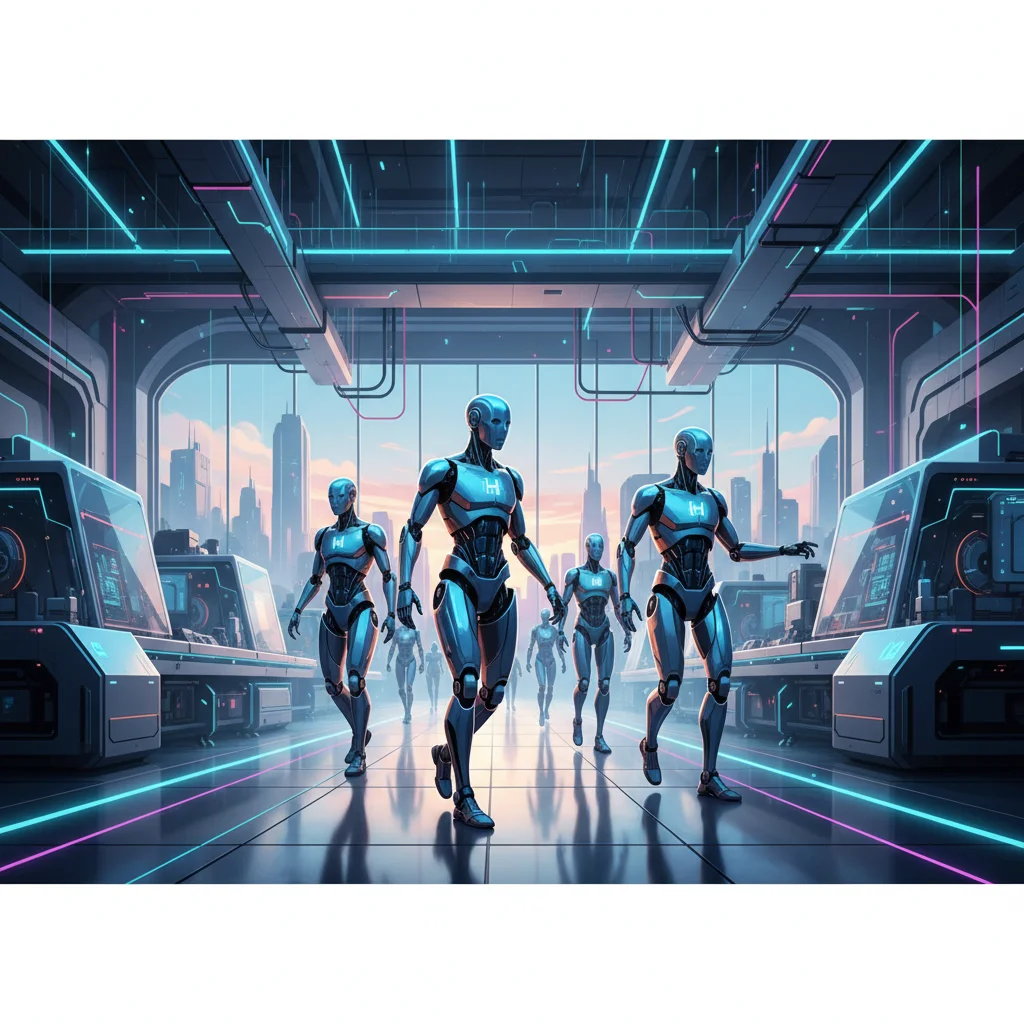
Picture the factory of tomorrow. It’s not the clunky, noisy assembly line of the past, dominated by sparks and single-purpose robotic arms bolted to the floor. Instead, imagine a workspace where bipedal, human-like robots walk the floor, deftly handling tools, inspecting parts, and collaborating seamlessly with their human counterparts. This isn’t a scene from a sci-fi blockbuster; it’s the future Hyundai is actively building. The automotive giant has announced plans to deploy advanced, human-like robots in its factories, marking a seismic shift in the world of manufacturing and automation.
The news, first reported by the BBC, is more than just a technological curiosity. It signals a convergence of cutting-edge artificial intelligence, sophisticated robotics, and a strategic response to complex global labor dynamics. Interestingly, Hyundai is targeting a plant that has been at the center of labor-related controversy, suggesting this move is as much about solving human resource challenges as it is about engineering excellence. This decision forces us to ask a critical question: Are we witnessing the dawn of a new industrial revolution, or the beginning of a future fraught with ethical dilemmas about the role of humans in the workplace?
In this deep dive, we’ll unpack Hyundai’s ambitious plan, explore the groundbreaking technology making it possible, and analyze the profound implications for developers, startups, and the very future of work itself.
From Bolts on the Floor to Boots on the Ground: The Evolution of Factory Automation
For decades, factory automation has been defined by stationary, single-task robots. Think of the giant, articulated arms you see in car commercials, welding frames with perfect precision. They are incredibly efficient but fundamentally limited. They can’t move, adapt to new environments, or perform a variety of tasks without extensive and costly reprogramming.
Humanoid robots represent a paradigm shift. By acquiring robotics pioneer Boston Dynamics in 2021 for nearly $1.1 billion, Hyundai gained access to some of the most advanced humanoid robotics technology on the planet, most notably the ‘Atlas’ robot. These machines are designed to navigate and operate in spaces built for humans. They can walk, climb stairs, carry objects, and use tools designed for human hands. This versatility is their superpower.
To understand the magnitude of this leap, let’s compare traditional factory robots with the emerging humanoid models.
| Feature | Traditional Robotic Arms | Humanoid Robots |
|---|---|---|
| Mobility | Stationary, fixed to one location | Mobile, can walk and navigate complex environments |
| Versatility | Single-purpose, designed for one specific, repetitive task | Multi-purpose, can be programmed for a wide range of tasks |
| Environment | Requires a custom, robot-centric workspace (cages, safety zones) | Designed to operate in human-centric environments without major retrofitting |
| Core Technology | Primarily pre-programmed movements and basic sensors | Advanced AI, machine learning for dynamic balance, navigation, and object manipulation |
| Integration Cost | High initial cost plus significant facility redesign | High unit cost but potentially lower facility integration cost |
This shift from specialized tools to general-purpose workers is the core of this innovation. A humanoid robot could, in theory, perform quality control in the morning, assist with logistics in the afternoon, and help re-tool a production line overnight—a level of flexibility previously unimaginable in automated systems.
The Great AI Firewall: Why China's New Rules for Protecting Kids Will Reshape Global Tech
The ‘Why’: More Than Just a Quest for Efficiency
So, why is Hyundai making this massive investment now? The pursuit of efficiency, quality, and safety is a given. Robots don’t get tired, they don’t need breaks, and they can perform dangerous tasks without risk to human life. But the context surrounding this decision reveals deeper strategic motivations.
The automotive industry is grappling with persistent labor shortages and supply chain vulnerabilities. Furthermore, Hyundai has faced intense scrutiny over its labor practices. In 2022, a Reuters investigation uncovered the use of child labor at a Hyundai supplier’s factory in Alabama, leading to significant brand damage and legal repercussions (source). While automation is not a simple fix for complex ethical issues, for a corporation, it can be framed as a way to create a more controlled, predictable, and scandal-proof workforce. Deploying robots in a plant with a history of labor issues is a powerful statement, intended to signal a future with fewer human-related variables.
Beyond damage control, this is a strategic play for leadership in the next generation of manufacturing. The company that masters the deployment of a humanoid workforce will not only optimize its own operations but will also be positioned to sell this technology and expertise to others, potentially creating a new, multi-billion-dollar revenue stream.
The Brains Behind the Brawn: The Software and AI Stack
A humanoid robot is a marvel of mechanical engineering, but its true power lies in its software. This is where the magic of artificial intelligence and machine learning comes to life, transforming a heap of metal and actuators into an autonomous agent.
The software stack for a robot like Atlas is incredibly complex, involving several layers:
- Perception: Using a suite of sensors (LIDAR, cameras, depth sensors), the robot’s AI builds a real-time 3D map of its environment. Machine learning algorithms are used for object recognition, allowing it to differentiate between a box, a tool, and a human colleague.
- Navigation & Locomotion: This is where the dynamic balancing that makes Boston Dynamics’ robots famous comes in. Sophisticated control-theory algorithms constantly adjust the robot’s joints to maintain stability, even on uneven terrain or after being pushed. This isn’t simple programming; it’s a predictive, AI-driven process.
- Manipulation: The ability to pick up and use objects requires advanced AI. The robot must calculate the best way to grip an object, apply the right amount of force, and move it without collision. This is often trained in cloud-based simulations before being deployed on the physical robot.
- Decision Making: At the highest level, an AI model, often referred to as a “policy,” dictates the robot’s actions based on its goals. This system integrates data from all other layers to decide whether to walk, grab, or wait. The massive computational load for training these models and processing real-time data often relies on robust cloud infrastructure.
For tech professionals, this represents a new frontier. The demand for engineers who understand the intersection of mechanical systems, AI, and enterprise-grade SaaS (Software as a Service) for robot fleet management will skyrocket.
Beyond the Great Firewall: Decoding China's Ambitious Plan to Tame AI for its Youth
The Ripple Effect: A New Ecosystem for Startups and Tech Talent
Hyundai’s move isn’t happening in a vacuum. It’s an accelerant for a whole new ecosystem of technology and commerce. For entrepreneurs and startups, this signals a gold rush of opportunity in several key areas:
- Specialized AI Software: Startups can develop AI modules for specific factory tasks, like advanced quality inspection, predictive maintenance, or complex assembly, and sell them on a SaaS platform for robots.
- Simulation and Digital Twins: Creating realistic virtual environments for training robots is a massive technical challenge. Companies that can provide hyper-realistic simulation platforms will be invaluable. According to one industry report, the digital twin market is projected to grow to $110.1 billion by 2028.
- Robotic Cybersecurity: As noted earlier, securing a fleet of autonomous robots is a critical, unsolved problem. Startups specializing in embedded systems security and AI-driven threat detection for robotic networks have a massive greenfield opportunity.
- Human-Robot Interface (HRI): Designing intuitive ways for human workers to safely collaborate with, manage, and program their robotic counterparts will be essential. This field combines UI/UX design, psychology, and software engineering.
For developers, data scientists, and AI specialists, this is a clear signal to start acquiring skills in robotics-adjacent fields. Expertise in Python, C++, robotics operating systems (ROS), and machine learning frameworks like TensorFlow and PyTorch, when combined with an understanding of physical systems, will be a golden ticket in the job market of the near future.
Shaken, Not Stirred: Why the 007 Game Delay Is a Masterclass in Modern Tech Innovation
Are We Ready for Our New Robotic Co-Workers?
Hyundai’s plan to deploy humanoid robots in its factories is a landmark moment. It represents the point where science fiction begins its transition into industrial reality. This innovation holds the promise of unprecedented productivity, safety, and manufacturing flexibility.
However, it also forces a societal reckoning. The conversation can no longer be about *if* automation will impact jobs, but *how* we manage the transition. It raises urgent questions about corporate responsibility, income inequality, and the need for massive public and private investment in education and reskilling programs. The future of manufacturing won’t be a battle of humans versus robots; it will be a collaboration. But building that collaborative future requires careful planning, ethical consideration, and a commitment to ensuring that the benefits of this technological revolution are shared by all.
The robots are coming. The real work, for us, is to prepare the world for their arrival.

Related Posts

The AI Productivity Paradox: Why Your ChatGPT Habit is Reshaping the Economy (Even if GDP Can’t See It)
The Robots Are Clocking In: Why Hyundai’s Plan to Deploy Humanoids is a Glimpse into Our AI-Powered Future