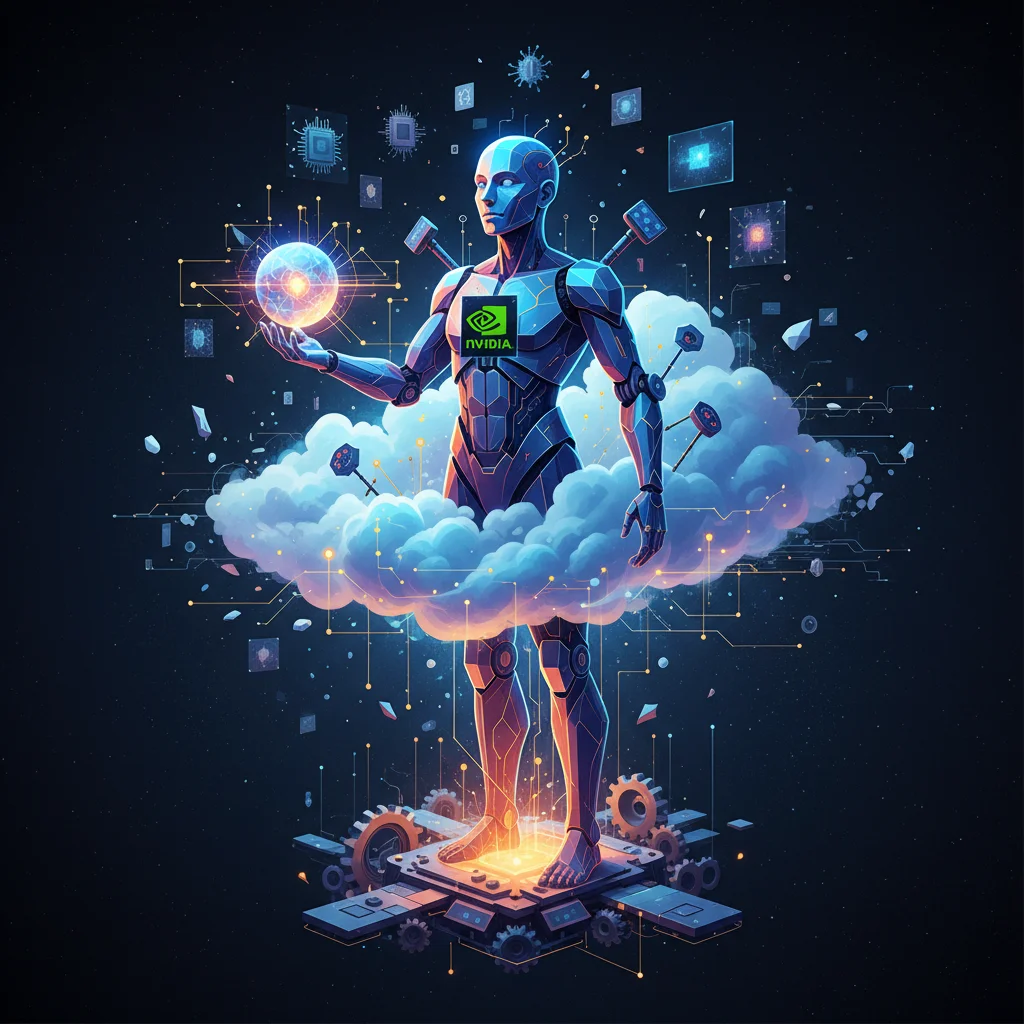
Beyond the Cloud: Nvidia’s Grand Plan to Give AI a Physical Body
For the past few years, the term “AI” has conjured images of chatbots typing witty responses, artists generating surreal landscapes from a text prompt, or algorithms recommending your next binge-watch. This has been the era of disembodied intelligence—powerful, yes, but living almost exclusively within the digital confines of the cloud and massive data centers. But what happens when that intelligence gets a body? What happens when AI can see, move, and interact with the physical world?
That’s the multi-trillion-dollar question, and chip giant Nvidia believes it has the answer. In a move that signals a monumental shift in the trajectory of the AI revolution, Nvidia recently unveiled its latest self-driving car technology, making it clear that its ambitions stretch far beyond powering the software that thinks. The company is building the brains and nervous systems for the machines that do.
This isn’t just about another cool gadget. It’s a strategic pivot from the digital to the physical, a move to embed artificial intelligence into the very fabric of our reality. For developers, entrepreneurs, and tech professionals, this is more than a headline; it’s a roadmap to the future of innovation. Let’s break down what this means and why it’s one of the most important developments in tech today.
From Cloud-Based Brains to Embodied Intelligence
The first wave of the modern AI boom was defined by scale. Companies raced to build bigger and bigger language models, training them on unfathomable amounts of data hosted in the cloud. The business model was clear: offer this intelligence as a service, a SaaS (Software as a Service) product that anyone could access via an API. This model gave us incredible tools and powered countless startups, but it had a fundamental limitation: the AI was a passive oracle, waiting for a prompt.
The next wave is about agency. “Embodied AI” is the concept of integrating AI systems into physical hardware—robots, drones, and, most visibly, cars—allowing them to perceive their environment and act upon it autonomously. This is exponentially more complex than running a language model.
Consider the difference:
- A cloud AI needs to understand language and context.
- An embodied AI needs to understand physics, spatial awareness, sensor fusion (data from cameras, LiDAR, radar), and the unpredictable nature of the real world.
Nvidia’s dominance in the first wave came from its GPUs, which became the default hardware for training these massive models. Now, the company is leveraging that expertise to create a new kind of computing platform—one designed not for a data center, but for a vehicle moving at 70 miles per hour.
Meta's Next Frontier: Why the Quiet Acquisition of AI Startup Manus is a Game-Changer
Nvidia’s DRIVE Platform: More Than Just a Chip
When Nvidia talks about its self-driving car tech, it’s not just selling a piece of silicon. It’s offering an entire ecosystem—a full-stack solution that automakers can build upon. This is a classic platform play, designed to make Nvidia indispensable in the next era of computing.
Let’s look at the key components of their automotive strategy, which provides a blueprint for their ambitions in other areas like robotics and industrial automation.
The table below breaks down Nvidia’s full-stack approach to autonomous driving:
| Component Layer | Description | Why It Matters for Developers & Automakers |
|---|---|---|
| Hardware: The “Brain” | The DRIVE Thor™ System-on-a-Chip (SoC). This single chip is designed to unify a vehicle’s vast array of functions—from automated driving and parking to the driver monitoring and infotainment system. It boasts staggering performance, capable of trillions of operations per second (TOPS). | Provides a centralized, high-performance computing architecture, simplifying the electronic design of the car and enabling powerful, consolidated software. |
| System Software: The “Nervous System” | NVIDIA DRIVE OS, a real-time operating system with extensive libraries, APIs, and developer tools. It manages the flow of data from sensors to the AI algorithms. | Offers a robust and secure foundation for programming complex AI applications. Developers don’t have to start from scratch, accelerating innovation. |
| AI Applications: The “Skills” | Pre-trained AI models for perception (seeing pedestrians, other cars), planning (charting a safe path), and control. This includes Drive Perception, Drive Planning, and more. | Automakers and startups can use these as a baseline and then customize or build upon them for unique features, saving years of development time. |
| Simulation: The “Virtual World” | NVIDIA Omniverse™, a virtual testing ground. Here, companies can simulate billions of miles of driving in a photorealistic, physically accurate environment to train and validate their AI models safely. | Dramatically reduces the cost and risk of real-world testing. It’s a critical tool for achieving the level of reliability required for full autonomy, a fact underscored by Nvidia’s focus on creating physical products powered by AI. |
This end-to-end platform strategy is Nvidia’s true moat. While a competitor might design a powerful chip, replicating this entire integrated hardware and software ecosystem is a monumental task. It turns the incredibly difficult problem of building an autonomous vehicle into a more manageable software and integration challenge for their customers.
The Ripple Effect: Beyond the Automobile
While self-driving cars are the flagship example, they are just the beginning. The same core technology—a powerful AI computer, a sophisticated software stack, and a virtual training ground—is directly applicable to a vast array of other fields. This is where the true scale of Nvidia’s ambition becomes clear.
Think about the implications:
- Logistics & Warehousing: Autonomous forklifts, delivery drones, and inventory management robots that can navigate complex, dynamic environments. This is automation on a whole new level.
- Manufacturing: “Cobots” (collaborative robots) that can work alongside humans, adapting to new tasks with machine learning rather than rigid, pre-programmed instructions.
- Agriculture: Smart tractors and drones that can identify weeds, apply pesticides with surgical precision, and monitor crop health, boosting yields and reducing environmental impact.
– Healthcare: Surgical robots with enhanced perception and robotic assistants in hospitals and elder care facilities.
For each of these industries, Nvidia aims to provide the core “AI engine.” This creates a massive opportunity for developers and startups to build the specialized applications and software layers on top. Just as the iPhone created the App Store economy, Nvidia’s physical AI platforms could ignite a new gold rush for developers skilled in robotics, computer vision, and real-world programming.
Beyond OpenAI: Inside Satya Nadella’s Bold New Blueprint for Microsoft's AI Future
The Cybersecurity Imperative in a Physical AI World
As AI moves from the digital to the physical, the stakes for security increase exponentially. A hacked language model might generate misinformation, but a hacked autonomous vehicle or industrial robot could have catastrophic real-world consequences. This is where cybersecurity becomes a non-negotiable, foundational layer.
The attack surface is immense: from the sensors that perceive the world to the control systems that act upon it. Securing these “edge” devices is a far more complex problem than securing a centralized cloud server. It requires a defense-in-depth approach, including:
- Hardware-level security: Secure boot processes and cryptographic accelerators built directly into the silicon.
- Software integrity: Ensuring that only authenticated and validated code can run on the system.
- Secure communications: Encrypting all data, both in transit and at rest.
- Continuous monitoring: AI-powered threat detection systems that can identify anomalous behavior in real time.
For cybersecurity professionals and firms, this emerging field of “embodied system security” represents a massive area of growth and innovation. Securing the AI that drives our cars and operates our factories will be one of the defining technological challenges of the next decade. The chip giant is acutely aware of this, as security is a core pillar of its DRIVE platform, knowing that a single major security failure could set the entire industry back years (source).
China's New AI 'Guardian': Protecting Kids or Stifling Innovation?
The Road Ahead: A World in Motion
Nvidia’s push into self-driving cars is a powerful statement of intent. It marks the moment the artificial intelligence revolution begins its march out of the data center and into the physical world. This transition from bits to atoms, from pure software to intelligent machines, will be more challenging and transformative than anything we’ve seen yet.
It’s a future that demands a new generation of tools, platforms, and developer skills. It’s a future where the lines between digital and physical blur, and where the most profound innovation will happen at the intersection of code and concrete.
We are not just teaching machines to think anymore. We are giving them bodies and setting them loose in our world. For better or worse, Nvidia is building the engine that will power them, and we are all along for the ride.

Related Posts
Beyond the Plastic: Why Lego’s New AI-Powered Bricks Are a Game-Changer for Tech and Play
Inside the X-ecutive Suite: Who Really Runs Elon Musk’s “Everything App”?