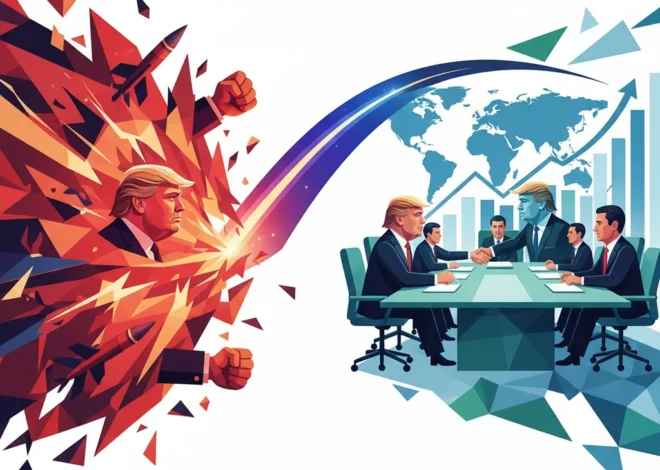
Beyond the Briefing Room: Decoding the High-Stakes Economic Chess Game in Venezuela
In the quiet, wood-paneled rooms of Washington D.C., a conversation of immense global consequence recently took place. Top White House officials, including National Security Adviser Jake Sullivan, met with Republican leaders to discuss a topic that has become a focal point of geopolitical and economic tension: the future of Venezuela. According to a report from the Financial Times, the administration sought to reassure skeptical lawmakers that its strategy is not a prelude to long-term U.S. involvement or a soft pivot towards the Maduro regime.
But this meeting was far more than a simple political briefing. It was a clear signal to the world—and particularly to investors, energy traders, and leaders in international finance—that the tectonic plates of U.S. policy towards the economically devastated but oil-rich nation may be shifting. The conversation is no longer just about democracy and human rights; it’s a complex calculation involving global energy security, inflation, and the intricate dance of international economics. This post will dissect the delicate balance the U.S. is attempting to strike, explore the profound implications for the global economy and stock market, and analyze what this means for the future of investing in one of the world’s most volatile regions.
The Political Tightrope: A Strategy of Calculated Ambiguity
The core challenge for the White House is navigating a treacherous political landscape both at home and abroad. On one hand, there is immense pressure to increase the global oil supply. With sanctions hobbling Russia’s energy exports and OPEC+ maintaining tight production quotas, every available barrel of oil has a magnified impact on prices at the pump and, consequently, on inflation—a key concern for any administration. Venezuela sits on the world’s largest proven oil reserves, a resource that has been largely offline for years due to economic collapse and crippling sanctions.
On the other hand, there is a strong, bipartisan consensus in Washington that the regime of Nicolás Maduro is illegitimate, corrupt, and responsible for a catastrophic humanitarian crisis. Easing sanctions is seen by many, particularly influential Republican leaders, as rewarding a dictator and abandoning the cause of democracy. The briefing’s purpose was to thread this needle: to signal a pragmatic approach to energy without appearing to abandon long-held principles. The message was clear: any engagement is tactical, limited, and aimed at specific outcomes, not a wholesale normalization of relations.
A Ghost of an Economy: Understanding the Venezuelan Collapse
To grasp the stakes, one must understand the sheer scale of Venezuela’s economic implosion. This is not a typical recession; it is a historic collapse. From 2013 to 2021, Venezuela’s economy contracted by an estimated 80%, a downturn worse than that of the United States during the Great Depression. Hyperinflation has rendered the national currency, the bolívar, virtually worthless, wiping out savings and forcing millions to flee the country in one of the largest migration crises in modern history (source: IMF).
At the heart of this collapse is the oil industry. Once a powerhouse producing over 3 million barrels per day (bpd), the state-owned oil company, PDVSA, is a shadow of its former self. Due to mismanagement, corruption, and a lack of investment—exacerbated by U.S. sanctions targeting the industry—production has plummeted. In recent years, it has struggled to stay above 700,000 bpd, a fraction of its potential (source: U.S. Energy Information Administration).
The following table illustrates the dramatic decline in key economic indicators, painting a stark picture of the crisis:
| Indicator | 2013 (Pre-Collapse) | 2022 (Post-Collapse) | Change |
|---|---|---|---|
| Crude Oil Production (Avg. bpd) | ~2.89 Million | ~716,000 | -75% |
| Annual Inflation Rate | 56% | ~234% (Official estimates vary) | Exponential Increase |
| Real GDP (Constant USD) | ~$372 Billion | ~$83 Billion (Estimate) | -78% |
Data compiled from EIA, IMF, and World Bank sources. Figures are approximate and subject to revision.
The Billionaire's Gambit: Why India's Most Powerful Men Couldn't Win Over Trump
The Global Ripple Effect: Why Wall Street is Watching Caracas
The situation in Venezuela is not contained within its borders. The decisions made in Washington have direct and significant consequences for global finance, investing, and the broader economy.
1. Energy Markets and the Stock Market
The most immediate impact is on the price of oil. Even a modest, sanctioned increase in Venezuelan production—say, an additional 200,000 to 300,000 bpd facilitated through a company like Chevron—could help ease tightness in the global market. For traders and the stock market, this translates to lower energy prices, which can help curb inflation, potentially leading central banks to adopt less aggressive monetary policies. This could positively impact equities, particularly in energy-dependent sectors.
2. Sovereign Debt and High-Risk Investing
Venezuela is in default on over $60 billion of sovereign and state-oil-company bonds. For years, these bonds have been the domain of only the most adventurous distressed-debt investors, trading for mere cents on the dollar. Any sign of sanctions relief or economic stabilization, however tentative, causes these bond prices to jump. A potential future debt restructuring represents one of the largest and most complex opportunities in the history of emerging market finance. The legal and political battles to recover value will be immense, but for those with the right risk appetite, the potential returns are astronomical. This is the high-stakes end of international investing.
3. The Chevron Litmus Test
The key barometer for U.S. policy is the license granted to Chevron, the last major American oil company operating in the country. The White House has used this license as a diplomatic lever, expanding its scope to allow Chevron to export Venezuelan oil to the U.S. as a form of debt repayment. Watching the terms and renewals of Chevron’s license is the single best way for the financial community to gauge the administration’s true intentions. Every modification is a signal, parsed by analysts from Wall Street to Houston.
Financial Technology in a Failed State
In the vacuum left by a collapsed formal banking system, fascinating economic adaptations emerge. With hyperinflation destroying the value of the local currency, many Venezuelans have turned to alternative financial systems out of necessity. This is where the worlds of geopolitics and financial technology intersect.
The use of cryptocurrencies, particularly U.S. dollar-pegged stablecoins, has surged in Venezuela. For ordinary citizens, blockchain technology isn’t an abstract investment; it’s a lifeline. It offers a way to save, transact, and receive remittances from abroad without touching the hyperinflated bolívar or a banking system they don’t trust. While the Maduro regime has made clumsy attempts to launch its own digital currency, the real story is this grassroots adoption of decentralized finance (DeFi) tools. This trend underscores a crucial point for the future of fintech: its most powerful use cases often appear in environments where traditional financial infrastructure has failed. It’s a real-world stress test for the promise of blockchain as a parallel financial system.
Geopolitical Shockwaves: How US-Iran Tensions Could Reroute the Global Economy
The Road Ahead: Three Potential Scenarios
As investors and business leaders look to the future, the path forward for Venezuela’s economy is far from certain. The situation can be broadly categorized into three potential scenarios:
- The Gradual Thaw: In this scenario, the U.S. continues its current path, granting incremental sanctions relief in direct exchange for concrete political concessions from the Maduro regime (such as allowing free and fair elections). Oil production slowly ticks up, led by foreign partners like Chevron. This would create a slow, volatile, but upward-trending market for Venezuelan assets.
- The Stalemate: Political negotiations break down, and no further concessions are made by either side. The U.S. freezes sanctions relief, and Chevron’s license is maintained but not expanded. The economy remains stagnant, and Venezuela continues to be a minor player in the global energy market. This is the “muddle through” scenario.
- The Hardline Return: Triggered by increased political repression by Maduro or a shift in U.S. domestic politics, sanctions are re-imposed and tightened. Chevron could be forced to wind down its operations. This would likely lead to further economic deterioration and increased regional instability.
Navigating this requires more than just economic analysis; it requires a deep understanding of political risk and the ability to react quickly to policy shifts.
The Labubu Bubble: Can Pop Mart's Global Ambition Outrun Its One-Hit Wonder Problem?
Conclusion: A High-Stakes Game for the Global Economy
The White House briefing to Republican leaders was more than a procedural update. It was a subtle but significant acknowledgment of the new realities shaping the global economy. The world’s need for energy is forcing a re-evaluation of long-standing foreign policy, creating a delicate and unpredictable dance between Washington and Caracas. For the financial world, this is not a distant political drama; it is a live variable impacting everything from the price of oil and the direction of the stock market to the future of sovereign debt and the adoption of new financial technology.
The road ahead for Venezuela is fraught with peril and opportunity. While a full economic recovery remains a distant prospect, the tactical shifts underway are creating ripples across the global financial system. For investors, traders, and business leaders, the key takeaway is that the Venezuelan file is no longer dormant. It is active, it is influential, and it demands close attention.

Related Posts
Geopolitical Chess: Why a Squeeze on Venezuela’s Oil Has China—and Global Investors—on Edge

The Billion-Dollar Phantom: How an Alleged Crime Lord’s Arrest Exposes the Dark Side of Global Finance